



Community-based schools and ones operating under the shadow government are filling the gaps.
By RFA Burmese
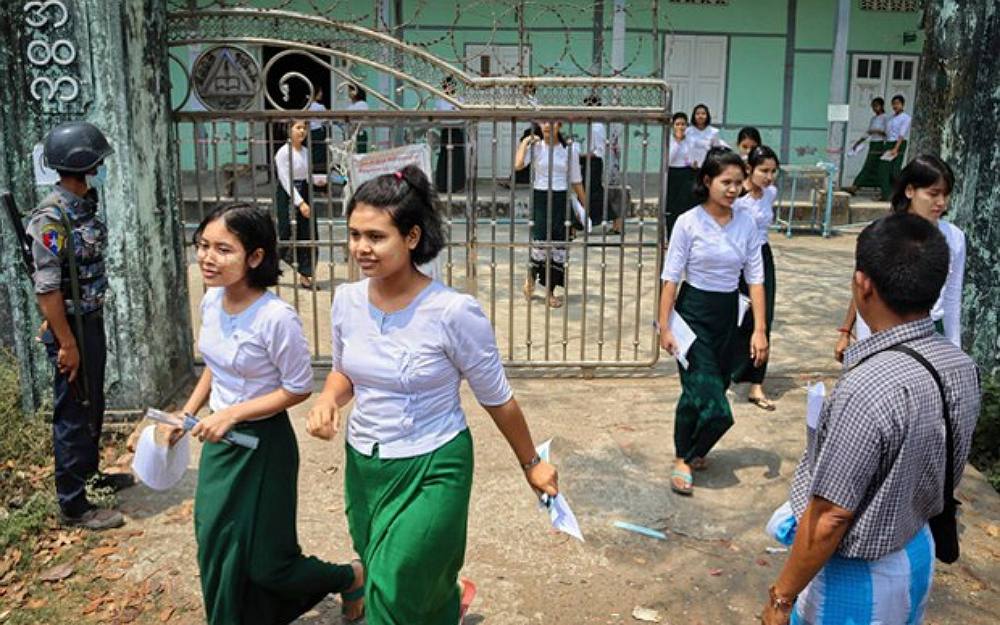
Battered by the COVID-19 pandemic, the military coup and an ensuing civil war, Myanmar’s school system is in shambles. The number of high school students taking a key exam has plunged 80%, parents, teachers and educational experts say.
To protest against the February 2021 coup, some 300,000 teachers and other school staffers walked off their jobs at government-run schools as part of the Civil Disobedience Movement, leaving schools severely understaffed. In response, the junta has suspended more than 11,000 academic staffers and about 125,000 teachers and professors, according to U.S. government data.
Subsequent fighting between the army and rebel groups has displaced thousands, making schooling extremely difficult. Many other families have stopped sending their children to school because they don’t trust the junta, or have sent them to schools run by the shadow National Unity Government.
“People no longer trust their education system,” said a teacher who, like others in this report, refused to be named for security reasons. “And now with the online federal schools and other non-military-operated schools, children can consider what is better for them and which education system can give them more knowledge and skills.”
“That’s why we see that there are fewer and fewer students who are taking the tenth-grade exam in the junta’s schools,” he said.
During the 2019-20 academic year, when the civilian-led National League for Democracy was still in power, nearly 970,800 students sat for the 10th grade matriculation exam, a benchmark for the country’s educated workforce for decades.
The following year, that number slipped to 312,300, and during the current 2022-23 year, fewer than 179,800 students took the exam, according to the junta’s education data.
Reforms on hold
The coup also put on hold educational reforms that were being carried out by the former NLD government, including increasing budgets for schooling and implementing a strategic plan to transform the country’s education system and improve learning at all levels.
In June 2022, when the Ministry of Education ordered the reopening of primary, middle and high schools across the country for in-person classes for the 2022-2023 academic year, over 7 million of the country’s roughly 12 million students returned to the classroom, according to junta Education Minister Nyunt Pe.
Some of the remaining 5 million students across the country do not attend the schools run by the junta, while some primary, middle and high school teachers say they have not returned to their schools because they do not want to work under the military administration.
Ongoing fighting between the military and ethnic armed groups in conjunction with anti-coup People’s Defense Forces in some of Myanmar’s states and regions have prevented students from attending school.
In response, the shadow National Unity Government, or NUG, had set up its own schools throughout the country.
“As many areas of several states and regions are war zones, exams cannot be held and there are no students to take them,” said Kyaw Ye Lwin, a committee member of NUG’s Federal Democratic Education Cooperation Network.
“Another thing is that NUG has strengthened its educational system on the ground,” he said, with students who attend federal schools trying to take the basic education completion assessment test administered by the NUG’s Ministry of Education. “Due to these factors, the number of students in schools under the junta administration has decreased.”
Separate exam
NUG Education Minister Zaw Wai Soe said that the shadow government is implementing an interim education system throughout the country, and about 90,000 students are taking its own tenth-grade exam.
“We hold practical exams for students in the areas where NUG is in control,” he told RFA. “We hold digital and internet-based exams in the areas where we are not in control yet. We are trying to implement online, practical and digital classes and exams for students in the areas away from our control, too.”
Residents in Sagaing and Magway regions, where fighting has intensified, have set up their own community-based schools so that local teachers can prepare students for the matriculation exam.
“Since the education system here in our area is in accordance with the federal education system, schools here can offer their own lessons,” said a teacher at a community-based school in Magway.
“It’s rather independent,” she said. “There are several different exam designs, too. There are many NUG-recognized schools in Magway, [but] there are hardly any students studying for the exams in the junta schools.”
A parent of a student from Magway’s Yesagyo township told RFA that he enrolled his children in community-based schools because teachers there provide extra help to students.
“The difference between the junta’s schools and our community-based schools is that our community-based schools focus on the people and teach students very well,” he said. “If students need more help, teachers give them more revision time and teach them at their homes, too.”
‘Conflict zone’
Residents of a village in Sagaing region, a hotbed of resistance in northwestern Myanmar, set up a primary school there for children who could not attend state-run schools due to the hostilities, said the school’s founder.
She and four permanent teachers as well as other educators from the Civil Disobedience Movement teach about 150 students at the primary school which opened in June 2022 under the auspices of the NUG, she said.
“Since we are in a conflict zone and a war refugee zone, there are no other schools here,” she told RFA.
“We can now teach music, art and the curriculum to our children,” she said. “Many stationery and teaching accessories are donated to us by well-wishers from faraway places.”
So far, parents of schoolchildren do not seem daunted by an announcement by the junta via state-run media networks on March 1 that authorities will take action against them under the Counterterrorism Law if they enroll students in online schools managed by the NUG. The junta also said that parents must enroll their children only in the junta schools and private schools recognized by the military.
But the teacher at the primary school in a village in Sagaing said children know they have a right to education no matter where they live, regardless of such threats.
“Issuing politicizing orders to stop such rights of the schools and children from benefiting is a very vulgar act,” she said.
Meanwhile, junta-run schools are coping with manpower shortages by piling up work on educators.
“We have to teach eight classes a day,” one high school educator said. “In the past, we could rest for two or three class periods as break time during which we could prepare the lesson plans for the next classes. We used to have extra time to study and preview the lessons before we went into each class. But now, we have very little extra time.”
And new teachers entering the profession are not receiving adequate training, she said.
“With only two days of skill training, teachers cannot be qualified to teach,” the educator said. ‘They do not know their subjects very well. Now we have to coordinate with each other and learn to teach these classes.”
Translated by Myo Min Aung for RFA Burmese. Edited by Roseanne Gerin and Malcolm Foster.
Copyright © 1998-2020, RFA. Used with the permission of Radio Free Asia, 2025 M St. NW, Suite 300, Washington DC 20036. https://www.rfa.org.