



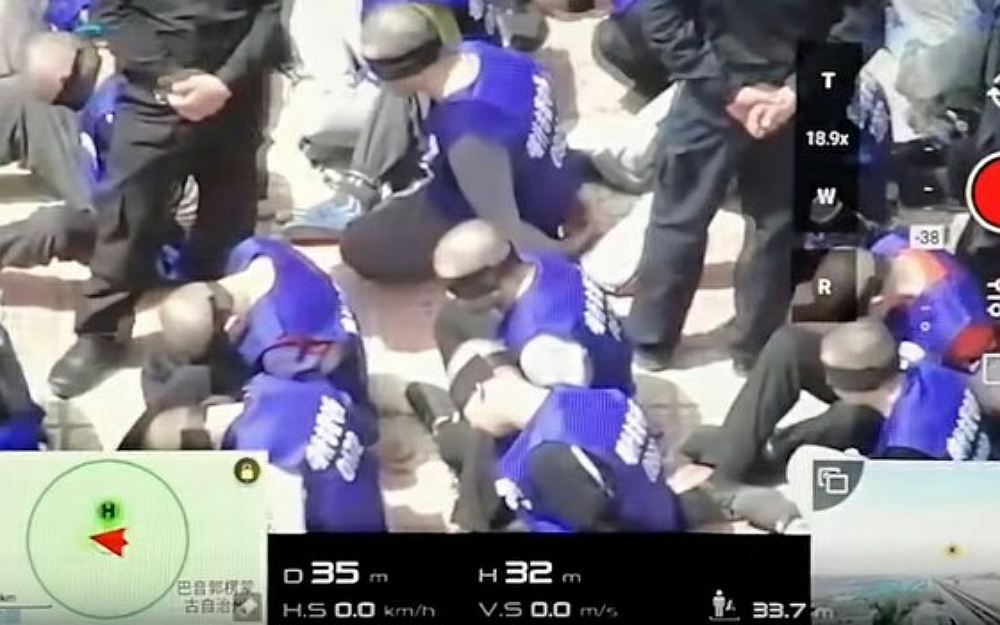
Video footage appearing to show authorities in northwest China’s Xinjiang Uyghur Autonomous Region (XUAR) transferring hundreds of Uyghur inmates to detention centers surfaced last week on a newly created Youtube account. But clues within the video would be key to finding out approximately when and exactly where the video was shot.
RFA’s Mandarin Service interviewed Nathan Ruser, a researcher with the Australian Strategic Policy Institute’s international cyber policy center who has previously identified detention sites in the XUAR. Over the weekend he said in a series of posts on Twitter he used landmarks and other clues in the footage to verify the video, and believes it was taken northwest of the city of Korla (Kuerle in Chinese) in August 2018. In this interview with RFA, he explains how he was able to use satellite imagery to put a date and time on this video, as well as the video’s significance vis-à-vis the situation in Xinjiang, which he says is a human rights emergency.
The interview has been edited for length and clarity.
RFA: Why is this video important to understand the Xinjiang situation?
Ruser: The situation in Xinjiang is very opaque. There’s a very strong PR campaign being undertaken by Xinjiang authorities and the Chinese authorities more broadly to present the situation in Xinjiang through its own terms. Through ones of progress and the upholding of human rights. This PR campaign doesn’t really hold up to any scrutiny cause the evidence of human rights abuses is very clear with any sort of analysis, but this video is a very stark reminder of how manicured and how choreographed the access to Xinjiang that is given by the Chinese authorities [has been].
RFA: How were you able to find the location by just looking at the video itself?
Ruser: Essentially what you’re looking for is areas on the ground in satellite imagery that matches perfectly what you see in the video. This video was lucky because it showed in Chinese characters Bayinguo in the corner which allowed me to narrow down where to look and after that it was just sort of scouring the train lines along [Bayin’gholin Mongol (Bayinguoleng Menggu) Autonomous Prefecture] looking for a suitable candidate, like a train station that perfectly matched the features that we were seeing in the video. Essentially when you are trying to geolocate a video it’s very much you’re searching and it’s not quite right until you have it and then it’s perfect. And that was exactly the case here. It was every feature that you’re looking for matched up pretty much perfectly with the satellite imagery, so once you sort of realized it was northwest of Bayingol and just looked through the train stations there and once you found the right one it was sort of very self-evident that was exactly where it was filmed. What was especially useful was that sort of orange and white striped pavement that the detainees are sitting on, which, yeah basically clinched the location.
RFA: The many details helped you confirm the location?
Ruser: Yeah, essentially, you’re looking for sort of like, tens of details that match up and once you’ve found them there are like 50, 100 details that you can like, look into and they all sort of match up perfectly. [For example,] however many sort of train lines, however many train tracks are parallel to each other, to the number of trees, and all of that sort of stuff, and that sort of helps you verify the video and [you can] be very confident that what you’re seeing did actually occur in this location at about this time, because all these details would be impossible to fake.
RFA: Can you explain how you were able to estimate when the video was taken?
Ruser: So essentially when you’re looking at an object that goes straight up, such as a telegraph pole, the shadow it casts is basically a sundial. So by looking at the angle and the length of that shadow you can work out almost precisely where the sun was in the sky at the moment of time that that video was filmed and basically there’s only two times in the year where that sun would be in that exact place. So using that you can, yeah, narrow down the date pretty confidently within two times a year, and then to work out which year it’s in takes matching changes in the landscape that you can see to what year fits with them.
RFA: Does that tell you the time during day that the video was taken as well? Or is it only the date?
Ruser: It does tell you the time of the day as well, so this was at about in the first half hour after midday.
RFA: What time during the year was it?
Ruser: I believe it was about August 20 within a few days but it’s also possible it was within about April 21.
RFA: Which year?
Ruser: I believe it was 2018. Prior to 2018 there were bushes that weren’t planted and in 2019 the car park was paved.
RFA: Because this was drone footage in a railroad station, do you think the person who obtained the video was somehow connected to the authorities, given his access?
Ruser: Any answer to that would be pure speculation, so I can’t say with any confidence. In the video you can actually see what looks to be the drone operators on the ground, next to the detainees, filming, and I don’t suspect it was them. Someone did mention to me that it looks like they were using a particular configuration of Linux, which was specifically designed for hacking, but I don’t know about that myself, that’s just what I’ve heard.
RFA: Do you consider this kind of video to be rare?
Ruser: I think the timing of the video also goes to show that there was a lot of thought going into leaking it. The fact that it was leaked the week before the UN general assembly, where there was purportedly going to be a fair bit of pressure to be placed on China about Xinjiang and human rights there. So I think that it’s a very unique video and the only other sort of organization that’s gotten anything close to that is Bitter Winter as far as real footage from the ground in Xinjiang.
(Bitter Winter is a website launched by the Italian research center CESNUR that focuses on religion in China and routinely publishes photos and video documenting human rights violations submitted by citizen journalists from inside China.)
RFA: Some critics might ask why this is outrageous. Authorities move detainees everywhere else in the country, so why is this particular case any different?
Ruser: What’s outrageous is sort of, the contextual information which goes to show how little it takes to be detained and sent to a detention center in Xinjiang, which isn’t sort of based on fair trial or due process. It seems to be based on local authority quotas, where something as mundane as receiving wire transfers from overseas or having taught a particular class in a particular language seems to be sufficient to get you sent to one of these extremely high detention centers.
RFA: So it is more about the context, not the actual video itself?
Ruser: Yeah, the video is a shocking visual that really sharply undercuts China’s PR campaign, but what makes it specifically noteworthy is the contextual information around it and how these detainees could well be sentenced without due process for something as little as, sort of exhibiting Uyghur culture.
Copyright © 1998-2016, RFA. Used with the permission of Radio Free Asia, 2025 M St. NW, Suite 300, Washington DC 20036. https://www.rfa.org