



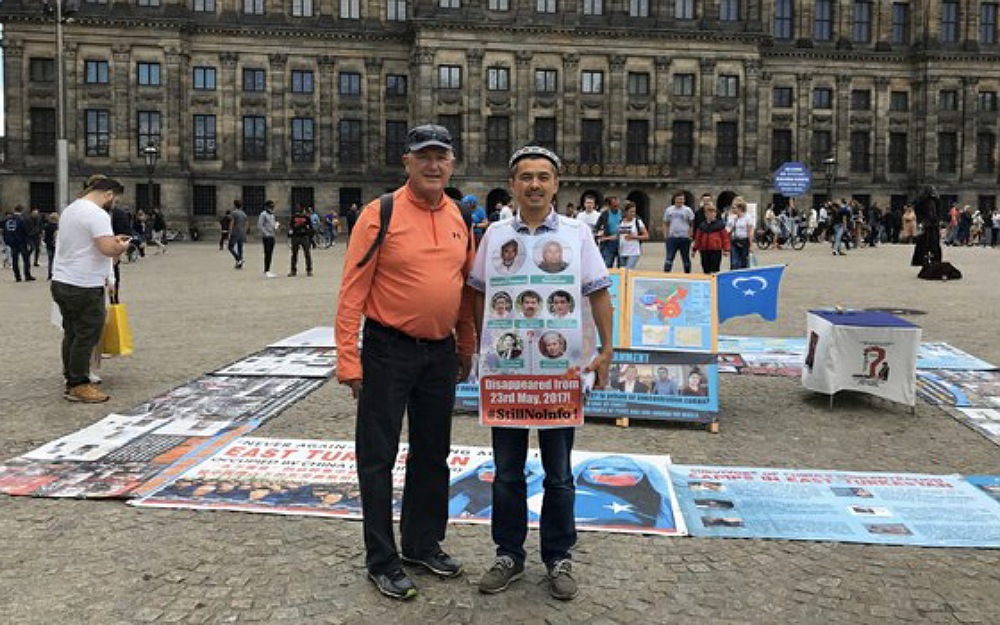
Abdurehim Gheni, 43, is an ethnic Uyghur from Aksu (in Chinese, Akesu) prefecture, in northwest China’s Xinjiang Uyghur Autonomous Region (XUAR). A university graduate and former chemistry teacher, Gheni fled discrimination in the region in 2007 and resettled in the Netherlands. In the summer of 2018, he lost contact with his parents and other relatives who two years earlier had their homes torn down by authorities in Aksu’s Uchturpan (Wushi) county and were forced to resettle elsewhere, although he does not know where. Gheni believes that several of them were detained in the XUAR’s vast network of internment camps, where authorities are believed to have held up to 1.8 million Uyghurs and other Muslim minorities since April 2017.
Beginning in June 2018, Gheni began staging weekly one-man demonstrations in Amsterdam’s Dam Square over Beijing’s repressive policies against Uyghurs and calling on China’s government to provide him information on the whereabouts of his 19 missing relatives, who he last saw in 2014. Among those he cannot locate are his father, stepmother, three brothers, and their families. Gheni has met multiple times with representatives from the Dutch Ministry of Foreign Affairs, which has made inquiries on his behalf to the Chinese Embassy, but he has yet to receive any answers. He has also written letters to KingWillem-Alexander of the Netherlands and Prime Minister Mark Rutte to enlist their help in his case, met with Dutch lawmakers, and has provided a testimonial on a database website that stores information on the relatives of Uyghurs who are missing in the XUAR. On July 12, U.S. Ambassador to the Netherlands Pete Hoekstra met with Gheni on Dam Square to discuss his situation as well as rights violations against Uyghurs in China.
Gheni recently spoke with RFA’s Uyghur Service about his more than two-year campaign to locate his family members in the XUAR—which he and many other Uyghurs refer to as East Turkestan—how the Dutch government has assisted him, and his meeting with Ambassador Hoekstra, which he described as inspirational. RFA also spoke with Hoekstra, a former U.S. Representative for Michigan, who discussed U.S. support for the Uyghur diaspora in the Netherlands, thought to number 1,500, and for Uyghurs in their homeland.
RFA: How did you launch this campaign for your family and for the Uyghur people?
Gheni: I started protesting in Dam Square on June 23, 2018. Throughout this time, along with showing pictures of my parents and the rest of my family, I’ve also put up photos depicting the massacre that is occurring in East Turkistan. I’ve attracted a lot of attention.
RFA: In looking for information about your parents and siblings, did you ever get in touch with police officers back in your home area?
Gheni: I have tried calling [the police]. They didn’t pick up though. I wasn’t able to get in touch. I also tried going through people I know in mainland China. They tried calling a phone number for one of my brothers but couldn’t get in touch at all. I still don’t know anything about their whereabouts.
[The authorities] demolished our family home in 2016. We had a big house in the county, inside the county seat itself. We had a large plot of land with a garden. They demolished everything and destroyed the houses. Apparently, they moved a lot of the families from our neighborhood to other places, but even now I still don’t know where. Even if I wanted to get other people to go look for [my family], I don’t know their address.
RFA: So, in that case, is it correct to say that the fact that your relatives’ home was torn down is a big part of the reason you’re unable to track them down?
Gheni: Yes, it’s turned out to be a big reason why, the demolition. In addition to that, apparently, they’re not letting people into Uchturpan county from the outside. For example, there have been some journalists who said they will go and see if they can find my family. I told them to go [and search for them], but I’ve heard nothing in response from them. But then I heard that [the authorities] are apparently not letting people into Uchturpan from the outside, not at all.
Diplomatic assistance
RFA: What have you done [over the past few years]?
Gheni: I wrote to the Dutch foreign ministry, figuring that by going through these diplomatic relationships I’d be able to find out whether my family members were dead or alive, if they were dead what the cause of death was, whether they were in camp or prison, for what reason they’d been put in camp or prison—that I would be able to find a clear answer. The ministry sent my letter to the Chinese Embassy in the Netherlands, to the Ambassador (Xu Hong) … There was no response. In the meantime, a letter came from the [Dutch] foreign ministry. It said they’d been in touch with the Chinese Embassy but had gotten no formal response and couldn’t do anything but would keep looking into the situation. And then after waiting a half year with no response, I wrote another letter on March 8 of this year. Up to now, I’ve gotten no response … I feel like if [my relatives] were alive, the Chinese Embassy would have given a formal response to the Dutch Ministry of Foreign Affairs. They’ve sent no response.
On July 12, U.S. Ambassador to the Netherlands Mr. Peter Hoekstra came to Dam Square, the square where I’ve been protesting. He looked at all the signs I had put out and complimented me on what I’d done. I was wearing signs printed with photos of my parents and other relatives, and he asked who they were. I told him they were my parents and relatives, and he asked whether I knew where they were. When I told him no, I haven’t been able to contact them, he asked how I’d tried to contact them. I told him I’d tried a lot of different ways to contact them by phone but that no one had been able to give me any news about them.
I also told him that I’d been in touch with the Chinese Embassy through the Dutch foreign ministry but that even then, the Chinese government still hadn’t made any sort of response. He expressed disappointment at hearing this. He also wanted to know what’s happening in the homeland right now and asked about how the situation has developed. Later I wrote out detailed information about my family, including their names, and sent it to him in a letter.
RFA: Have you received a response?
Gheni: I haven’t gotten a response yet, but I’m sure it will come. In the letter I expressed my thanks to the U.S. Ambassador and formally thanked the U.S. on behalf of the Uyghur people for passing the Uyghur Human Rights Policy Act [providing for sanctions against Chinese officials deemed complicit in rights abuses in the XUAR]. I also asked the U.S. Ambassador to use everything within his means to find my parents and my relatives, and wrote to him about my activism and my requests.
Ambassador on Uyghurs
RFA: What motivated you to decide to personally visit the Uyghur community in the Netherlands two weeks ago?
Ambassador Hoekstra: Well, I’ve had the opportunity to become a little bit familiar with the Uyghur community since I’ve been in the Netherlands, obviously aware of the Uyghurs through my work in Congress. But, you know, this is an issue where the United States and the Netherlands see this eye-to-eye. We can stand shoulder-to-shoulder on this in terms of supporting the Uyghurs in China. So, it’s something that strengthens our bilateral relationship. But most importantly, it’s the right thing to do. This is a persecuted minority; this is a persecuted people of religious belief. It’s exactly the type of thing that America and the Dutch should be working on.
RFA: And when you visited the Uyghur community, what kind of message did you send to them?
Ambassador Hoekstra:America is committed to supporting your efforts, and we are committed to making sure that you as a community are safe and secure and that we will work toward stopping the persecution that you are currently experiencing in China. It’s wrong and we will advocate on your behalf. It is a message that has been strongly articulated by the president, by the secretary of state, and also by Congress in a bipartisan way.
RFA: During your visit, you met with a lot of Uyghurs, some of whom have loved ones in China’s internment camps. Many have not seen or heard from their relatives for the past three or more years. What kind of stories did you hear that really touched you?
Ambassador Hoekstra: I met one of the Uyghurs on Dam Square in Amsterdam … I just stopped and talked with him … He had pictures of 17 family members that he had not had the opportunity to interact with for … multiple years. So that’s one story. But I think the thing that … had more of an impact on me was when I [met with the diaspora] and you had a group of roughly 40 Uyghurs there and asked “How many of you have a personal story to tell that you can’t know or you haven’t been able to communicate with a family member or you don’t know where they are and what happened to them?” My experience as a Congressman, when you’re talking like that to a group, you might have a half or one-third of the group raise their hand. Here, every single individual raised their hand. They all have a personal story to tell which tells you how widespread this oppression is of the Uyghurs in China.
Reported by Mihray Abdilim and Alim Seytoff for RFA’s Uyghur Service. Translated by Elise Anderson. Written in English by Joshua Lipes.
Copyright © 1998-2020, RFA. Used with the permission of Radio Free Asia, 2025 M St. NW, Suite 300, Washington DC 20036. https://www.rfa.org
Bridges to China, Russia Preparing to Open as North Korea Deepens Ties with Both
Minister for Foreign Affairs of Togo Briefs Press on “Correct the Map” Resolution
From Rocksprings to Kerrville,Texas, Newborn Kitten Stuck in Engine Rescued

French Bulldog

Emergent Behavior
Informal Meeting to Hear Briefing by UN Secretary-General on UN80 Initiative
Police in College Town,Georgia,Found Massive Green Alien Statue That Had Been Stolen from outside of Store
St. Bernard Dog Breed
Subscribe Our You Tube Channel

Fighting Fake News
Fighting Lies