



Advocates call on Chinese authorities to allow information transparency in Tibet’s rescue and relief efforts.
By Noh Jung Min for RFA, Dolkar, Dickey Kundol, and Tawang for RFA Tibetan
Satellite imagery taken at the Nepal-Tibet border shows extensive destruction from flooding and landslides that inundated the area Wednesday leaving hundreds of people dead or missing, but information from the Chinese-controlled side of the border is severely lacking, Tibetan rights activists told Radio Free Asia.
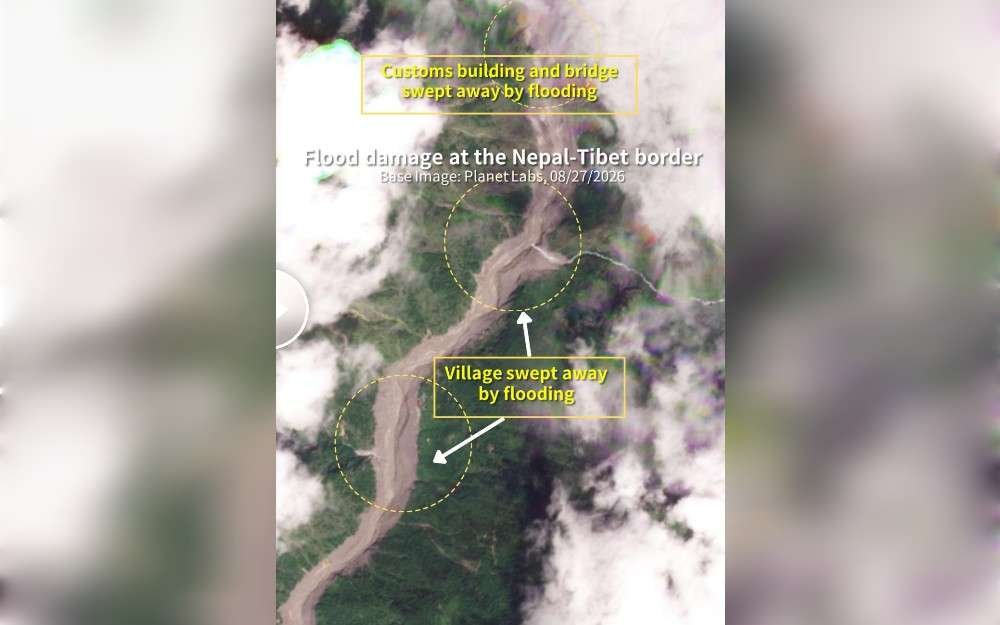
A comparison of imagery taken Aug. 23 and Aug. 27 of Tibet’s Kyirong County (Gyirong in Chinese), and Nepal’s Rasuwa district, shows that customs buildings, a bridge and other infrastructure on the border appear to have been swept away in the carnage. Restaurants, hotels, homes, and other buildings downstream on the Nepal side also appear to have been destroyed or washed away.
Further downstream, much of Timure village appears to have disappeared in the latest imagery, underscoring the scale of the disaster and raising concerns about casualties and property loss.
China’s state-run Xinhua news agency reported that the disaster also caused extensive infrastructure damage — about 3 kilometers of the G216 highway leading to Kyirong Port were damaged, and five telecommunications base stations initially stopped operating.
The Chinese government is severely restricting detailed information about the situation inside Tibet, Ryan Fioresi, executive director at Washington-based International Campaign for Tibet, or ICT, told RFA citing sources on the ground.
“Chinese authorities have relocated local residents, barred journalists, independent observers, and others from entering the affected area, and prevented reliable firsthand information from emerging,” he said. “As a result, the international community remains largely dependent on Chinese state media, whose coverage has focused primarily on Xi Jinping’s directives and official accounts of rescue and relief efforts, rather than the actual conditions on the ground, survivors’ experiences, or the full extent of the casualties and destruction.”
Lobsang Yangtso, a senior environmental researcher at the International Tibet Network, said she was concerned that the Chinese government has been engaged in large-scale construction projects in Tibet, a region that is geographically vulnerable to disasters such as earthquakes and flooding. She called on Chinese authorities to publicly and transparently release information about casualties and missing people.
In total, at least 1,468 people were missing and 392 were confirmed dead according to AFP at the time of writing.
On the Nepalese side, the disaster has also devastated Tibetan communities in Rasuwa district.
As of August 27, Chinese authorities said three people had died and 558 were missing in Kyirong County. At the time of the disaster, hundreds of people were believed to be in the vicinity of the Kyirong border crossing including villagers, border staff, freight and construction workers, merchants, and non-Chinese citizen tourists.
Tibetan casualties in Nepal
Sources within the Tibetan diaspora told RFA that many Tibetans living in Nepal were affected by the disaster.
The homes and property of five Tibetan households in the town of Timure were swept away by floodwaters, according to a statement from the Tibetan Refugee Welfare Office in Nepal. Members of two Tibetan families remained out of contact, while members of three other families escaped to higher ground and survived.
In the Gegyeling Tibetan settlement in Rasuwa district, 11 houses and the surrounding area were swept away. The whereabouts and condition of some of the residents remain unclear.
Sources familiar with the situation also told RFA that floodwaters swept away a Tibetan in the Shabrubesi market area, also in Rasuwa.
Sikyong Penpa Tsering, president of the Central Tibetan Administration, the exile government in Dharamshala, India, later reported the same statistics, adding that in Gegyeling, two elderly residents were still missing.
He also provided an update on the situation in Shabrubesi, which he said was largely swept away, one Tibetan was killed and three others remained missing. In Timure, he said, six people from two Tibetan families were reported missing. Nepalese authorities had rescued six Tibetans as of the morning of August 27, Tsering said.
Three other Tibetan settlements in Nepal — Thangpoche, Khangjim and Biritim, also known as Briddim — were not affected because their homes are located at higher elevations.
The Dalai Lama, Tibet’s exiled spiritual leader, expressed his condolences Thursday, acknowledging that the disaster had caused heavy damage and loss of life.
“I hope that appropriate follow-up measures will be taken, wherever possible, to help ensure that such disasters do not recur,” he said.
The exact cause and sequence of the disaster remains under investigation and experts cautioned against prematurely describing the disaster as simply a glacial collapse, as many international media outlets had been reporting.
The evidence points to a very large slope failure involving both rock and glacier ice on the northern side of the Langtang Lirung massif, Tenzing Chogyal Sherpa, a physical geographer at Utrecht University in the Netherlands, told RFA.
“What is clear is that this was not simply a conventional river flood,” Sherpa said. “A very large volume of rock and ice moved rapidly downslope and entered the river system, producing an extraordinary amount of debris and sediment.”
He said he preferred the more cautious term “large rock-ice avalanche” until further evidence is available.
Tibetan blackout
The Chinese government deployed hundreds of emergency responders, firefighters, engineers and military personnel to the area, China’s state-run Xinhua news agency reported. Authorities are also monitoring a landslide-dammed lake upstream from the border crossing. Xinhua reported that the water level had risen compared with the previous evening, raising concerns about a possible secondary disaster.
Experts and advocates told RFA that they are calling for better monitoring of high-altitude source areas, stronger river-level early warning systems, rapid communication between upstream and downstream communities, and, particularly in transboundary river basins, much stronger sharing of information across borders.
Nepal’s rescue efforts on its side of the border are more transparent than the Chinese government’s response on the Tibetan side, Tencho Gyatso, president of ICT, told RFA.
“While Nepal is providing timely information and avenues for international humanitarian assistance, we hope that, in Tibet, disaster relief efforts will be accompanied by timely and transparent information and unhindered access for humanitarian support,” she said.
Edited by Eugene Whong.
“Copyright © 1998-2023, RFA.
Used with the permission of Radio Free Asia,
2025 M St. NW, Suite 300, Washington, D.C. 20036.
https://www.rfa.org.”