



The project can boost CNMI economy and U.S. national security, but there are also local concerns, they said.
By Bryan Manabat for RFA
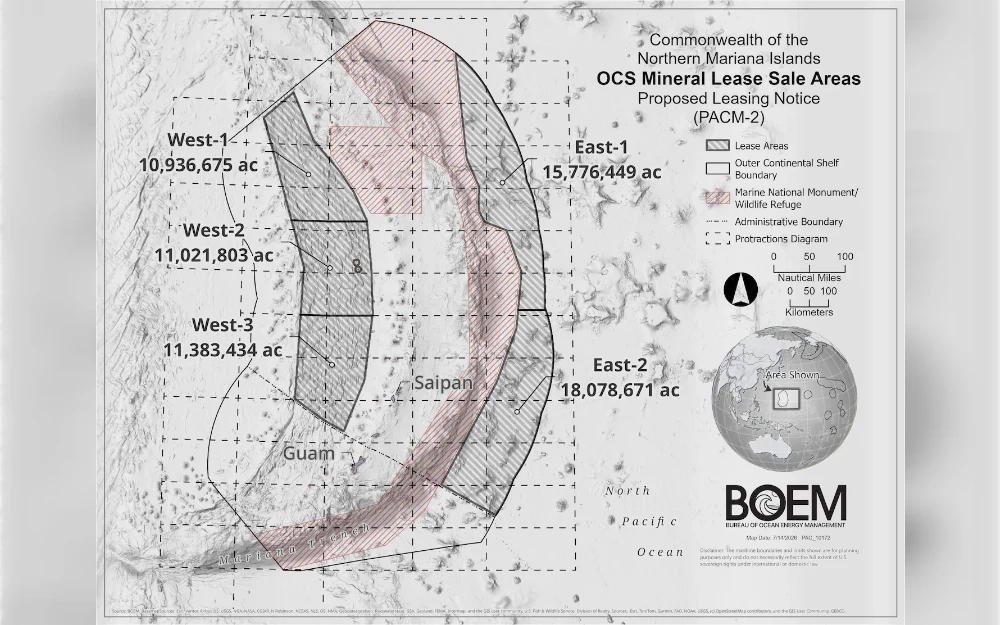
SAIPAN, Northern Mariana Islands — As the U.S. government moves forward with plans to open more than 65 million acres of federal waters around the Northern Mariana Islands to potential seabed mineral exploration, business leaders and Indigenous advocates told Radio Free Asia the U.S. territory must not be sidelined in decisions driven partly by national‑security priorities.
The proposed leasing notice, released August 17 by the Marine Minerals Administration, or MMA, follows earlier steps identifying vast areas of ocean for possible mineral development around the territory, officially called the Commonwealth of the Northern Mariana Islands, or CNMI. The plan has triggered intense debate across the islands, where concerns span environmental risks, cultural impacts, fisheries, tourism, and democratic accountability.
Though the plan could be economically beneficial, the business community in the CNMI is approaching it with caution, Joshua Wise, president of the Saipan Chamber of Commerce, told RFA.
“There are legitimate concerns, but there may also be significant economic opportunities that deserve to be fully understood,” Wise said, adding that critical minerals have become central to U.S. national security, manufacturing, technology, and supply‑chain resilience — meaning the CNMI could become part of a broader federal strategy.
“If resources located near the CNMI ultimately become part of that national strategy, then we should be asking what role the Commonwealth will have and what economic opportunities could be created here,” he said.
Resource rivalry
The push for offshore critical minerals comes as the United States and China compete for control of the materials that power modern technology — including batteries, semiconductors, electric vehicles, renewable‑energy systems, and advanced defense platforms. China currently dominates global processing of rare earth elements, cobalt, nickel, graphite, and battery components, giving it significant leverage over global supply chains. U.S. officials have warned that this dependence poses strategic vulnerabilities for national security and manufacturing.
“Critical minerals are essential to America’s national security, economic strength and resource sovereignty,” Matt Giacona, acting director of the MMA, said in the Aug. 17 announcement. “The United States cannot afford to depend on foreign nations for the resources that power our economy and support our defense industrial base. The Marine Minerals Administration is working to unlock the critical mineral potential of the U.S. Outer Continental Shelf responsibly, transparently and with the rigorous environmental review the American people expect.”
Washington is exploring new sources of critical minerals, including the deep ocean, where polymetallic nodules and crusts contain metals essential for clean‑energy and defense technologies. MMA’s interest in CNMI waters is the potential future node in U.S. supply‑chain resilience efforts.
History has shown what can happen when national‑security priorities override local interests, Gregorie Michael Towai (Eipéráng), a researcher of and advocate for indigenous people in the territory, told RFA.
He cited the 67 U.S. nuclear tests in the Marshall Islands between 1946 and 1958 and the long‑term contamination there, as well as the continuing discovery of unexploded ordnance across the Marianas as lessons from history.
“Decisions justified by national security can create consequences for Pacific communities that endure long after the strategic circumstances that originally justified them have changed.”
Towai stressed that deep‑sea mining is not equivalent to nuclear testing — but the imbalance of power is similar.
He said the CNMI must insist on credible independent science, meaningful public participation, and enforceable guarantees before any commitments are made. Consultation, he said, must be capable of changing the decision, not merely documenting that communities were heard.
“National security matters, but the security of Pacific communities matters too. That includes clean water, healthy fisheries, cultural continuity, food security, and the ability of future generations to inherit an environment that has not been irreversibly altered,” Towai added.
Red flags
Even if the plan provides contracts for CNMI companies and jobs for its people, there are unanswered questions surrounding how exploration or mineral development could affect industries that already sustain the CNMI, Wise said.
“Our marine environment directly supports industries that already exist today, particularly tourism and fisheries,” he said. “So we need a much clearer understanding of what future exploration or mineral development could mean for those industries.”
Wise said the CNMI needs baseline environmental data, protections for fisheries, and much greater clarity about both risks and benefits.
“The question should be: if this moves forward, can it be done responsibly, can our existing industries be protected, and will the people and businesses of the CNMI have a meaningful seat at the table and a meaningful share in the opportunities that may result?” he said.
Government officials said that they need other assurances prior to the plan being enacted.
In public statements, CNMI Governor David M. Apatang said the federal notice triggers a 60‑day review period during which the CNMI will insist on strict environmental and cultural safeguards, while U.S. Delegate Kimberlyn King‑Hinds said that she is advancing legislation to secure revenue sharing, mandatory mitigation studies, and formal consultation with CNMI leaders.
But the CNMI’s legal authority over offshore waters remains limited. It can demand safeguards and challenge inadequate environmental review, but it cannot block the MMA from advancing leasing in federal waters.
Under the Covenant and federal court rulings, submerged lands beyond the 12‑mile territorial sea fall under exclusive federal jurisdiction.
But the Pacific Ocean is more than just a boundary for people native to the Pacific, Towai said.
“For Indigenous peoples of Oceania, the ocean is part of our homeland,” he said. “Decisions about the seabed cannot be evaluated exclusively through mineral values, lease blocks, and federal jurisdiction.”
Edited by Eugene Whong.
“Copyright © 1998-2023, RFA.
Used with the permission of Radio Free Asia,
2025 M St. NW, Suite 300, Washington, D.C. 20036.
https://www.rfa.org.”