



Frud Bezhan/RadioFreeEurope/RadioLiberty
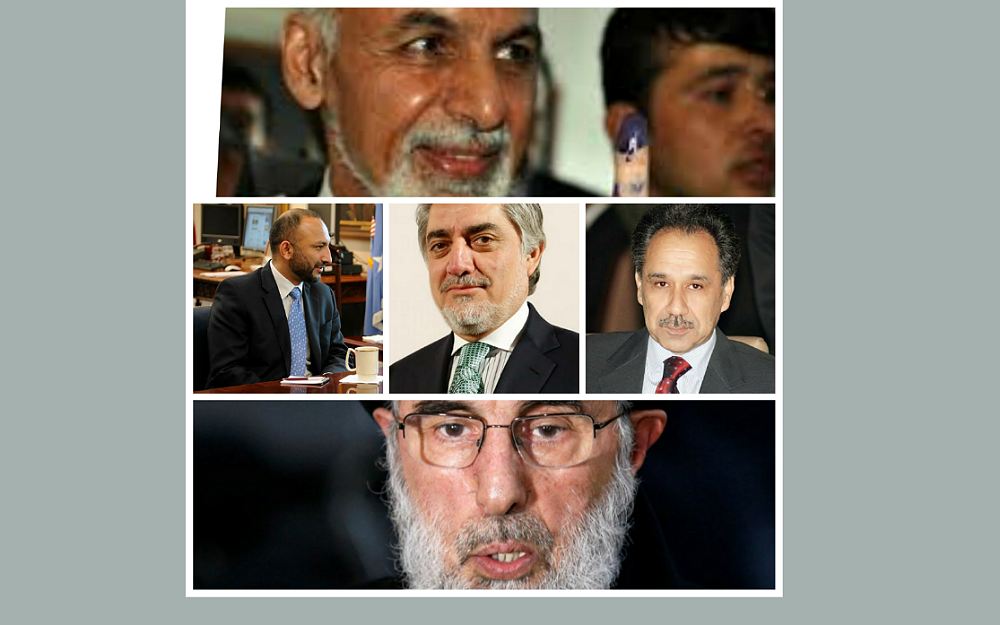
Seventeen men will contest Afghanistan’s presidential election in a race among old power brokers — ex-government officials, prominent technocrats, and a notorious former warlord.
The twice-delayed September 28 election is slated to be only the second-ever democratic transition of power in the war-wracked country of 35 million people.
The candidates include some controversial figures from the last four decades of conflict in the country — former cadres of the Soviet-backed communist regime of the 1980s, mujahedin from the civil war that erupted in the early 1990s, as well as members of the Taliban regime that ruled from 1996 until 2001.
Each candidate has entered the race on tickets that include first- and second- vice presidential running mates. These are often the result of political horse-trading that can forge unlikely unions. In a country where no ethnic group can dominate the political scene on its own, candidates cross ethnic lines to choose high-profile running mates who can marshal votes from specific ethnic communities. The results can defy logic and assumptions based on previous electoral alliances and coalitions.
If no candidate receives a majority in the first round of the election on September 28, a second round will be held between the top two finishers.
Ashraf Ghani
Analysts consider incumbent President Ashraf Ghani, who is seeking a new five-year term, as the favorite.
Ghani’s deeply unpopular and divided national unity government has proved unable to curb violence, raise living standards throughout the country, or tackle endemic government corruption since coming to power after a disputed presidential election in 2014.
Despite the 70-year-old’s unpopularity, analysts said few of his rivals have the financial resources and campaign infrastructure to beat him.
“Ghani also enjoys the advantage of being the incumbent — which is a tremendous help in a poor country such as Afghanistan,” said Haroun Mir, a Kabul-based political analyst. “Ghani has been able to form a ticket of running mates who have clean pasts and are not haunted by human rights abuses and political corruption.”
A Pashtun, Ghani is from the country’s largest ethnic group. He has picked Amrullah Saleh, an ex-intelligence chief, as one of two running mates. Saleh is a prominent ethnic Tajik, the second-largest ethnic group, with grassroots support among the youth. Saleh is expected to deliver a significant proportion of the ethnic Tajik voting bloc.
Ghani’s other running mate is Sarwar Danish, a Hazara who is the current vice president and a former justice minister. The Hazara constitute the third-largest ethnic group in the country.
Former Foreign Minister Zalmai Rasul withdrew his candidacy on August 6 in favor of Ghani.
Hanif Atmar
Ghani’s former national security adviser, Hanif Atmar, is expected to be among his closest challengers.
The 50-year-old, a former interior minister, unexpectedly quit his post last year, citing major policy differences with the president, including on peace talks with the Taliban.
Atmar’s past could hurt him.
An ethnic Pashtun, he was an intelligence officer for the KHAD, the notorious spy agency during communist rule in Afghanistan. Trained by the Soviet KGB, KHAD is accused of torturing and killing thousands of Afghans. During the Soviet occupation of Afghanistan from 1979-89, Atmar fought against the mujahedin and lost a leg while fighting in the eastern city of Jalalabad in 1988.
Ironically, Atmar has selected two mujahedin stalwarts with controversial backgrounds as his running mates.
Former Vice President Yunus Qanuni is one of the leaders of Jamiat-e Islami, the predominately ethnic Tajik political group that was one of the mujahedin’s most powerful factions. Atmar’s other running mate is Mohammad Mohaqeq, a Hazara and former warlord who has been accused of human rights abuses during the country’s brutal civil war.
Atmar’s campaign has threatened to unravel because of infighting between Qanuni and Atta Mohammad Noor, another leader of Jamiat-e Islami and a powerful former governor. Noor has accused Atmar of backtracking on a future promise to create and hand him the position of prime minister.
“The sudden and unpredictable making and unraveling of political coalitions has been the norm in Afghanistan,” said Mir. “Most of these coalitions are shaped based on power-sharing arrangements rather than a common political vision.”
Abdullah Abdullah
Chief Executive Officer Abdullah Abdullah is also considered to be among Ghani’s closest rivals. Both men claimed victory in the fraud-wracked election in 2014, and Abdullah was given his newly created position in a power-sharing agreement brokered by the United States.
This is the third time Abdullah is running for president.
A prominent member of Jamiat-e Islami, his influence in the party has waned and he has lost the support of several stalwarts, including Saleh, Noor, Qanuni, and former warlord Ismail Khan, all of whom have backed his rivals.
In the 2014 election, Abdullah claimed a large chunk of the ethnic Tajik voting bloc, but a repeat of that support is unlikely. But he retains the support of Foreign Minister Salahuddin Rabbani, who leads the party.
Abdullah also has the support of Abdul Rashid Dostum, the powerful former warlord turned politician.
A former ethnic Uzbek militia leader, Dostum has been accused of serious human rights violations. He returned to Afghanistan in 2018 after more than a year in exile in Turkey after he was accused of being involved in the rape and torture of a political rival. Dostum, Ghani’s vice president, remains a powerful figure and his Junbish Party is supported mainly by his fellow ethnic Uzbeks.
Abdullah’s running mates are Enayatullah Babur Farahmand, an ethnic Uzbek who was a former lawmaker and is Dostum’s ally, and Asadullah Sadati, a Hazara who is backed by a faction of the Hazara-dominated Hezb-e Wahdat faction led by Mohammad Karim Khalili, a former vice president.
In another blow to Abdullah, the Hazara voting bloc is likely to be divided between several of his rivals.
The Outsiders
Rahmatullah Nabil
The two-time head of Afghanistan’s National Directorate of Security (NDS), the country’s main intelligence agency, Rahmatullah Nabil is a Pashtun from the central province of Maidan Wardak.
Nabil is an outspoken opponent of the Taliban and its chief backer, Pakistan. He has also been fiercely critical of Ghani’s administration, blaming him for the growing insecurity and endemic government corruption.
His vice presidential running mates are Murad Ali Murad, a Hazara who was the deputy interior minister and an army commander, and Massuda Jalal, an ethnic Tajik who was the former minister of women’s affairs.
Ahmad Wali Massud
Ahmad Wali Massud is the younger brother of Ahmad Shah Masud, the legendary anti-Soviet and anti-Taliban resistance commander who was assassinated by Al-Qaeda two days before September 11. An ethnic Tajik and a prominent member of the Jamiat-e Islami, he served as ambassador to Britain.
His vice presidents are Farida Mohmand, a Pashtun who was a former higher education minister, and Latif Nazari, a Hazara who was educated in Iran and unsuccessfully ran for parliament in 2018
Gulbuddin Hekmatyar
Afghanistan’s most notorious former warlord and militant leader, Gulbuddin Hekmatyar, is the head of the Hezb-e Islami militant group that signed a controversial peace deal with the government in 2016.
He has since taken over the leadership of the Hezb-e Islami political party.
Hekmatyar, who lives in a government-funded residence in Kabul, is widely despised for his role in the brutal civil war.
His vice-presidential running mates are Fazl ul-Hadi Wazin and Hafiz ul-Rahman Naqi, both ethnic Tajiks who are members of Hezb-e Islami.
Nur ul-Haq Ulumi
Former General Nur ul-Haq Ulumi, a Pashtun, is a former interior minister.
A former Communist Party member, he was a major figure in the 1980s, when he was a general in the Afghan Army. His running mates are Bashir Bezhan, an ethnic Tajik who is a former journalist who founded a cultural magazine, and Mohammad Naim Ghayur, a former intelligence official hailing from the western city of Herat.
Abdul Latif Pedram
An ethnic Tajik from the northeastern province of Badakhshan, Abdul Latif Pedram heads the National Congress party.
A former lawmaker, he has been accused of being an ethnonationalist. His vice-presidential mates are Ehsanullah Haidari, a Hazara who worked for several international organizations in Kabul; and Mohammad Sadeq Wardak, a Pashtun and former member of the mujahedin.
Nurullah Jalili
A former official in the Taliban regime’s Foreign Ministry, Nurullah Jalili is a wealthy businessman who owns a construction company in Kabul.
His vice presidential candidates are Khalil Roman, an ethnic Tajik communist-era official who served as former President Mohammad Najibullah’s chief of staff; and Cheragh Ali Cheragh, a health official who headed a university in northern Afghanistan.
Shaida Abdali
A Pashtun and former ambassador to India, Shaida Abdali was a member of the National Security Council under former President Hamid Karzai.
His running mates are Abdul Basir Salangi, an ethnic Tajik former police chief and governor; and Zulfiqar Omid, one of the leaders of the street protest group Enlightenment Movement, which has accused the Ghani administration of discrimination against Hazara.
Faramarz Tamana
Educated in India and Iran, Faramarz Tamana is a former Foreign Ministry official and university lecturer.
His vice presidential candidates are Sayyed Qias Saidi, a Pashtun who worked for UNICEF; and Mohammad Amin Reshadat, a Hazara who is the chancellor of a private university in Kabul.
Hakim Tursan
An ethnic Uzbek, Hakim Tursan was an intelligence official under Soviet-era ruler Najibullah.
He graduated from Kabul University with a degree in Persian literature. His running mates are Nader Shah Ahmadzai, a Pashtun who heads a Kabul-based think tank; and Mohammad Shafi Qaisari, another ethnic Uzbek and former communist.
Mohammad Ibrahim Alekozai
A Pashtun who is a tribal elder in Kandahar, Mohammad Ibrahim Alekozai has chosen Khadija Ghaznawi, a Hazara who owns her own logistics company; and Sayyed Same Kayani, from the minority Shi’ite Ismailis in northern Afghanistan, as his vice presidential candidates.
Ghulam Faruq Nejrabi
An ethnic Tajik, Ghulam Faruq Nejrabi is a surgeon from Kapisa Province. His running mates are Sharifullah and Mohammad Sharif Babakarkhel.
Nur Rahman Liwal
A Pashtun, Nur Rahman Liwal is the owner of a software company in Kabul. His vice presidential candidates are Abdul Hadi Zul-Hekmat and medical doctor Mohammad Yahya Wyar.
Enayatullah Hafiz
A Hazara who has a literature degree, Enayatullah Hafiz’s running mates are Jannat Khan Fahim Chakari, an ex-army officer; and Abdul Jamil Shirani, a former employee of the Afghan Independent Human Rights Commission.
Copyright (c) 2019. RFE/RL, Inc. Reprinted with the permission of Radio Free Europe/Radio Liberty, 1201 Connecticut Ave NW, Ste 400, Washington DC 20036
You know Independent Journalism needs fund to run the not for profit venture Please contribute if you like our effort Donate through PayPal Or paytm +919903783187 phone pe +919875416249 Google Pay +919875416249 or write to us editor@humanitynewsworld.com