



Experts tell RFA that Matthew Wale will be ‘more moderate’ and ‘less enthusiastic’ about China than his predecessors.
By Charley Piringi and Eugene Whong for RFA
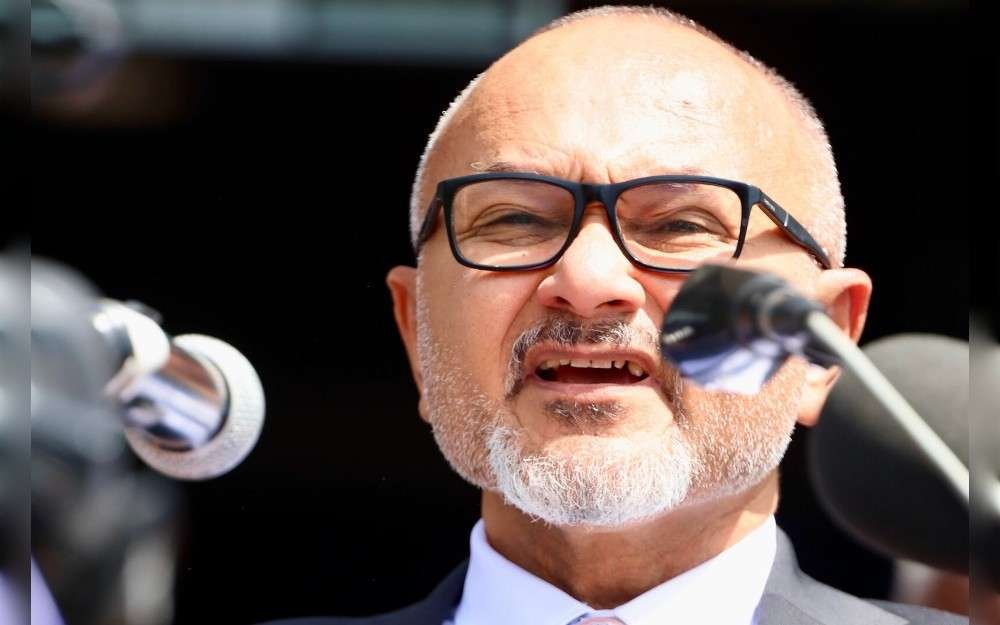
HONIARA — The Solomon Islands’ choice of longtime opposition leader Matthew Wale as its new prime minister could be a sign that a diplomatic shift toward Canberra is likely, while the Pacific island nation still engages moderately with Beijing, experts told Radio Free Asia.
Wale was sworn in on Friday after winning 26 out of 50 votes in parliament, edging out the 22 votes for Foreign Minister Peter Shanel Agovaka, and drawing to a conclusion months of political chaos surrounding Wale’s predecessor Jeremiah Manele, who last week was ousted in a no-confidence vote.
“Fellow Solomon Islanders, change is coming,” Wale said during his inaugural address.
The new prime minister takes office amid mounting geopolitical tension across the Indo-Pacific, and he will likely exercise more diplomatic caution with China, unlike the two prime ministers before him, Graeme Smith, associate professor at the Department of Pacific Affairs at The Australian National University, told RFA.
“I think it’s a pretty seismic shift in the diplomatic sense. It does bring the Solomons more back into kind of an Australian, and to a lesser extent U.S. orbit,” he said. “It’s certainly a development that will have, I think, pleased people in Canberra.”
Wale has been opposition leader for roughly seven years, dating back to the beginning of the fourth term of Manasseh Sogavare, during which it could be said that Honiara decisively entered into Beijing’s sphere of influence – in 2019 the Solomon Islands stopped recognizing Taiwan in favor of China, and in 2022 entered into a secretive controversial security pact with Beijing, which, at the time, Wale criticized as undermining the security of the country.
When Sogavare’s term was up in 2024, parliament chose his foreign minister Manele to succeed him, in what was largely seen as an extension of Sogavare’s pro-China stances.
Smith said that the switch to Wale likely would not vastly change relations with China, but “he certainly will be much more moderate in his language around Beijing and certainly far less enthusiastic than his two predecessors in both Manele and Sogavare.”
Wale during his speech described the current global climate as a difficult period shaped by geopolitical rivalry and economic uncertainty, pressures he said the Solomon Islands cannot escape.
“We take government at a difficult time given what is happening throughout the world,” Wale said. “We are not immune from the impacts of these geopolitical events.”
He pledged that his government would pursue disciplined and prudent management to guide the country through the challenges ahead.
Wale’s election reflects a broader struggle over the future foreign policy direction of the Solomon Islands, international relations scholar Alexander L. Vuving of the Daniel K. Inouye Asia-Pacific Center for Security Studies, told RFA.
“For the people of Solomon Islands, the key concerns are economic and political issues within the country,” Vuving said. “But for the wider Indo-Pacific, the most important question is how the next government positions itself among the major powers.”
Wale vs. Agovaka
The political contest was widely interpreted as a choice between maintaining close ties with Beijing or recalibrating relations toward Australia and Western allies.
Agovaka, who had served as foreign minister under Manele but then led an exodus of lawmakers from the ruling coalition in defecting to the opposition in March, was widely estimated to have been the favorite to succeed him, especially after Manele endorsed him after his ouster.
A vote for Agovaka therefore would have been seen as a vote to stay the course in maintaining close China ties, whereas a vote for Wale would favor a more cautious approach to China’s expanding security footprint while favoring stronger engagement with Australia and the United States, Vuving said.
“The election can turn Solomon Islands in a very different direction about how it positions itself among the major powers,” he said, adding that Wale’s victory was likely to be welcomed in Western capitals as evidence that China’s growing influence in the Pacific can still be challenged.
Smith acknowledged that Wale’s victory came as a surprise.
“He’s been opposition leader for seven years now, and I think a lot of people assumed that he’d missed his chance and this day would never come,” he said. “I think a lot of people I assumed it would be Agovaka that would get the job given that he was sort of the lead critic of Manele, and in many ways sort of was the main person pushing the no confidence motion.”
Smith said that Agovaka’s world view was much more pro-China, and that among parliament there is more support for China over Taiwan, pointing out that Wale’s coalition might not be very stable, as he won the “bare minimum” of 26 votes in a 50 seat parliament.
“Wale will be looking to get a few more numbers across and that may mean that he has to give a signal that he’s a bit more pro-China,” he said. “So he will not be stridently anti-China but he’ll certainly be less pro than Agovaka would have been.
Challenges ahead
Holding on to power could be difficult with such a slim majority, Joseph Foukona, a history professor at the University of Hawaii at Manoa, who hails from the Solomon Islands, told RFA.
“It’s going to be a challenge for him in terms of trying to continue to maintain the numbers on his side,”Foukona said. “If there’s any political disagreement or tensions within his group, we might see people moving or changing sides again.”
Smith said Wale will be under pressure to publicly release the details of the 2022 security agreement with Beijing, which he had been a huge critic of and which until now has been confidential, save for a leaked draft of the deal prior to its finalization. Wale might then push to revise parts of it, he said.
Foukona said that Wale would likely be more transparent than his predecessors, not just about the 2022 security pact, but also in other arenas.
“Often when he speaks he sort of emphasizes transparency and accountability and this is one area that we must see some changes in terms of going forward,” Foukona said of Wale. He said Wale’s government might put more resources into the country’s anti-corruption commission, and disclose details about international agreements signed by the previous government.
Strategic importance
Located in the South Pacific and relatively close to Australia, the Solomon Islands occupies maritime space considered important for regional security and trade routes. During World War II, the islands were a major battleground. Today, competition has shifted toward infrastructure, technology, and access to resources.
One major area of rivalry involves undersea telecommunications cables, which carry nearly all global internet traffic.
“The undersea cables have become critical infrastructure,” Vuving said. “China is trying to gain influence in that business, and that has triggered pushback from the United States and particularly Australia.”
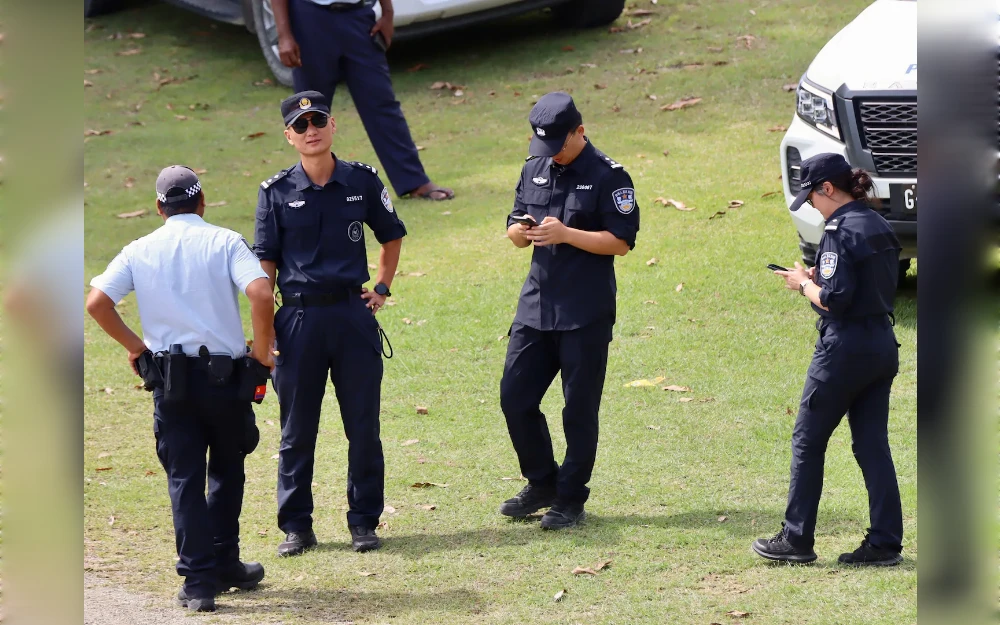
The cables are part of a larger telecommunications infrastructure competition in the islands. Chinese technology giant Huawei recently completed the installation of more than 160 telecommunications towers across the country under a Chinese-funded project.
Vuving also said that the Solomons controls a vast Exclusive Economic Zone rich in fisheries and seabed minerals, including resources increasingly important for renewable energy technologies and artificial intelligence industries, but which the country lacks to capacity to exploit.
“Countries like the Solomon Islands need major powers with the capability to mine those minerals, and China is looking for that,” said Vuving, who said that China’s expansion in the Pacific has been gradual. He described China’s approach as “salami slicing.”
“You don’t see a big shift overnight,” Vuving explained. “Every day, they expand a little bit. After years, they gain huge influence and can lock people into those relationships.”
He said that regardless of who is in charge of the Solomons, the country would still have to balance influence by foreign powers.
“You’re small, and you’re playing the game with giants,” he said.“In that way, you’re very vulnerable.”
Vuving argued that the Solomon Islands must diversify its international partnerships to avoid overdependence on any single country, strengthening ties not only with China, Australia, and the United States, but also with partners such as Japan, India, France, the United Kingdom, New Zealand, and the Association of Southeast Asian Nations.
He said the long-term challenge for the Solomon Islands will be maintaining political independence while navigating relationships with competing global powers.
“The fate of great power competition may not be decided entirely in Solomon Islands,” Vuving said. “But for a small Pacific nation, it is extraordinary to find itself at the centre of such an important geopolitical contest.”
Eugene Whong reported from Washington. Edited by Charlie Dharapak.
“Copyright © 1998-2023, RFA.
Used with the permission of Radio Free Asia,
2025 M St. NW, Suite 300, Washington, D.C. 20036.
https://www.rfa.org.”