



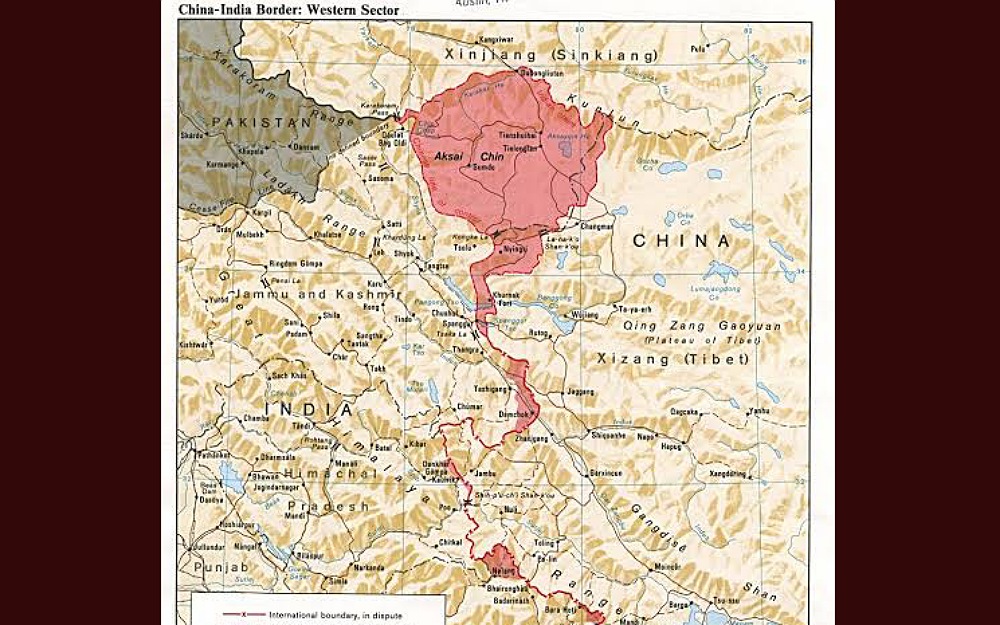
China’s and India’s foreign ministers spoke by phone following a military clash at their shared border in the western Himalayas, Chinese state media reported on Wednesday, as analysts said neither country will likely allow the situation to escalate.
Thousands of Indian and Chinese troops have faced off in recent weeks at three or four locations in the western Himalayas after Beijing’s forces intruded into Indian territory, according to Indian security officials and local media.
But China has denied breaching the “Line of Actual Control” near the Galwan River in India’s snowy and mountainous Ladakh region during the clash on Monday.
Indian media said some 20 Indian troops died in Monday’s clashes. China has admitted that its People’s Liberation Army troops also sustained casualties, without mentioning a number.
The U.S. has sided with India, saying China’s incursion into Indian territory was typical of its behavior in other regions, including the South China Sea.
Foreign ministry spokesman Anurag Srivastava said Chinese troops had recently “undertaken activity hindering India’s normal patrolling patterns.”
China’s state-controlled Global Times said Indian troops had been trespassing on Chinese territory and even trying to erect illegal defense facilities since the beginning of May.
India committed to peace, it says
Srivastava said India was committed to resolving border disputes through talks.
“The two sides have established mechanisms to resolve such situations peacefully through dialogue. Both sides remain engaged with each other to address any immediate issues,” Srivastava said.
In the phone call between Chinese foreign minister Wang Yi and his Indian counterpart Subrahmanyam Jaishankar, China urged India to investigate the clash incident in the border region on Monday, punish those responsible, and restrain its military forces in the region, state news agency Xinhua reported.
Wang said India shouldn’t “miscalculate” the current situation, the agency, which is an approved outlet of the ruling Chinese Communist Party, reported.
But China’s Global Times newspaper, a tabloid linked to party mouthpiece the People’s Dailythat often takes a strongly nationalistic stance, quoted official commentators as saying that no escalation was likely from the incident.
And Chinese Foreign Ministry spokesman Zhao Lijian played down concerns over the incident at a regular news briefing on Wednesday. But he said the incident happened on China’s side of the border.
Troops on both sides have agreed not to carry guns, so the conflict was fought with “cold weapons,” the Global Times quoted Tian Shichen, vice president of government-backed think tank the Grandview Institution, as saying.
“In an age of firearms, a cold weapon conflict reflected both sides’ unified attitude to keep the conflict at a low level,” Tian told the paper.
“To ease pressure from domestic public opinion, India will make some strong reactions, but is unlikely to risk another provocative action again,” Tian said.
Online comments on Chinese social media platform Weibo called on Beijing to come clean about the number of Chinese casualties, but generally supported their government’s view of the incident.
And Chinese Foreign Ministry spokesman Zhao Lijian played down concerns over the incident at a regular news briefing on Wednesday. But he said the incident happened on China’s side of the border.
Troops on both sides have agreed not to carry guns, so the conflict was fought with “cold weapons,” the Global Times quoted Tian Shichen, vice president of government-backed think tank the Grandview Institution, as saying.
“In an age of firearms, a cold weapon conflict reflected both sides’ unified attitude to keep the conflict at a low level,” Tian told the paper.
“To ease pressure from domestic public opinion, India will make some strong reactions, but is unlikely to risk another provocative action again,” Tian said.
Online comments on Chinese social media platform Weibo called on Beijing to come clean about the number of Chinese casualties, but generally supported their government’s view of the incident.
Several commenters asked “what does India think it’s doing?”
Both sides showing restraint
Daniel Markey, a former policy planning adviser on South Asian affairs at the State Department, said both sides seem to be exercising extreme restraint, with neither wanting the situation to get out of hand.
“I don’t think this incident will lead to an actual war between China and India,” Markey said. “While it’s true that this is the first time in forty-five years that we’ve seen tension, it’s not unlike the artillery and air strikes between India and Pakistan.”
Some social media comments in China mentioned the 1962 border war with India.
But Satu Limaye of the East-West Center in Honolulu said he would be very surprised to see a repeat of that conflict.
“India is gradually changing its stance, which has always been distinct from that of the United States and its allies in the past,” he said.
“But even if India does move closer to the U.S. diplomatically, politically, and militarily, it doesn’t mean that Delhi will cut all economic ties with China, or come into conflict with China.”
No country in the Indo-Pacific wants a military conflict with China,” he said.
Markey, currently a senior professor at the Johns Hopkins University School of Advanced International Studies, said the U.S. support for India is necessary to signal to China’s neighbors that Washington won’t tolerate further Chinese expansionism.
“U.S.-China relations are about as bad as they can get over Hong Kong, so they don’t need another incident over the India border dispute,” Markey said, in comments translated into Mandarin by RFA.
“The United States must make it clear that there is a price to pay for any further aggressive action by China,” he said.
Reported by Zheng Chongsheng for RFA’s Mandarin Service, and by the Cantonese Service. Translated and edited by Luisetta Mudie.
Copyright © 1998-2020, RFA. Used with the permission of Radio Free Asia, 2025 M St. NW, Suite 300, Washington DC 20036. https://www.rfa.org
“The United States must make it clear that there is a price to pay for any further aggressive action by China,” he said.
Reported by Zheng Chongsheng for RFA’s Mandarin Service, and by the Cantonese Service. Translated and edited by Luisetta MudCopyright © 1998-2020, RFA. Used with the permission of Radio Free Asia, 2025 M St. NW, Suite 300, Washington DC 20036. https://www.rfa.org. For

Tibetan Mastiffs

LLM Phishing
UN Secretary-General Meets with Assistant Secretary-General for Africa in Departments of Political and Peacebuilding

North Carolina Police Encountered Two Men Travelling Down Couch Mounted on E-Scooter

Scottish Deerhound Dog Breed

AI-Powered Mortgage Fraud

Exclusive: North Korean Army Video Says K-Drama Watchers Deserve to be Executed

Press Briefing by Special Rapporteur on Sale and Sexual Exploitation of Children
Subscribe Our You Tube Channel

Fighting Fake News
Fighting Lies