

Headlines
  • After an Iranian attack on a container ship in the Strait of Hormuz earlier in the weekend that set it on fire and left a crew member missing, the United States launched several waves of strikes on Iran on Sunday.
  • Antonio Guterres, the secretary-general of the United Nations, voiced his "deep concern" over the escalating attacks in Iran and warned "catastrophic consequences" on a global scale if parties resume "full-scale hostilities."
  • Iran has denounced the latest wave of American attacks on its territory, claiming that they have "rendered futile" all of the past few months' diplomatic efforts..
  • In order "to continue degrading their ability to attack civilian mariners and commercial ships" in the Strait of Hormuz, the U.S. Central Command (CENTCOM) said on Sunday that its forces had carried out more strikes against Iran.
  • A bar fire in Bangkok, the capital of Thailand, claimed at least 27 lives and injured over 60 more.

More Details

Satellite Imagery Reveals Increased Activity at North Korean Nuclear Complex

Steam plumes and construction at Yongbyon suggest Kim Jong Un is making good on his five-year nuclear buildup plan

By Noh Jung Min for RFA
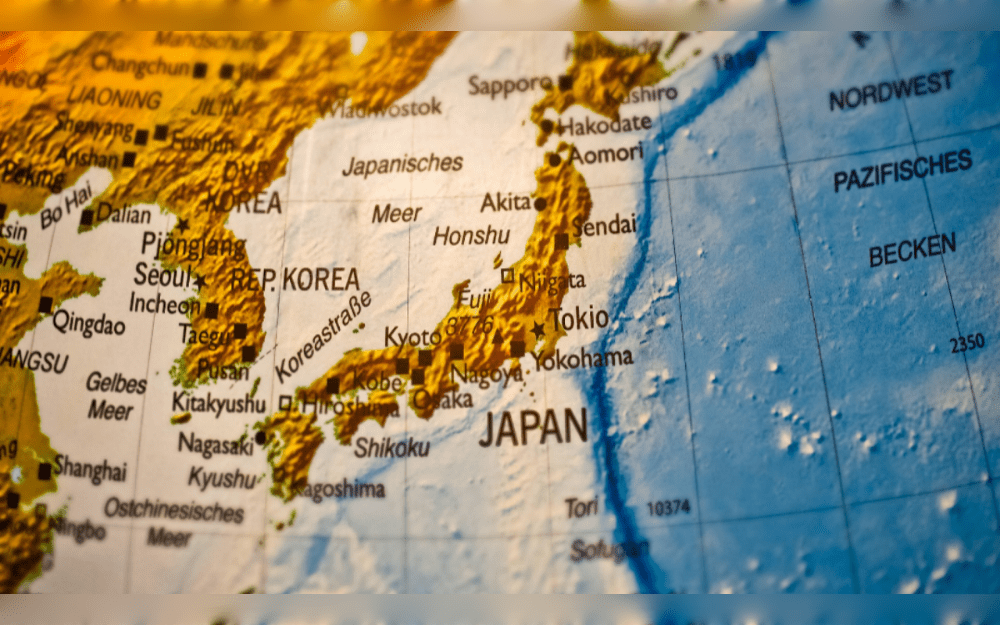
At North Korea’s Yongbyon Nuclear Complex, heightened activity observed on satellite imagery indicates that Pyongyang is increasing its capacity to produce nuclear weapons, experts told Radio Free Asia.

At North Korea’s Yongbyon Nuclear Complex, heightened activity observed on satellite imagery indicates that Pyongyang is increasing its capacity to produce nuclear weapons, experts told Radio Free Asia.

The imagery shows new buildings and plumes of steam in previously inactive areas of the complex, which lies roughly 90 kilometers (56 miles) north of the capital.

North Korea has long claimed that Yongbyon serves peaceful, civilian energy purposes, but the international community and monitoring organizations say that the complex produces fissile materials to produce nuclear weapons.

The increased activity observed in April follows Kim Jong Un’s announcement at the Ninth Congress of the ruling Korean Workers’ Party in February that the country would build up and diversify its nuclear arsenal over the next five years.

Where there’s smoke…

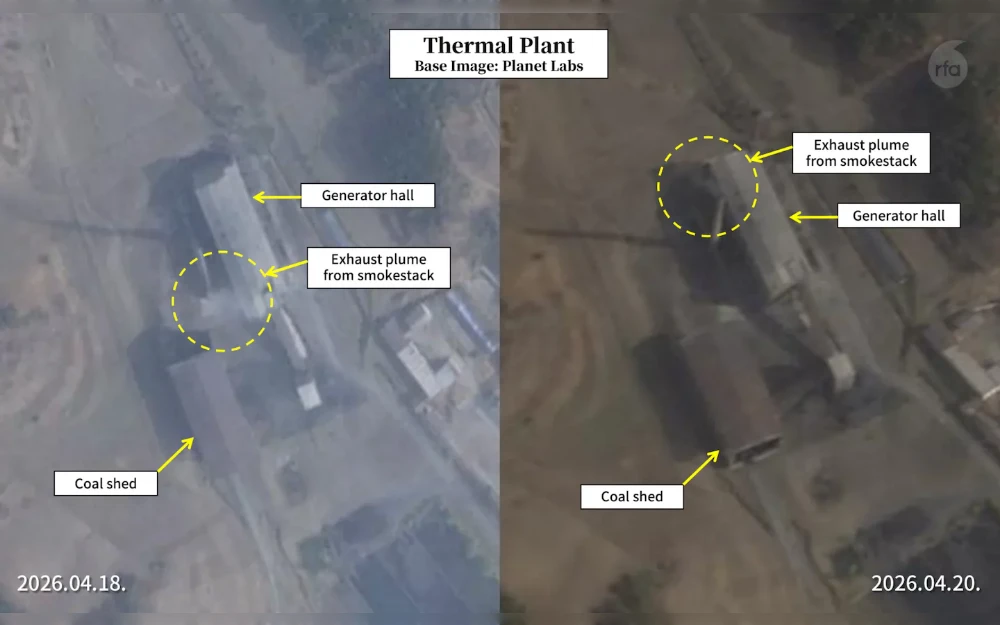
Images captured by Planet Labs on April 18 and 20 show steam emitting from the thermal generating plant at the radiochemical laboratory. On March 12 and April 25, images showed the reactor discharging water into the nearby Kuryong River. These discharges are consistent with many other images captured since January.
At North Korea’s Yongbyon Nuclear Complex, heightened activity observed on satellite imagery indicates that Pyongyang is increasing its capacity to produce nuclear weapons, experts told Radio Free Asia.
Steam escapes from the thermal plant at the Radiochemical Laboratory at the Yongbyon Nuclear Complex in North Korea on April 18 and 20, suggesting at least limited operations at the laboratory.(Analyzed by Jacob Bogle/RFA)

The evidence suggests that North Korea is producing weapons grade plutonium, Olli Heinonen, a former deputy director-general of the International Atomic Energy Agency and a distinguished fellow at the Stimson Center, told RFA.

“It looks that North Korea still continues to produce plutonium in the 5 megawatt reactor and it’s on a campaign basis,” he said, using a technical term to indicate a start-to-finish production cycle. “So it operates for about a year or so and then they discharge the fuel which is a very quick operation.”
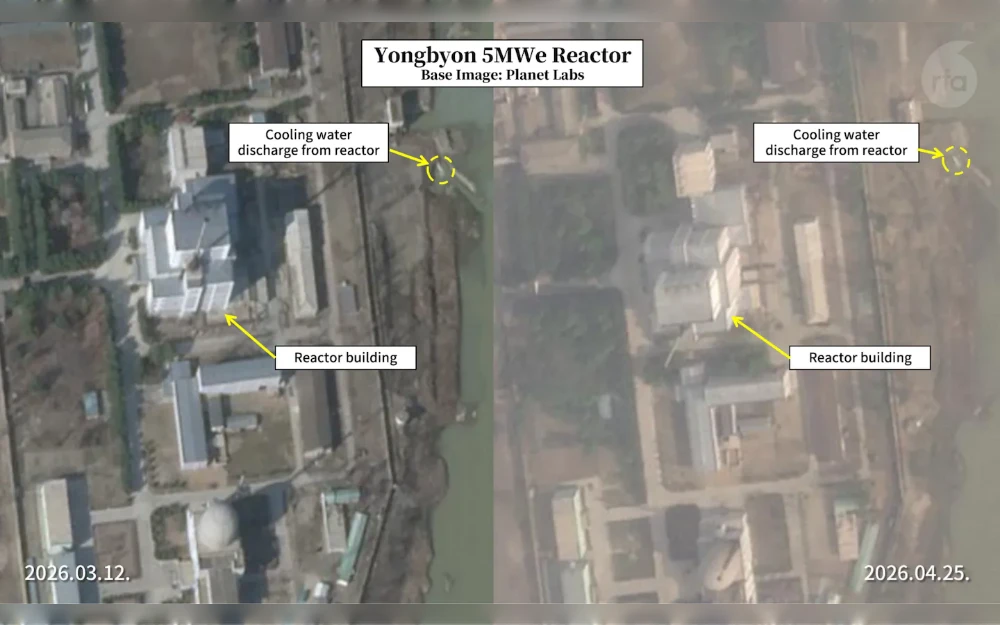
At North Korea’s Yongbyon Nuclear Complex, heightened activity observed on satellite imagery indicates that Pyongyang is increasing its capacity to produce nuclear weapons, experts told Radio Free Asia.
Water discharge is visible from the 5-megawattt reactor on high-resolution imagery from January to April this year. This discharge is one of the indicators that the reactor has been operating for that timeframe as part of the plutonium production cycle at the Yongbyon Nuclear Complex in North Korea. (Analyzed by Jacob Bogle/RFA)

Jacob Bogle, a U.S.-based private satellite imagery analyst, told RFA that since October 2024, the complex has been in its seventh cycle of fuel irradiation and reprocessing for plutonium production.

“This multi-year cycle of activity has continued to the present and is supported by two key pieces of visual evidence – consistent water discharge from the 5 MW reactor throughout 2026 and occasional activity at the Radiochemistry Lab as indicated by steam generation,” he said.

The findings are consistent with confirmation from the International Atomic Energy Agency, or IAEA, that North Korea has significantly expanded its nuclear activities at Yongbyon.

During a visit to South Korea on April 15, IAEA Director-General Rafael Grossi told reporters that many of the facilities at Yongbyon, including the main reactor, were active.

“This suggests a serious increase in North Korea’s nuclear weapons production capacity, which appears sufficient to produce dozens of warheads,” Grossi said, adding that the construction of a new nuclear enrichment facility comparable to existing ones had also been confirmed.

Construction ongoing

Satellite imagery also confirms that new buildings are appearing at the complex. Exterior construction on one of the new buildings–suspected to be a new uranium enrichment facility–was completed in either November or December of last year.
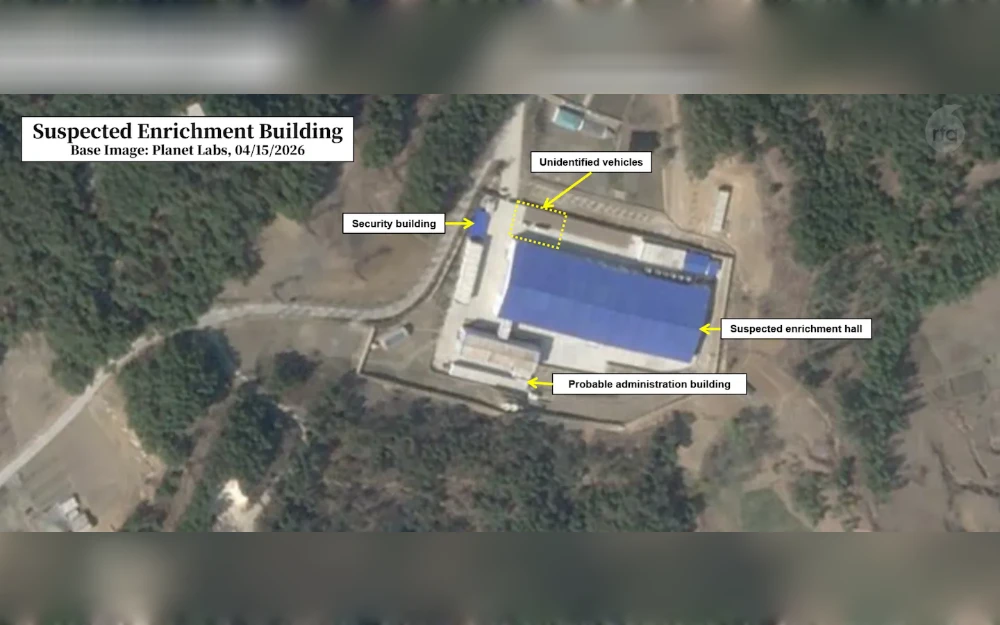
At North Korea’s Yongbyon Nuclear Complex, heightened activity observed on satellite imagery indicates that Pyongyang is increasing its capacity to produce nuclear weapons, experts told Radio Free Asia.
A new building at North Korea’s Yongbyon nuclear complex, suspected to be for uranium enrichment. High-resolution images from March to April all show that the facility is being well-maintained and occasionally vehicles can be seen on the premises, such as on April 15. (Analyzed by Jacob Bogle/RFA)

Bogle said that melting snow on the roof of the building was visible, suggesting the building is connected to electricity and that interior construction is at a minimum still ongoing.

A vehicle was observed next to the building on April 15, though no external indicators have emerged to determine whether interior work is still in progress or whether the facility has become operational.

Additionally, in March, the roofs of two buildings within the radiochemical laboratory were replaced.

New high-rise residential buildings have also been erected in the area, likely needed to house an expanded workforce.
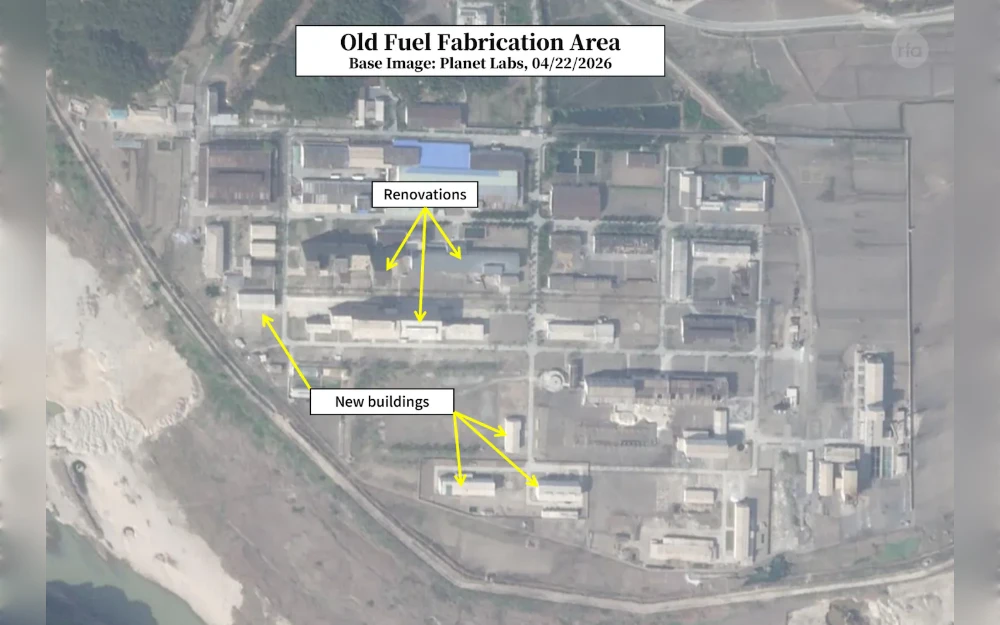
At North Korea’s Yongbyon Nuclear Complex, heightened activity observed on satellite imagery indicates that Pyongyang is increasing its capacity to produce nuclear weapons, experts told Radio Free Asia.
At the old fuel rod fabrication area of North Korea’s Yongbyon Nuclear Complex some buildings have been renovated while others were newly built. The purpose of these changes is unknown, experts told RFA. Credit:RFA

Heinonen said that the satellite images showed changes to the complex that are not yet understood. In the southern part of the complex, in an area where fuel rods were fabricated, four entirely new buildings have appeared.

“Some of them seem also to be quite well-built and one is even separated from the others with a fence which tells me that it’s very important,” he said. “We don’t know what it is, but I think that these buildings have to do with a plan of Kim Jong Un to enhance the nuclear weapons production and to produce nuclear material and components for nuclear weapons. So we have to see that change as a part of his former and current five-year plan.”

Edited by Eugene Whong.

“Copyright © 1998-2023, RFA.
Used with the permission of Radio Free Asia,
2025 M St. NW, Suite 300, Washington, D.C. 20036.
https://www.rfa.org.”

Related Article

Myanmar Removes At Least 15 Statues…

removed or destroyed at least 15 statues of Gen. Aung San, who led the country to independence from ...
July 11, 2026

Tibetan Activist Dies After Setting Himself…

A Tibetan activist died Thursday after setting himself on fire outside the United Nations headquarte ...
July 4, 2026

PNG Received Millions After Cyclone Maila,But…

After Cyclone Maila devastated parts of Papua New Guinea in April, disaster relief funds poured into ...
July 2, 2026

Border Cities Bright At Night as…

A North Korean city on the border with China is no longer completely dark at nighttime, satellite im ...
June 30, 2026

Taiwan’s Robodogs Signal Military Shift to…

When Taiwan’s military in early June unveiled robot dogs designed to patrol remote South China Sea ...
June 26, 2026

Turtle Power: How China Uses Scientific…

When Chinese researchers recently announced the discovery of a large gathering of endangered hawksbi ...
June 25, 2026

Other Article

News & Views

Myanmar Removes At Least 15 Statues…

removed or destroyed at least 15 statues of Gen. Aung San, who led the country to independence from ...
July 11, 2026
Pick of the Day

UN Parmanent Representative of Iran Briefs…

Amir Saeid Iravani, Permanent Representative of the Islamic Republic of Iran to the United Nations, ...
Bizzare News

Goats Trek Across Terrain with Colorado…

Recently, while Colorado firefighters were putting out a small wildfire, Goldie, a goat short for Go ...
July 10, 2026
Pet Corner

Tonkinese Cat Breed

Tonkinese cats are mix of Burmese and Siamese cats.Their coats are short, soft,, and smooth, with co ...
Prevent Cyber Crime

Global AI Regulations

The legal frameworks and regulations established to oversee the advancement and application of artif ...
Pick of the Day

2026 High-level Political Forum on Sustainable…

Anacláudia Rossbach, Executive Director of UN-Habitat, addresses the 2026 High-level Political Foru ...

Top