



Beijing routinely skirts international agreements, so a COC must have enforcement mechanisms, analysts said.
By Taejun Kang for RFA
Southeast Asian leaders are unlikely to resolve long-standing disputes in the South China Sea at next month’s ASEAN Summit, but they could make “incremental progress” towards a Code of Conduct, or COC, aimed at managing tensions there, analysts told Radio Free Asia.
The annual summit brings together leaders of the Association of Southeast Asian Nations, or ASEAN, to discuss regional security and economic issues. China is participating as a dialogue partner this year, and the forum presents an opportunity to address the South China Sea, a persistent flashpoint where China’s sweeping claims overlap with the exclusive economic zones of several Southeast Asian states.
Regional officials have said they are aiming to complete negotiations on the COC by 2026, but key issues, including its geographic scope, legal status and enforcement mechanisms, remain unresolved after more than two decades of talks.
Resolution unlikely
It is improbable that a code resolving all disputes in the South China Sea could be hammered out at the ASEAN leaders’ summit this year, Joseph Kristanto, a research analyst at Singapore’s S. Rajaratnam School of International Studies, told RFA. The key issue at the summit will be if meaningful progress on mitigating tensions can be achieved.
“While the COC may help prevent misunderstandings in daily interactions, I’d say it’s unlikely to stop grey-zone activities or coercive behavior by claimant states, most notably China, altogether,” he said. “Therefore, the COC is best seen as a mechanism for managing friction, rather than transforming the underlying dynamics of the dispute.”
Agreements to reduce friction have been tried before. ASEAN and China signed a non-binding Declaration on the Conduct of Parties in 2002 and began formal negotiations on a binding code in 2013. Progress since then has been described by some officials as slow.
COC negotiators face a fundamental trade-off between a politically feasible but limited “thin” code based on general principles, and a more robust framework with clearer rules and enforcement mechanisms that would be harder to achieve, Kristanto said.
“The slow pace of the COC process demonstrates the complexity of these issues and exposes the limits of ASEAN’s consensus approach,” he said.
Other analysts say that China’s track record of frequent provocations in the region makes them skeptical that any agreement would make a meaningful difference in practice.
“My pessimism on the COC really comes down to two things: China’s track record of undermining or ignoring its existing agreements, and the question of who would actually do the binding in a ‘legally binding’ COC,” Ray Powell, executive director of Stanford University’s SeaLight maritime transparency project, told RFA.
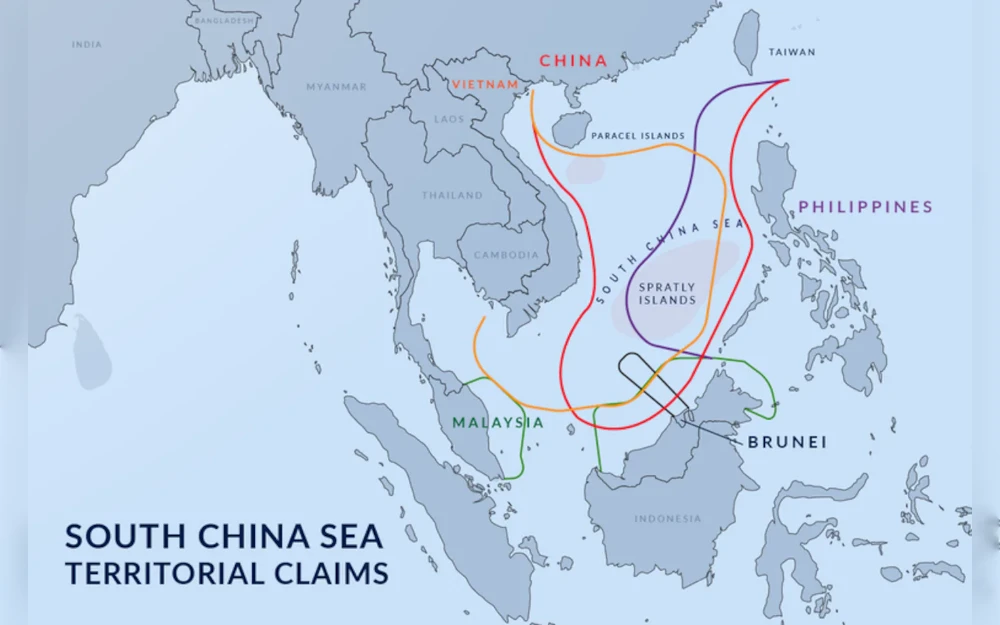
Powell noted that the 2002 declaration already committed parties to self-restraint and peaceful dispute resolution, yet tensions have persisted.
“That experience shows the problem is not the absence of written rules but a lack of any authority China is willing to accept above its own political will,” he said, adding that a meaningful code would require an enforcement or arbitration mechanism that Beijing has historically rejected.
A weaker version, he warned, could risk undermining existing legal protections for Southeast Asian states under international law.
Legal questions
Others argue that even a limited agreement could still play a role in stabilizing day-to-day interactions, provided it is grounded in established international legal frameworks.
“A substantive and comprehensive COC on the South China Sea would not just be about something that could ease the tensions between the Philippines and China,” Josue Raphael J. Cortez of the De La Salle-College of Saint Benilde in the Philippines, told RFA.
“Instead, it would be an inclusive document, grounded in UNCLOS and public international law that should pave the way for all state claimants to coexist responsibly and peacefully,” he said, referring to the United Nations Convention on the Law of the Sea.
Cortez said a meaningful code should go beyond traditional issues such as fisheries and navigation to include broader resource-sharing arrangements, including oil, gas and critical minerals, reflecting the region’s evolving economic stakes.
Though a legally binding framework could help reduce tensions, he cautioned that it would need to be backed by continued dialogue and mechanisms to ensure compliance.
“Forging such an agreement can never be enough,” he said. “Instead, continuous dialogue … must still be continued so as to ascertain compliance and whether future revisions can be undertaken for the framework’s viability.”
The 48th ASEAN Summit is slated to start May 5-9 in Cebu, Philippines.
Edited by Eugene Whong.
“Copyright © 1998-2023, RFA.
Used with the permission of Radio Free Asia,
2025 M St. NW, Suite 300, Washington, D.C. 20036.
https://www.rfa.org.”