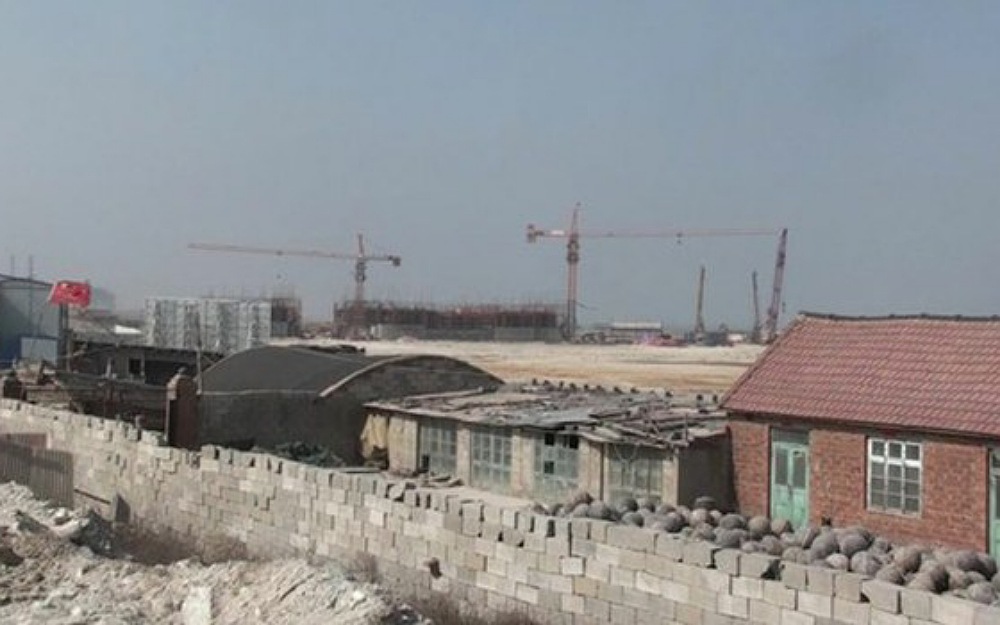
Authorities in the eastern province of Shandong have suspended a mass rural resettlement program after it was criticized by the ruling Chinese Communist Party’s official newspaper, the People’s Daily, in the face of growing public anger.
While government land grabs in rural areas have sparked mass unrest and, rarely, organized resistance across China for decades, the Shandong program of “village mergers” was far more ambitious in scope, and had been packaged as a bid to improve the lives of farming communities in a total revamp of rural areas.
But local residents told RFA that the program had left them homeless and with no income, compensation or social security assistance.
Xiao Li, a resident of Xinxing township in Shandong’s Lanling county, said his family had fled their home to escape ruthless harassment by the authorities after they tried to say no to the resettlement plan.
Their idyllic courtyard extended family home that had been renovated in 2009 was demolished in their absence.
Shandong provincial party secretary Liu Jiayi announced at end of June that the controversial resettlement program would be suspended.
“The projects that are controversial among people and the ones that have not been launched yet should be suspended and checked again,” Liu said in comments quoted by the Global Times, which has close ties to the People’s Daily.
Liu added that the program had been “rashly” implemented, it said.
No compensation, no accommodation, no subsidies
Village mergers and rural development programs in other parts of China haven’t usually involved people being forced out of their homes, the paper said.
But families whose homes have already been lost say they have seen no compensation, no resettlement accommodation and no government subsidies to help them get by.
“I haven’t received anything,” Xiao Li told RFA. “I am living at a friend’s place right now. I’m homeless.”
“They have destroyed everything, and I am pretty much a beggar now. I rely on my friend to feed me,” he said.
Six other Xinling residents told RFA that, as of July 24, they had yet to receive compensation linked to the scheme’s suspension, and that they had already exhausted all of the possible options when it came to government relief.
Xiao Li said the local village committee had totally failed to stand up for the interests of local residents.
“Not only did they not stand up for our interests; they actually provided detailed information [to enforcers] about possible weaknesses that could be exploited in the case of families who didn’t want to sign the agreements,” Xiao Li said.
“We didn’t organize, because we didn’t dare to organize.”
According to a June 25 commentary in the People’s Daily, the original rural development plan was a good one, but its harsh implementation had sparked public anger, partly because people didn’t have a meaningful choice.
“You have to agree to it, or it will affect your children’s college entrance examinations and civil service exams,” the article said, adding that holdouts had been bumped to the top of the demolition gangs’ lists.
Property rights
Kristen Looney, assistant professor of Asian studies at Georgetown University in the United States, said Chinese rural residents have no access to rural organizations that protected the rights of their counterparts in Taiwan and South Korea.
Property rights are also lacking in China.
Guo Yuhua, sociology professor at Beijing’s prestigious Tsinghua University, said China’s farmers don’t actually own their land, but lease it on contract from a nebulous entity known as the “collective,” a throwback to the Mao era of commune-style rural living.
“In Chinese law, urban land is owned by the state. But who is the state? Rural land is owned by the collective, but who is the collective?” Guo says, in a reference to the Chinese Communist Party’s control of both entities.
“The land isn’t yours. Property rights are not guaranteed in China at all, and property rights underlie human rights,” he said.
California State University professor Song Yongyi, an expert on Chinese rural land reforms, put it more bluntly, saying that the Communist Party is effectively the biggest landlord in China.”
“If the issue of property rights isn’t resolved, conflicts like this will continue,” Song said. “Petitions and complaints may occasionally resolve individual issues. But the main issue won’t be resolved.”
At the 18th Party Congress in 2013, an attempt was made to reform property rights to allow for greater protection for landowners, homeowners and businesses.
But it was overturned personally by Communist Party general secretary Xi Jinping.
Private ownership taboo
According to Wen Guanzhong, economics professor at Trinity College in the U.S., said nobody has dared to raise the issue since.
“Anyone who tries to discuss private ownership of land in public now is setting themselves against the general secretary,” Wen said.
“You would basically be risking your life, because the general secretary has more power than the whole party combined. Nobody is going to do that.”
According to Guo, current policy debates can now only “go around in circles” on issues such as demolition methods, persuasion work, and local finance initiatives.
The fundamental power structure remains the same, however.
“The central government must control everything, and this rule must be maintained behind closed doors. There are no checks or balances on power,” Guo said.
Fellow Xinling resident Xiao Lan has posted a number of posts to social media platform WeChat since her home was demolished in March 2020.
She has called online for an investigation into official corruption surrounding the resettlement program, but there is scant coverage in the state-controlled media following a directive from the powerful central propaganda department ordering them to lay off the story.
The phrase “village mergers,” which was originally used to describe the scheme, has been removed from China’s tightly censored internet, and only positive reports about the “beautification” of rural areas are now allowed. The ban also extends to social media posts.
“Who actually cares about me?” one of Xiao Lan’s posts read. “Nobody in my contacts list, none of my followers: nobody, basically,” she wrote.
Reported by Jane Tang for RFA’s Mandarin Service. Translated and edited by Luisetta Mudie
Copyright © 1998-2020, RFA. Used with the permission of Radio Free Asia, 2025 M St. NW, Suite 300, Washington DC 20036. https://www.rfa.org

Giant Schnauzer Dog Breed

NDR and ITDR
UN Security Council Meets on Situation in Libya

On Utah Highway, Semi-Truck Carrying French Fries Catches Fire

Tibetan Mastiffs

LLM Phishing

UN Secretary-General Meets with Assistant Secretary-General for Africa in Departments of Political and Peacebuilding

North Carolina Police Encountered Two Men Travelling Down Couch Mounted on E-Scooter
Subscribe Our You Tube Channel

Fighting Fake News
Fighting Lies