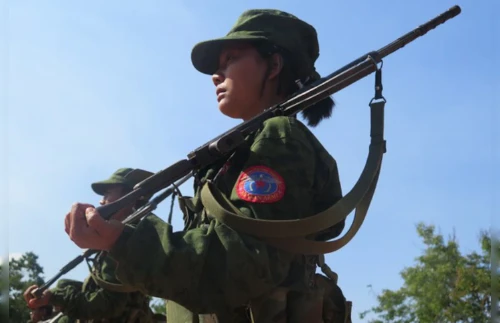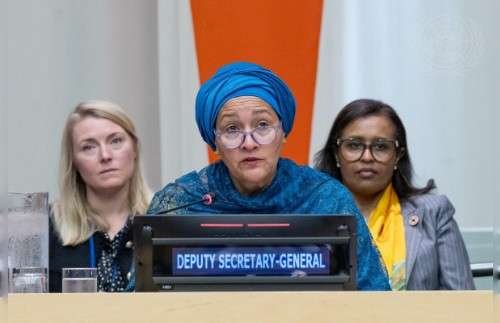




Washington’s framework includes peacemaking to increase regional influence and provide access to rare earths.
By RFA Burmese

Armed ethnic groups and members of Myanmar’s shadow government are hoping that a recently made public U.S. strategy for their country decrease fighting and bring about peace with the military-backed government, the organizations told Radio Free Asia.
The U.S. State Department recently released an Integrated Country Strategy document for Myanmar that outlines Washington’s aims to use diplomacy to promote peace in the volatile Southeast Asian country, potentially providing access to rare earth deposits dominated by China.
The policy document lays out four mission goals, which include protecting U.S. citizens, addressing trade deficits, promoting peace, and increasing U.S. regional influence through engagement.
To achieve these goals, dealing with Myanmar’s military-backed government – headed by the same people who ousted the previous government in a coup in 2021 – cannot be avoided. Washington initially shunned engagement with the military after the coup and imposed sanctions on its most senior leaders, but has since softened its stance, rolling back some sanctions and even holding high level talks in September 2026.
A U.S. State Department spokesperson on Tuesday explained the shift to RFA.
“The Administration has been evaluating how to calibrate Washington’s policy towards Burma to achieve regional stability, and also make progress on key U.S. priorities and has determined that wholesale disengagement with the authorities in Naypyidaw countered U.S. strategic interests in Burma and the region. We are pursuing a policy that welcomes dialogue with all stakeholders involved in the conflict as we encourage Burma to make progress on key U.S. priorities, including addressing scam centers, improving the domestic operating environment for U.S. businesses, and building towards a genuine peace process that stabilizes the country.”
David Gum Awng, Deputy Minister of Foreign Affairs for the National Unity Government, or NUG, a shadow government made up of former government officials who were ousted in the 2021 coup, told RFA he understood the realities of the situation.
“The NUG respects and acknowledges that the U.S. government is actively engaging in Myanmar affairs and formulating a strategy aimed at peace, economy, and regional stability. The NUG will continue to engage in discussions with the U.S. government, Congress, and the international community including relevant partner nations.
We will also continue to urge that the U.S. government’s policies and practical actions towards Myanmar support the democratic and federal aspirations of the Myanmar people, address the root causes of the conflict, and lead toward an inclusive political resolution. International engagement in Myanmar affairs should not prolong the military dictatorship, but should aim to bring about genuine political change based on the will and rights of the people after escaping from this bad system.”
Kyaw Ni, Deputy Minister of Home Affairs and Immigration for the NUG, shared his opinion that amidst the policies of superpower nations, one must strive to achieve benefits for one’s own country.
“In this policy shift of a superpower nation, small countries suffer a lot, so a country undergoing revolution like Burma suffers even more. It is likely to be affected. Since these are superpower nations, they write policies based on their own interests. So our public also has to struggle among these policies to reach our desired revolutionary goal without harming the interests of our country, our people, and our revolution.”
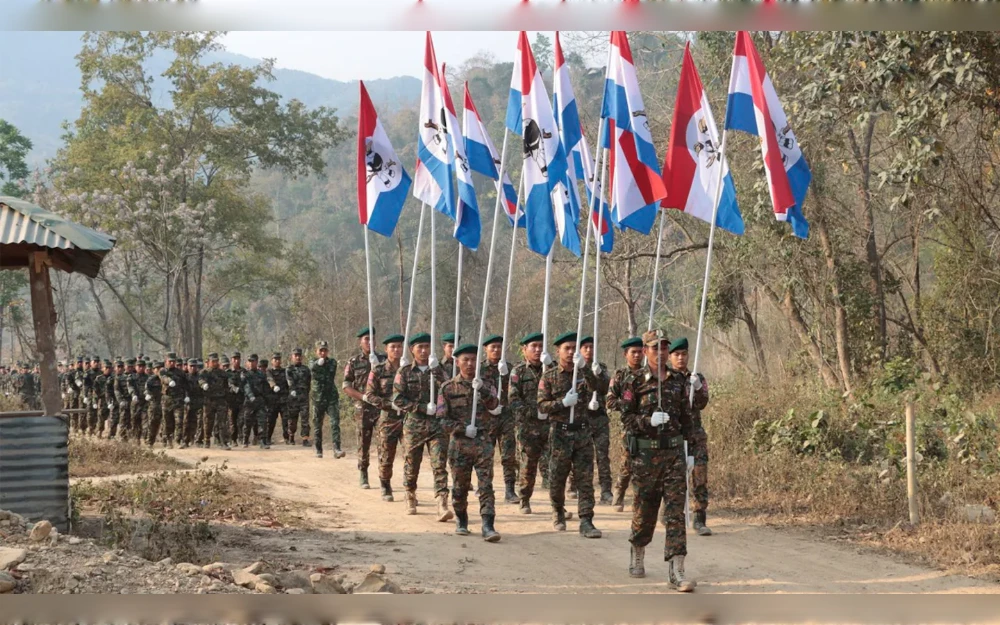
Salai Htet Ni, spokesperson for the Chin National Front, an armed ethnic rebel group, said the U.S. government needs to understand the underlying problems in Myanmar politics and get deeply involved.
“The U.S. government needs to understand the military junta’s unjust violence and killing of the people. They need to consider that. On our part, if they can perform first-stage actions like humanitarian aid for war refugees and addressing violent attacks and killings, we would welcome the U.S. involvement even more.”
Another ethnic armed group, — the Karen National Union — said U.S. involvement might reduce the amount of internal fighting, spokesperson Saw Kler Say told RFA on Wednesday.
“The new U.S. strategy could bring about changes or have a specific impact on our country from a military perspective. Firstly, it might lead to a situation where the military junta is compelled to stop its attacks targeting the civilian population.
Secondly, the U.S. might take steps — or offer recommendations — aimed at halting the ongoing internal conflicts. Politically, we also believe they are likely envisioning a political landscape that is acceptable to all parties—one that would include both the detained opposition leaders and the revolutionary forces.
To achieve sustainable peace in Myanmar by 2030, the first step must be to cease attacks targeting the civilian population. The next step involves reaching a consensus on a dialogue process aimed at ending internal conflicts; only through such a mutually agreed-upon framework can a ceasefire be attained.
In addition to these measures, all detained opposition leaders and political prisoners must be released. Without these actions, I believe that any dialogue will be extremely difficult. If detained political prisoners are excluded, meaning the process fails to be truly all inclusive, then a successful outcome may well be entirely impossible.
Regarding the emergence of a federal democracy in Myanmar, the new U.S. strategy presents both positive opportunities and concerning risks. On one hand, it could potentially lead to a genuine transition toward a federal democracy—for instance, by facilitating the abolition of the 2008 Constitution and the drafting and adoption of a new federal constitution. On the other hand, there is a risk that if the discourse is driven solely by U.S. interests, the path toward the federal democracy we envision could be diverted, creating significant challenges.”
Representatives of the Kachin Independence Army and the Arakan Army responded that they were not ready to comment.
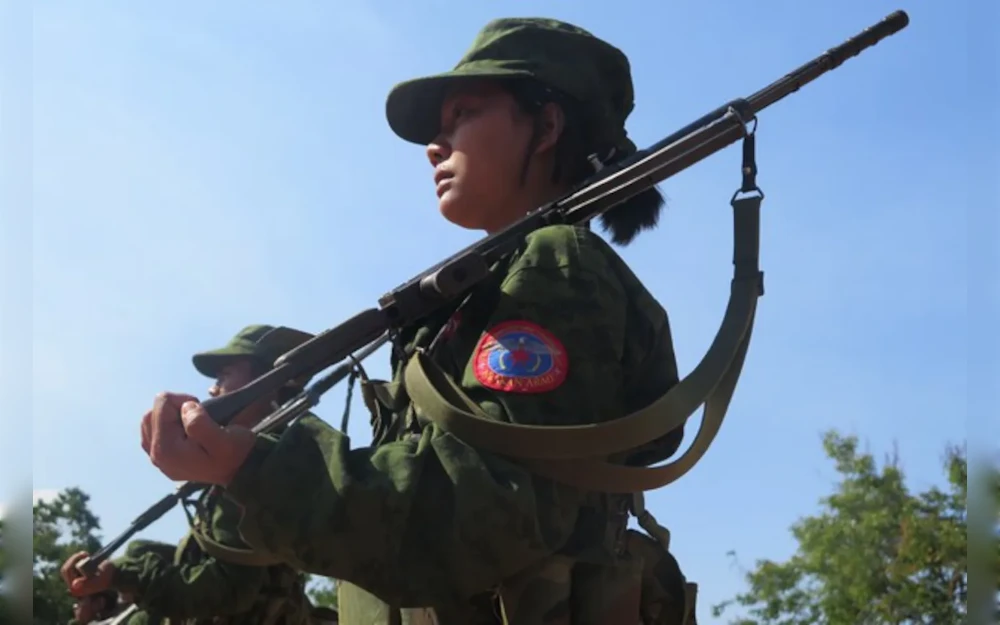
The Arakan Army’s Khaing Thukha asked that questions be channeled through official emails.
Hla Thein, spokesperson for the Union Solidarity and Development Party – formed by former military officers – told RFA that the U.S. strategy document is constructive for mutual interest and should be welcomed.
“Big nations becoming interested in our country, interested from a positive and beneficial perspective, should be welcomed no matter what. We have no permanent friends and no permanent enemies. If they come to cooperate fairly for our country’s interest, our people’s interest, and national interest, we will warmly welcome them.”
RFA attempted to contact Khaing Khaing Soe, spokesperson for the military government’s presidential office, but received no reply.
Col. Saw Kyaw Nyunt, spokesperson for the 7 EAO Alliance of ethnic armed organizations that have individually signed a Nationwide Ceasefire Agreement with the military, said the shift in U.S. attitude might be due to an understanding of Myanmar’s needs.
“In attempting to restart the peace process, international support and assistance are needed. The shift in attitude by the U.S. toward the peace process is likely because they realized that peace is urgently needed due to Myanmar’s reality. By 2030, which is in three or four years, seeking ways to build sustainable peace during that period can be viewed as assessing and speaking on our country’s needs.”
Salai Shein Tun, a secretariat member of the Chin National League for Democracy Party, which won a single seat in Myanmar’s parliament in the 2020 general election, told RFA that the new U.S. policy might face challenges from competitors.
“Speaking of challenges, the challenge from China as a big power is strong. Inside Myanmar and within ethnic regions, the challenge is also strong. In areas bordering neighboring China, they approach with a Chinese style model, whereas looking at the western side, in Chin, Kachin, and Rakhine states, they emphasize federalism. The country they connect with is India … Areas connected with neighboring China do not talk about federalism. Discussions will take quite a bit of effort when those following the Chinese model want to negotiate with the domestic groups that follow the federal model.”
According to the Integrated Country Strategy document, the released text was approved by the Trump administration on Aug. 31, 2026, before the mid-September secret visit to Naypyidaw by Michael Vance, the assistant secretary of state for intelligence and research.
Vance also led at least 12 U.S. government officials during a second round of talks with Myanmar military government officials in Tokyo in the second week of October.
Edited by Eugene Whong.
“Copyright © 1998-2023, RFA.
Used with the permission of Radio Free Asia,
2025 M St. NW, Suite 300, Washington, D.C. 20036.
https://www.rfa.org.”