



Mahbub Leelen and Kate Beddall/Benar News
Washington
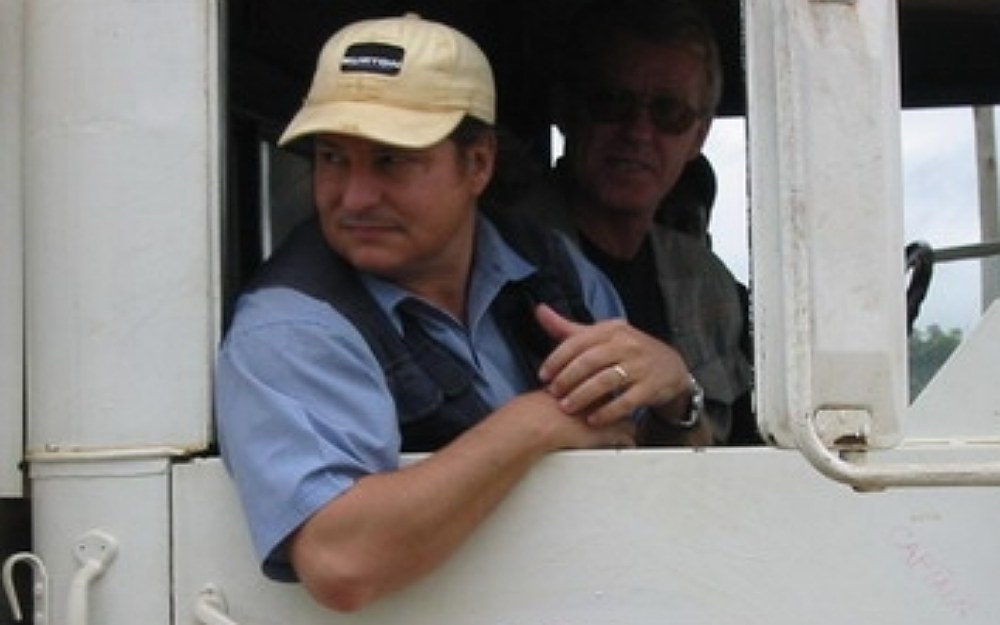
The largest refugee settlement in the world is a “vibrant” place where the lives of Rohingya Muslims are “in some ways better” than they were in Myanmar, the World Food Program’s representative in Bangladesh told BenarNews in a recent interview.
Richard Ragan heads an operation that supplies all food delivered to Rohingya refugees in southeastern Bangladesh, spending about $11 million per month on the effort.
WFP fed 878,032 Rohingya refugees in Bangladesh in January, according to its most recent country brief. It also pays thousands of refugees daily to provide services in what Ragan described as “one of the most sophisticated camp structures I’ve ever seen.”
“It’s very vibrant. It’s alive,” Ragan said of Kutupalong Refugee Camp.
“Rohingya will tell you, for the first time in their life, they feel free, they are able to worship, they are able to move … the situations that brought them there are clearly not good, but the end state of it is, their life in some ways is better,” he said.
Ragan, who lives in Dhaka, was in Washington last week to discuss budgeting, policy and programming with officials in the United States, the biggest donor to the WFP and Bangladesh for the Rohingya operation.
The United Nations last week launched an appeal for more than $800 million this year to support some 855,000 Rohingya refugees and 444,000 Bangladeshis in host communities in southeastern Bangladesh.
On March 3, Washington donated $59 million, bringing its total humanitarian assistance to Rohingya refugees and related communities in Bangladesh to almost $820 million since August 2017, when an outbreak of violence by Myanmar security forces sent around 800,000 fleeing across the border, the State Department said.
In his March 4 interview with BenarNews, Ragan provided a close look at how that money is spent, and an unusually positive depiction of life in the refugee camps.
BenarNews: What are the top concerns of WFP Bangladesh?
Richard Ragan: My top concerns are trying to get people to go back home … to try to work to create conditions on the other side of the border which will attract people to return home …
We take care of a quarter million people on the Rakhine side as well, we are one of the biggest humanitarian actors on the other side of the border, so we have a good sense of what’s happening in Myanmar as well as what I see in Bangladesh.
BN: What is your assessment?
RR: Conditions aren’t ripe for people to return. There’s been an uptick in violence over the last couple of months … people don’t see the stability that they need to make decisions to go home.
The Rohingya crisis has been with Bangladesh since its independence, it’s not a new crisis. … There’s been a consistent effort on the Myanmar side to push people out. And there remain 600,000 Rohingya still, on the other side of the border, which we are obviously concerned about – their welfare, the security issues they face, the potential that they might be pushed out to Bangladesh in the future.
BN: How do you feed the Rohingya in Bangladesh?
RR: If you look back at big refugee crises of 20 years ago, you provided [on site] handouts of grain, pulses, oil … [in a] crisis-like environment, with big queues of people lining up.
What we are doing in Bangladesh is different. … We have, basically, stores where we give Rohingyas a digital entitlement of the equivalent to $7 per person … per month. Then they can go to shops and they can purchase one of 19 different food items; fresh vegetables, fish, eggs, things that you normally wouldn’t see in a traditional refugee environment.
The other benefit about this is, these are Bangladeshi business people that are managing the supply chain. We have contracts with businesses based locally in the Cox’s Bazar area and some of the other contractors are in Chittagong and from Dhaka. They are providing the commodities.
We are transacting roughly the equivalent of $6 million per month through these stores, so it’s a big business opportunity for people who are involved in this.
BN: All of this food is being produced by Bangladeshi farmers?
RR: Yes.
BN: Do you have a plan for food production inside the camps?
RR: The [Bangladesh] government has restricted work and employment, because there is desire to not hurt the competitive market for the host community, so officially, jobs aren’t allowed.
But you have to manage the camps. This is a city of a million people, basically … you have to have all the different structures in place to manage the city, which means drainage of the roads, cleaning out the toilets, slope stabilization of land…
So the way we have done that is, rather than call them employees, they are volunteers. They get a volunteer stipend ….
In WFP, we probably have around 10 to 12 thousand volunteers doing labor for us on a daily basis, so we manage a pretty big work force … both men and women.
Rohingya will tell you, for the first time in their life they feel free, they are able to worship, they are able to move, they are able to go into these stores and shop, which is something that they weren’t allowed to do in Rakhine. So, they’re stateless, pushed out of their home, and suffered genocide. The situations that brought them there are clearly not good, but the end state of it is, their life in some ways is better.
There isn’t a Rohingya that you speak to who doesn’t want to go home. I think if given the choice of saying, stay in the camp and go to the e-voucher shop versus go home, they are going to all say ‘I want to go home.’ But those conditions don’t exist yet. So you do the best with what you’ve got.
BN: What is your opinion about relocating Rohingya to Bhasan Char Island?
RR: It is going to be more expensive, because anytime you divide the population, you put a population on an island, for us to manage it, it’s going to be more costly.
BN: Are you seeing hunger in communities around the refugee camps?
RR: Yes.
BN: What are the impacts of the Rohingya presence on the host community?
RR: It’s crowded. There’s a whole lot of new people, the size of two districts [where the camps are located] quadrupled. It’s in an environment that has always been under-developed, under-invested in. … I view it really as an opportunity in a lot of ways, because there’s a lot of investment being made into these two districts’ infrastructure, a lot more attention being made on some of the longer-term development challenges.
BN: With all these things in place, isn’t it a disincentive for repatriation?
RR: You know, the pull to go to your place of origin is strong and there’s still 600,000 people on the other side of the border. This has been historically where these people are from. I think they’d go back if the conditions were safe enough, and they were given the kind of liberties to live the kind of life that they would want to live.
BN: In your assessment, when will they be going back?
RR: I don’t see a lot of daylight at this point.
One of the things that’s really important is to hold Myanmar accountable. We, the international community, can’t let people forget what happened. … There’s nobody in these camps that doesn’t have a story of something terrible happening to them.
Ashif Entaz Rabi contributed to this report.
Copyright ©2015,BenarNews. Used with the permission of BenarNews https://www.benarnews.org/english

While Being Arrested in Connecticut, Suspect Bites Police Dog


Retrieval-Augmented Generation (RAG)
Bridges to China, Russia Preparing to Open as North Korea Deepens Ties with Both
Minister for Foreign Affairs of Togo Briefs Press on “Correct the Map” Resolution

From Rocksprings to Kerrville,Texas, Newborn Kitten Stuck in Engine Rescued

French Bulldog

Emergent Behavior
Subscribe Our You Tube Channel

Fighting Fake News
Fighting Lies