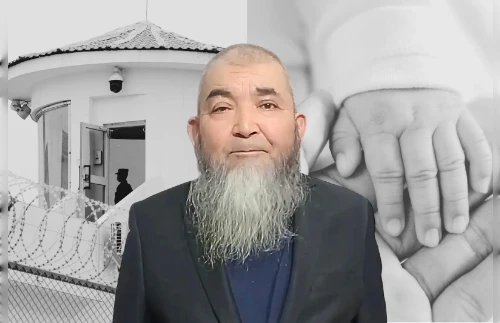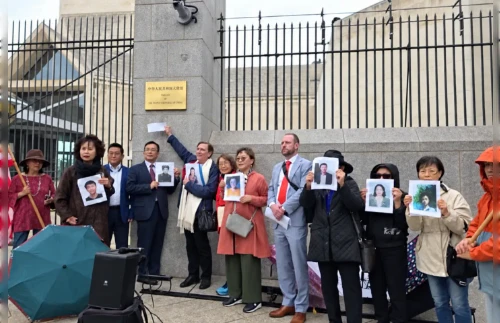




Abduhelil Hashim was healthy and had recently spoken with his wife, leading some to suspect foul play.

A jailed Uyghur businessman has been confirmed to have died in a prison hospital in northwest China’s Xinjiang Uyghur Autonomous Region (XUAR), according to his nephew, leading to speculation that his death may have been the result of torture while in detention.
Last year, RFA’s Uyghur Service learned that Abduhelil Hashim, a 59-year-old businessman from the county-level city of Ghulja (in Chinese, Yining) in the XUAR’s Ili Kazakh (Yili Hasake) Autonomous Prefecture, had been detained and subsequently sent to Qara Bughra Prison in the prefecture’s Kunes (Xinyuan) county for “religious extremism.”
The charges stemmed from Hashim having received religious education from a neighbor 40 years prior, when he was still a minor – enough to be considered a potential extremist under China’s tough policies on Uyghurs and their faith.
Last week, Hashim’s Kazakhstan-based nephew Abduwahab Hakim told RFA that he received news of his uncle’s death on social media, but hadn’t heard anything about him from relatives in Ghulja for days.
According to Hakim, he received a message from his relatives confirming Hashim’s death on May 2 after he sent them a video of a nezir, or wake, he held in his home in Kazakhstan after learning of the situation.
“I sent a video message of [a nezir] I’d had with relatives who came by. I showed them what we’d had to eat, told them that relatives had come to visit. Then they confirmed the death by saying, ‘May your heart and soul find peace and comfort,’” Hakim said.
“My father [Hashim’s brother] is here [in Kazakhstan]. They said, ‘Your father should take care of himself. He shouldn’t stress himself out. This is how fate goes.’”
According to Hakim, while his family members in Ghulja confirmed his uncle’s death, they did not provide any further details about what had caused it or whether Hashim’s body had been returned to them.
Hakim told RFA that the same social media post he had learned about Hashim’s death from also said that just two days before he died, on April 30, his uncle and aunt had been able to “meet” one another in a video conference, and that he had appeared to be in good health and spirits. He said that according to the post, Hashim’s body had yet to be returned to the family.
“Normally they got to once a month,” he said. “There was nothing wrong … He was very healthy. His health was good.”
“According to what I’ve heard from another very clear message, [the authorities] haven’t given [my family] the body.”
Hakim said that the mysterious circumstances surrounding his uncle’s fate led him to believe that he may have died as the result of torture or other mistreatment while in prison.
Death confirmed
RFA inquired about Hashim’s death at several relevant offices in Ghulja, including at police stations and Qara Bughra Prison, but staffers largely refused to answer questions.
However, RFA also called a prison in an industrial zone in Kunes county’s Beshtopa district colloquially known as “Yengi Turme,” or new prison, and spoke with a staff member who confirmed that Hashim had died in a prison hospital.
“He got sick and died,” the staffer said, when asked which hospital Hashim was being treated in.
On response to a question about whether Hashim had died as the result of torture, the staffer said it was unclear.
“One person says one thing, another person says another. There is some speculation about it,” he said.
A second employee at the prison told RFA that Hashim had died in the Yengi Turme hospital, but acknowledged that he was not there at the time and was unsure of the details.
“Even though we know about this, we don’t necessarily know things like where the person was from or what they’d done,” he said, adding that “the cadres of the prison’s political unit know about it.”
“Others who were working [on his case] know, but because I was on guard duty [at the time], I don’t know. I can’t give you an answer.”
In addition to imprisoning Uyghurs and other Muslim minorities for perceived “religious extremism” in the XUAR, authorities are believed to have detained up to 1.8 million people in a vast network of internment camps in the region as part of a campaign of mass extralegal incarceration launched in early 2017.
Mass detentions
While Beijing initially denied the existence of the camps, China in 2019 changed tack and began describing the facilities as “boarding schools” that provide vocational training for Uyghurs, discourage radicalization, and help protect the country from terrorism.
But reporting by RFA and other media outlets indicate that those in the camps are detained against their will and subjected to political indoctrination, routinely face rough treatment at the hands of their overseers and endure poor diets and unhygienic conditions in the often-overcrowded facilities. Former detainees have also described being subjected to torture, rape, sterilization, and other abuses while in custody.
Amid increasing scrutiny of China’s policies in the XUAR, the U.S. government in January designated abuses in the region part of a campaign of genocide—a label that was similarly applied by the parliaments of Canada, The Netherlands, and the U.K.
On Wednesday, during the release of the U.S. Department of State’s 2020 International Religious Freedom Report, Secretary of State Antony Blinken highlighted China’s ongoing abuses in the XUAR, saying it “broadly criminalizes religious expression and continues to commit crimes against humanity and genocide against Muslim Uyghurs and members of other religious and ethnic minority groups.”
Reported by Shohret Hoshur for RFA’s Uyghur Service. Translated by the Uyghur Service. Written in English by Joshua Lipes.
Copyright © 1998-2020, RFA. Used with the permission of Radio Free Asia, 2025 M St. NW, Suite 300, Washington DC 20036. https://www.rfa.org
Scottish Deerhound Dog Breed

AI-Powered Mortgage Fraud

Exclusive: North Korean Army Video Says K-Drama Watchers Deserve to be Executed

Press Briefing by Special Rapporteur on Sale and Sexual Exploitation of Children
Opossum Hanging on Fishing Hook Saved from Tree in North Carolina
Cane Corso Dog Breed

Buy Now Pay Later Fraud