



Frud Bezhan
RFE/RL
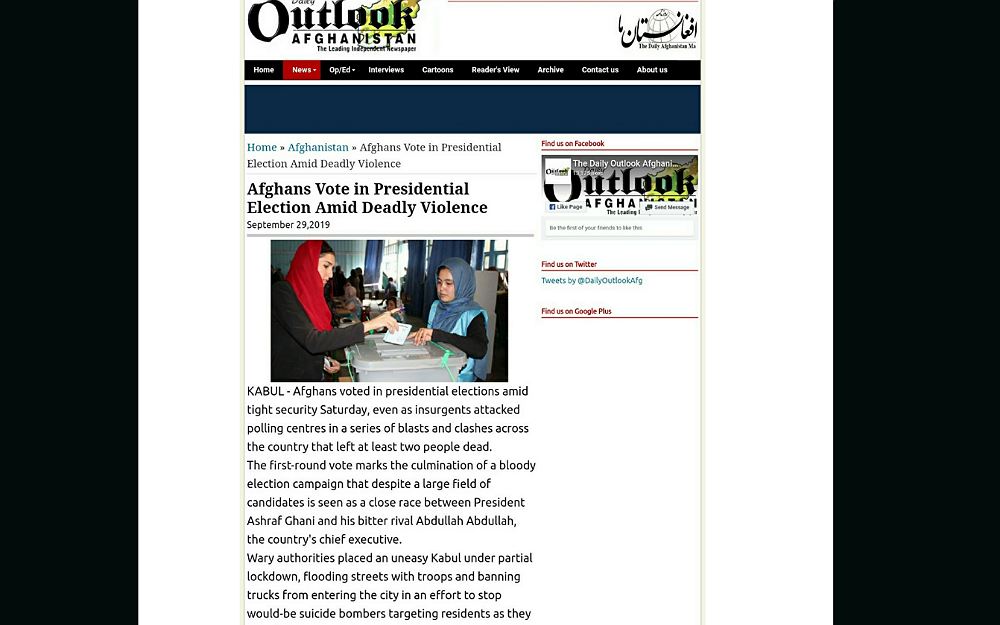
Afghans have voted in an election that was twice-delayed and widely expected to be scrapped until just weeks before the vote.
Voters braved security threats and concerns over widespread fraud to cast their ballots in the fourth presidential vote since the U.S.-led invasion in 2001.
But the September 28 vote was tainted by new and old issues, although the process appeared smoother than in previous polls.
Here are five key takeaways.
Likely Poor Turnout
Many observers reported low turnouts across Afghanistan, which could call into question the inclusiveness and legitimacy of the election.
Ahead of the vote, many predicted a record-low turnout due to fear of Taliban attacks and voter disillusionment at the widespread fraud and corruption that marred previous polls.
Even in the capital Kabul, turnout was sporadic and crowded polling stations were rare.
Afghanistan’s Independent Election Commission (IEC) was yet to provide turnout figures.
Ahmad Majidyar, an independent analyst, said on Twitter that the main reasons for the low turnout were the Taliban’s threats to attack the process, the violence on election day, and voters losing confidence in the process.
Another key reason, he said, was that many candidates did not “campaign with vigor this time to mobilize voters” because of doubts the election would even be held due to U.S.-Taliban peace talks that ended abruptly on September 7.
The Transparent Election Foundation of Afghanistan (TEFA), a Kabul-based civic-action body that monitors elections, said turnout was “very poor,” attributing it to the lack of female voters in 12 of the country’s 34 provinces.
TEFA said the requirement for voters to be photographed, which some women in the religiously conservative country are often reluctant to do, affected female participation.
Afghanistan’s Independent Human Rights Commission (AIHRC), which had dozens of observers at polling stations, also reported low turnout, especially among female voters.
The commission did report high female turnout in the central provinces of Bamiyan and Daikundi, the western province of Herat, and the southern province of Helmand, a Taliban stronghold.
Problems With The Biometric System
Voters reported that the voting process was better organized than October’s chaotic parliamentary elections.
But many still reported technical and organizational issues, including the absence of their names on voter lists and problems with the biometric voter-identification system used to prevent fraud.
In some provinces, this led people to visit several polling stations in the hope of casting their ballots.
The AIHRC said one of the major issues with the election was “the failure of the biometric system.”
It said election staff were unfamiliar with the system and had difficulties using it. In some provinces, it said, the devices arrived late, causing delays.
“At some polling stations the voting process has started late, and the biometric system still has problems, but if we compare it with the previous elections, there are less problems, and every polling station doesn’t have these problems,” said Yusef Rashid, the head of the Free and Fair Election Forum of Afghanistan (FEFA), an independent Afghan election observer group.
Addressing those concerns, the IEC eased restrictions, allowing anyone with election stickers on their national identity cards to vote.
It was the second time Afghans voted using the biometric voter verification, a system that caused chaos during the 2018 parliamentary elections when devices malfunctioned, went missing, or were not used by untrained electoral staff.
Improved Security
The election was marred by numerous small-scale Taliban attacks, but three people were confirmed dead, a significantly lower death toll than previous elections.
In response to a spate of Taliban attacks in recent weeks, the government bolstered security by deploying around 72,000 security personnel to secure polling centers across the country.
More than 2,000 out of 7,000 polling stations were closed due to the threat of militant attacks.
In the past, the Taliban has bombed polling centers and targeted voters, and in recent weeks has warned of more bloodshed if the election takes place.
An explosion at a polling station in a mosque in the southern city of Kandahar wounded 16 people.
In the northern province of Faryab, Afghan security forces clashed with Taliban fighters in six districts, preventing people from voting.
The Taliban said their fighters attacked polling stations in the eastern province of Laghman. Afghan officials said there were four explosions in the eastern city of Jalalabad, in which one person was killed, disrupting voting at some stations.
Small blasts also hit Kabul, Ghazni, and Kunduz, officials said.
Taliban Disrupting Telecommunications
The Taliban has targeted telecommunication towers in parts of Afghanistan, blowing them up and disrupting mobile-phone services in districts and even some cities.
The disruptions not only affected voters but also the IEC on election day.
The IEC said it had no contact with 901 of the 4,942 polling stations across the country. Many of those polling stations were in the northern provinces of Badakhshan, Takhar, Kunduz, and Baghlan.
It was not clear whether voting had taken place in these 901 centers, or if they were forced to shut down by the Taliban.
The IEC said it did not know the operational status of the polling centers.
Private telecommunication companies have been under intense pressure, sometimes facing attacks, to shut down their towers. The Taliban has accused several companies of serving as intelligence hubs for the government and foreign forces.
Acts Of Defiance
In the past, the Taliban has bombed polling stations and cut off the index fingers of voters, who must dip their finger in blue ink once they vote.
The Taliban cut off Safiullah Safi’s right index finger for voting in the 2014 presidential election. That did not stop the businessman from casting his ballot again.
A photo of the 38-year-old was posted and widely shared on social media, showing his missing right index finger and the left one stained with indelible ink, indicating he had voted.
“When it comes to the future of my children and country I will not sit back even if they cut off my whole hand,” he said.
Safi’s act of defiance resonated with many Afghans who risked life and limb to vote in the election.f
Copyright (c) 2019. RFE/RL, Inc. Reprinted with the permission of Radio Free Europe/Radio Liberty, 1201 Connecticut Ave NW, Ste 400, Washington DC 20036
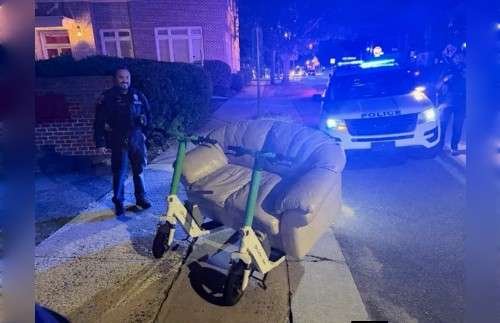
North Carolina Police Encountered Two Men Travelling Down Couch Mounted on E-Scooter
Scottish Deerhound Dog Breed

AI-Powered Mortgage Fraud

Exclusive: North Korean Army Video Says K-Drama Watchers Deserve to be Executed

Press Briefing by Special Rapporteur on Sale and Sexual Exploitation of Children
Opossum Hanging on Fishing Hook Saved from Tree in North Carolina
Cane Corso Dog Breed