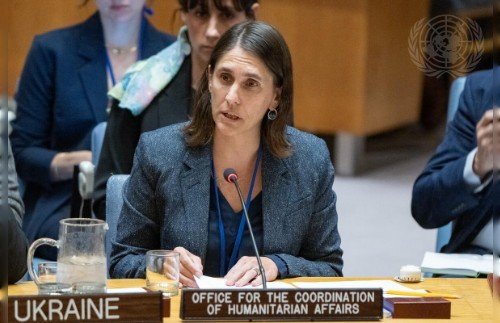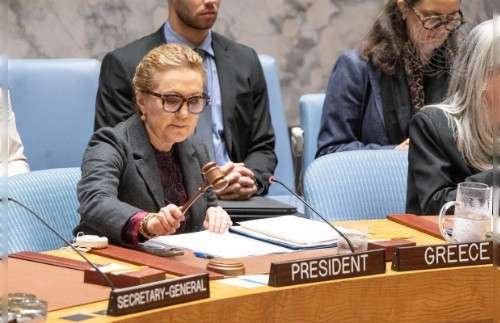




A young Syrian refugee who lives with cerebral palsy and uses a wheelchair told U.N. diplomats Wednesday that people like her are “invisible” in conflicts and said their needs must not be overlooked.

“While living in a country at war is daunting for anyone, it is particularly challenging for someone with a disability,” Nujeen Mustafa, 20, from Kobani in Aleppo, told the Security Council. It is the first time that the council has been briefed by a person with a disability on this issue.
She said life in Syria before the war began in 2011 was not easy for persons with disabilities.
“For me, it meant not being able to go to school, hang out with friends or go to the cinema. It was almost like house arrest,” Mustafa said in perfect English. “Having a disability in Syria often means that you are hidden away. You confront shame, discrimination and physical barriers. You are someone who is pitied.” She said she was lucky because she had a loving and supportive family.
Feared for family
But then the regime of Bashar al-Assad began a brutal crackdown on anti-government protesters and soon the country was mired in a civil war that has seen 6.2 million Syrians displaced inside the country and 5.6 million flee to other countries, and life changed.
“I quickly realized that I was the main obstacle standing in the way of my family’s safety,” Mustafa said. “Every day, I feared that I could be the reason my family was one or two seconds too late. My brother called us ‘the walking dead.’
” She said for other disabled Syrians, living in a war zone is both challenging and frightening. While they may have learned to cope in normal circumstances, conflict conditions present new and frightening challenges.
“A blind person may know how to manage in her own environment, but can you imagine what it must be like to navigate the rubble and debris strewn across their path to safety?” she asked.
In January 2014, her family decided to seek safety outside Syria, crossing the border into southeastern Turkey and renting an apartment in Gaziantep. Mustafa did not have a wheelchair in Syria and had to be carried to safety. She received one in Turkey.
As the situation continued to worsen back home, Mustafa, then 16, and her sister decided to undertake the dangerous journey to Europe. Their parents remained in Gaziantep.
Over the next month, the two girls traveled 5,600 kilometers, crossing eight borders by plane, bus, train, foot and a rubber boat with a group of about 30 other Syrian refugees.
“I had to roll on a very difficult terrain that is not at all suitable for a wheelchair,” she said. “I had to sleep in the wilderness with no blankets. I spent days eating just Nutella and sugar, which is not as fun as it sounds. I almost drowned in a dinghy.”
Disabled refugees, women at risk
She told diplomats that the risks are even greater for disabled refugees and women.
On Sept. 21, 2015, they arrived at a small border town south of Munich.
“One of the happiest moments of my life was just seeing the sign saying we had arrived in Germany,” she said.
“But this is not just my story, it is the experience of thousands of Syrians with disabilities who struggle to survive because of the limited to no basic services still functioning in the country, lack of accessibility, and the constant threat of violence, especially against women and girls,” she told council members.
Mustafa said the council must do more to include the needs of the disabled in all aspects of their work, including specific programs designed to reach disabled individuals with health services, assistive devices and psychosocial support.
“I understand that there are many competing priorities in this conflict and the humanitarian response, but you need to address the needs of people with disabilities, particularly women,” she said, “This is not a favor. This is not charity. This is our rights.”
Mustafa’s appearance at the council nearly did not happen.
Human Rights Watch, which helped arrange her visit with council president Germany, said that she was rejected twice by the U.S. government for a visa to come to New York. It was only after appeals were made and efforts exerted by the U.S. Mission to the United Nations that she received her visa.
Mustafa has lived in Germany now for 3½ years and speaks the language well. She is a student and has written a book about her experiences- VOA