




An analysis by Michael Lelyveld
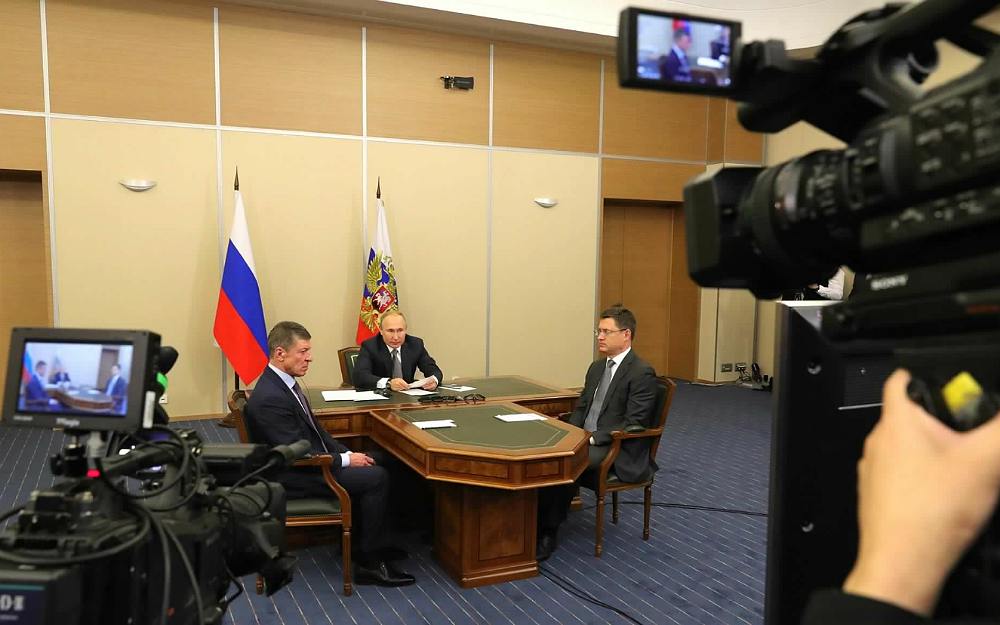
While China’s economy struggles to recover from the coronavirus epidemic, the Russian energy sector is anxiously awaiting the results.
The consequences of the crisis are piling up for China’s second-largest oil supplier with both direct and indirect effects on Russia’s stagnant economy.
Russia is directly affected by the sudden slump in demand from the world’s leading oil buyer. China has been Russia’s largest trading partner with an estimated U.S. $110 billion (773 billion yuan) in bilateral business last year.
In 2019, China imported 77.64 million metric tons (1.56 million barrels per day) of oil from Russia. The volume accounted for 31 percent of Russia’s crude exports outside the Commonwealth of Independent States (CIS), according to Chinese customs and Russian dispatch figures.
Earlier this month, the Financial Times reported that Chinese oil executives expected that demand in February would plunge by 3.2 million barrels per day, nearly 25 percent, due to the epidemic shutdown.
The impact is likely to fall heavily on Russia even if it keeps pumping at high volumes because of the indirect effect of the 25-percent slump in world prices and the country’s heavy reliance on revenues from oil and gas.
“The probability of the decline in oil export revenues is almost inevitable in the first quarter on the back of (the) spreading virus from China,” said Alexei Kudrin, chairman of Russia’s Accounts Chamber, on Twitter earlier this month.
On Feb. 13, the International Energy Agency (IEA) said it expected world oil demand in the first quarter would fall for the first time in over a decade.
The Paris-based IEA also cut this year’s forecast for demand growth by more than 30 percent to 825,000 barrels per day (bpd), the lowest since 2011.
The decline triggered discussions within the Organization of Petroleum Exporting Counties and cooperating producers, known as OPEC+, to consider lowering production by an additional 600,000 bpd.
But Russia has balked, fearing a further erosion of revenues and market share.
“A slowdown in the Chinese economy is fraught with a decrease in the consumption of energy resources, which is bad for prices on commodity markets and may slow down the formation of Russia’s reserves,” Sergey Suverov, senior analyst at BCS Premier bank, told the daily Nezavisimaya Gazeta.
Border shutdown
Russia has largely closed its 4,200-kilometer (2,609-mile) border with China and barred Chinese tourists with the emergence of two coronavirus cases in Siberia. The move drew thinly-veiled criticism of China’s closest ally from the Global Times.
The tourism ban will cost Russia U.S. $200 million (1.4 billion yuan) in the first quarter alone and “weigh on the two nations’ normal economic communication,” the Communist Party of China-affiliated paper said.
Russian analysts surveyed by the daily Izvestia estimated that the effects of the virus will reduce Russia’s gross domestic product by 0.1 to 0.3 percentage points from already sluggish growth forecasts of 1.75 to 1.9 percent this year.
On Feb. 22, the International Monetary Fund issued a revised forecast for global economic growth, based on the assumption that recovery would take place in the second quarter of the year.
“As a result, the impact on the world economy would be relatively minor and short-lived,” said IMF Managing Director Kristalina Georgieva, estimating a loss of just 0.1 percentage points.
The reduction in China’s growth rate this year would be larger, however, dropping to 5.6 percent from the previous estimate of 6 percent in January, Georgieva said, even assuming a speedy recovery.
The impact of China’s slowdown is likely to be felt in Russia’s gas industry, which has already been hurt by a relatively warm winter in Europe, high storage levels and U.S. sanctions that have stalled completion of the Nord Stream 2 pipeline from Russia to Germany.
The global gas glut was already well underway before the coronavirus added to the slide in Asian prices for liquefied natural gas (LNG) amid reports that Chinese importers have been trying to turn away contracted cargoes.
Energy analysts warned months ago that China had slowed its program for converting heating systems from coal to gas after two years of double-digit growth for the cleaner burning fuel.
Now at the end of the winter, some LNG cargoes have nowhere to go. On Feb. 13, Reuters reported that 15 LNG tankers have been turned into “floating storage,” citing data from Kpler, a commodity tracking firm.
“It’s hard to imagine that all those volumes will not pressure the market,” said Elena Burmistrova, director general of Gazprom Export.
Bad timing
At an investors meeting in London, Burmistrova said the Russian gas monopoly estimated that 20 million tons of LNG cargoes were “on the water,” according to Reuters.
The timing for Russia could hardly be worse.
After more than a decade of planning, negotiating and building a gas route to China, Russia opened its 3,000-kilometer (1,854-mile) Power of Siberia pipeline in early December, a little over a month before the coronavirus outbreak became known.
Now, Gazprom officials are said to be bracing for a declaration of force majeure, an internationally recognized legal exemption from contract commitments in case of unforeseen events.
China National Offshore Oil Corp, (CNOOC) has already invoked force majeure to turn away contracted LNG cargoes, Bloomberg News reported. China National Petroleum Corp.
(CNPC) and China Petroleum & Chemical Corp. (Sinopec) are considering similar moves, the Financial Times said.
Russia has invested some U.S. $55 billion (386 billion yuan) in the Power of Siberia project with planned deliveries of 5 billion cubic meters (bcm) to China this year, rising to 38 bcm by 2024. Those assumptions are now open to question.
On Feb. 5, a gas industry source told Interfax that Gazprom had not received a request from China to alter the delivery schedule “as of today.” But there are signs that plans for further expansion in China have already been derailed.
On Feb. 13, Gazprom said it had suspended talks on building a second line to China because of the coronavirus, Reuters reported. The company has been pursuing a second pipeline plan for the past 14 years with a western route through Xinjiang and, more recently, through Mongolia.
It is unclear whether the suspension means that Russia has abandoned its ambitions. But after failing for years to persuade China to fund the Power of Siberia project, it appears even less likely to attract Chinese financing now.
As China’s gas demand stalls, Gazprom appears to be depending on a “take-or-pay” provision of its contract with China. The clause calls for guaranteed payment on 85 percent of the contracted volume whether CNPC takes delivery or not, according to Interfax.
Force majeure
But even this protection could go by the boards if CNPC declares force majeure.
The developments suggest that Russia has relied too heavily both on China and petroleum revenues, said Edward Chow, senior fellow for energy and national security at the Center for Strategic and International Studies in Washington.
“This shows that oil and gas exports to China, in order to diversify from European markets, do not solve the Russian economy’s fundamental problem of over-reliance on cyclical commodities, particularly when they involve construction of expensive new infrastructure,” Chow said.
“It took 10 years for Russia to negotiate the gas deal with China. No doubt both sides were hoping for favorable market conditions by the time the pipeline was completed at the end of last year,” he said.
“Instead global prices are at historic lows with oversupply of gas and slowing demand even before the outbreak of the coronavirus, which will only exacerbate the situation.”
So far, Russia’s independent gas producer Novatek has voiced uncertainty but also longer-term confidence in China, which holds significant shares in its Arctic LNG projects.
“The coronavirus is the black swan event — unpredictable to forecast and difficult to gauge the extent and duration of this virus epidemic. Chinese demand has clearly been affected,” said Novatek CFO Mark Gyetvay, Platts energy news reported on Feb. 20.
“We can say with absolute certainty that this event will pass and we reiterate that China will remain the market of choice for many years,” Gyetvay said, adding that Novatek had not received any force majeure notifications from Chinese buyers “at this time.”
Copyright © 1998-2016, RFA. Used with the permission of Radio Free Asia, 2025 M St. NW, Suite 300, Washington DC 20036. https://www.rfa.org
Could ‘Apron Dad’ on North Korean TV Pave the Way for Kim Jong Un’s Daughter to Rule?
UN Security Council Meets on Maintenance of Peace and Security of Ukraine

Pet Iguana in Kansas Neighborhood Rescued from Tree

Curly Coated Retriever

Backpropagation
UN Security Council Meets on Sudan and South Sudan

From a Cardboard Box to an Iron Cage: a Father’s Fight for His Daughter’s Freedom

British Grower Set New World Record for the Title of Heaviest Pumpkin
Subscribe Our You Tube Channel

Fighting Fake News
Fighting Lies