Power shortages once darkened Sinuiju at night, but satellite images show a renewable energy boom is underway.
By Noh Jung Min for RFA
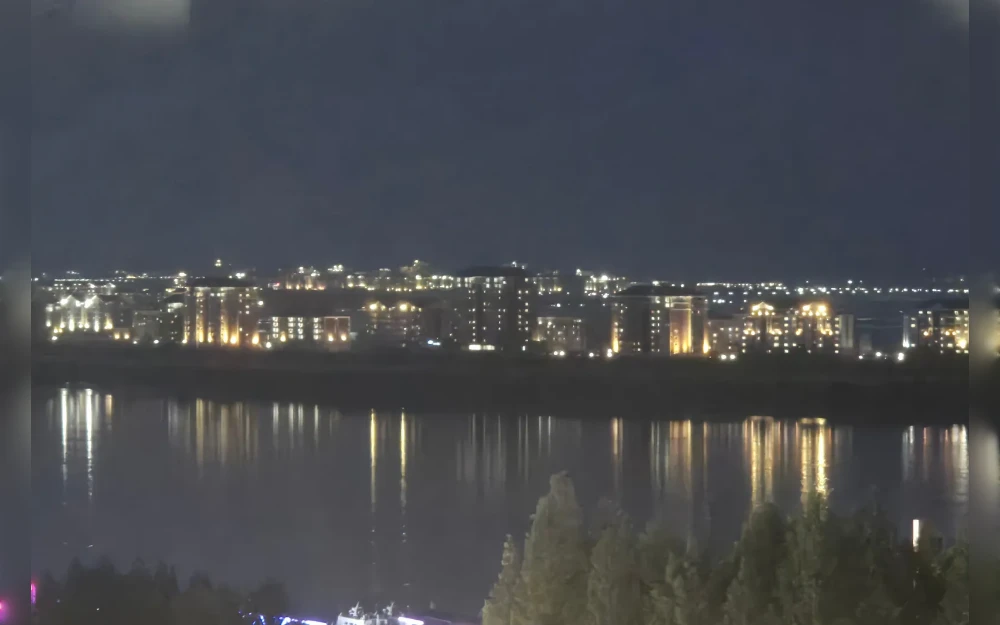
A North Korean city on the border with China is no longer completely dark at nighttime, satellite imagery and eyewitness accounts revealed. Experts told Radio Free Asia it is a sign that North Korea is turning to solar power to solve its chronic energy problems.
“As recently as about ten years ago, vehicle traffic would stop around midnight, and lights were barely visible,” Park Jongchol, a professor at Gyeongsang National University in South Korea, told RFA.
Park recently visited the Chinese city of Dandong, which lies across the Yalu River border from North Korea’s Sinuiju. The bridge connecting the two cities is the major gateway for overland trade between the two countries, and tourists often visit the Chinese side of the river to catch a glimpse of one of the most isolated societies in the world.
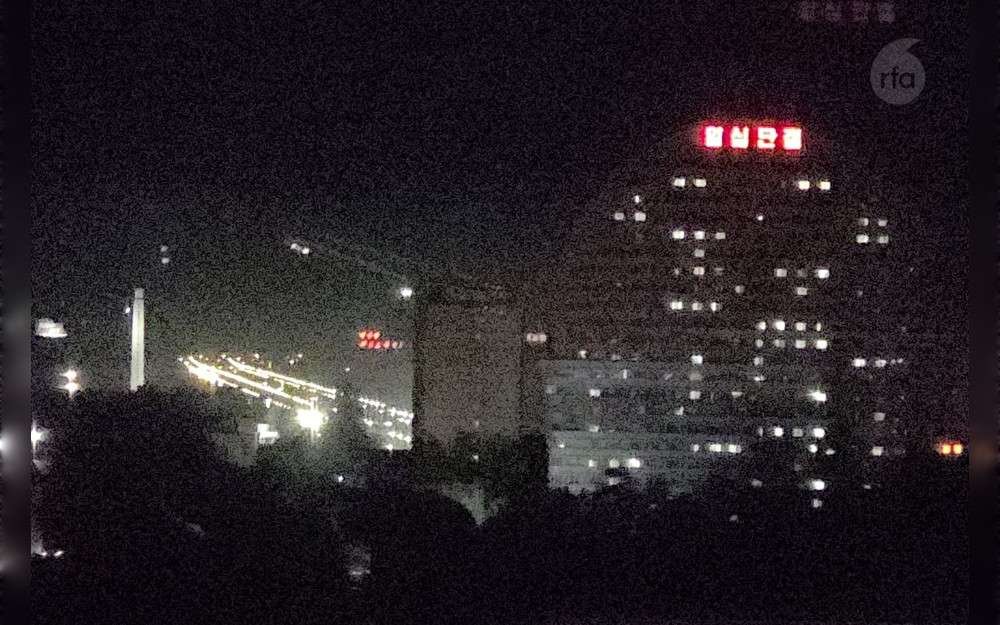
For decades, the two sides of the river sharply contrasted at nighttime. Dandong was awash with neon, and later LED signs, brightly lit streets, and apartment buildings with illuminated windows. But Sinuiju was completely dark, save for illuminated statues or portraits of North Korea’s leader Kim Jong Un’s father and grandfather, who were his predecessors.
Power shortages are so rampant in North Korea that in some places, the lights come on for only a few hours each day. Pyongyang was so embarrassed of the contrast with China, that in 2021, it ordered Sinuiju to be supplied with electricity until 10 p.m. to hide the severity of the country’s shortages. After 10 though, the city would virtually disappear to anyone looking across the river from Dandong.
“But now, Sinuiju is very noticeably bright — there are apartment buildings and factories with their lights on from night through morning,” said Park, who was in Dandong in early June, ahead of Chinese President Xi’s visit to North Korea.
Park said that during his three-day trip, he visited parts of Dandong that are across the river from rural villages far away from downtown Sinuiju, and even they were illuminated. He also described a noticeable increase in vehicle traffic at the border, with their headlights observable at night.
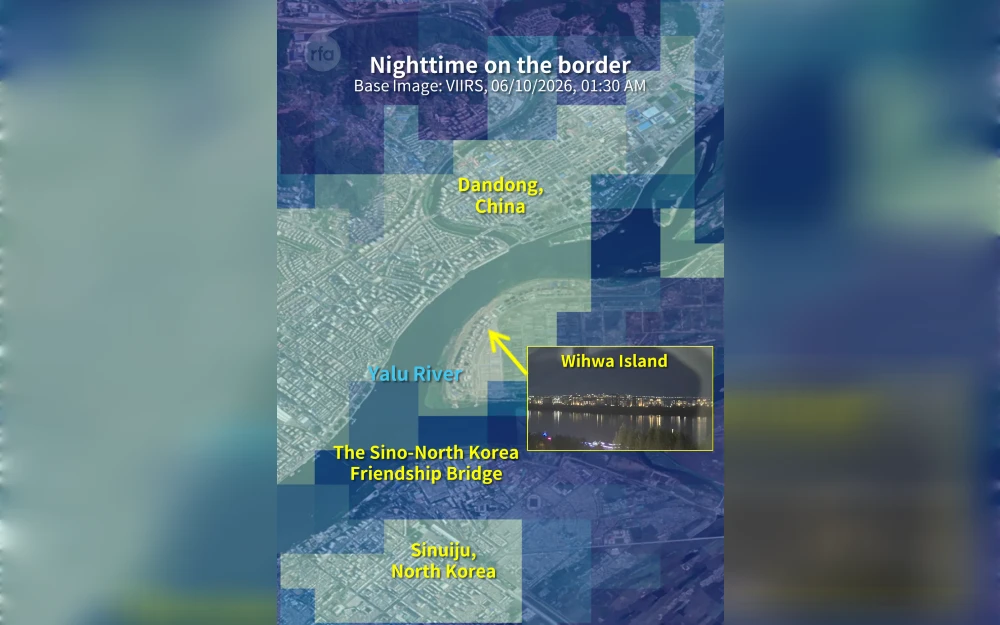
“Sinuiju has built North Korea’s largest solar power plant, and areas like Wihwa Island are now very bright at night,” he said, referring to a small island in the Yalu, upstream from the bustling downtown area.
Dramatic transformation
Nighttime satellite imagery captured at 1:30 a.m. on June 10 by the Suomi NPP satellite — jointly operated by NASA and the National Oceanic and Atmospheric Administration — also detected bright lights in Sinuiju, Bruce Songhak Chung, a senior researcher at the Seoul-based Korea Institute for Security Strategy, told RFA.
“Notably, the Sangdan-ri and Hadan-ri areas of Wihwa Island, which have traditionally been dark at night, were detected bright,” Chung said. “It appears the lights are being used at the Sinuiju Greenhouse Farm Complex to promote plant growth and increase crop yields during nighttime hours.”
Satellite imagery confirms the presence of the large solar and wind energy plant that Park referred to.
Construction of the plant began in 2019. It stretches 1,300 meters (4,300 feet) at present. Alongside the solar plant are small wind turbines. The combined capacity of the plant is 1,000 kilowatts according to North Korean state media. That is enough to power roughly 1,000 to 1,500 homes in the developed world at peak performance.
Solar boom
In the past, North Korean cities along the border relied heavily on hydropower, but aging infrastructure often failed to provide a stable electricity supply. Solar energy appears to be stepping in to solve this problem.
The newly installed solar panels are visible not only in Sinuiju but also in other cities, as well as in rural communities, mining areas and remote mountain villages along the border, Joung Eunlee, the director of the Seoul-based Korea Institute for National Unification, told RFA.
“Having traveled along the China-North Korea border for more than 15 years, I have observed a significant increase in solar panels installed on factories, office buildings, military facilities and customs offices in major border cities,” Joung said. “I have also noticed a growing number of apartment buildings equipped with outdoor air-conditioning units, which are imported from China either legally or illegally.”
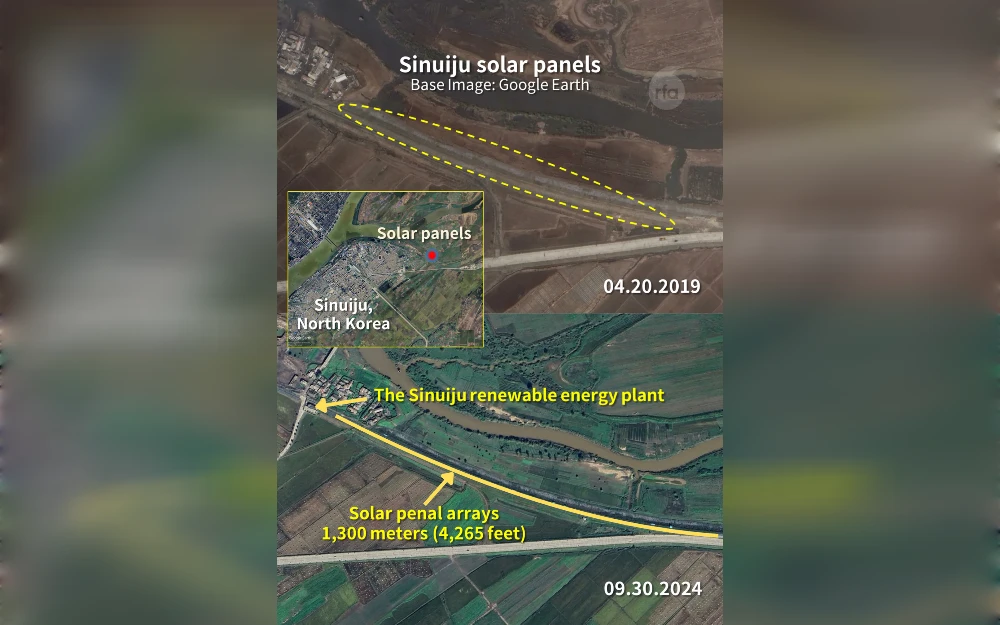
Satellite images also confirm a boom in solar installations that accelerated after 2018 and continued through the COVID-19 pandemic, particularly at factories and state-owned enterprises. Similarly, solar panels are appearing on hospitals, government offices, military facilities, cultural venues, hotels and restaurants in Pyongyang and other cities.
Renewable initiative
As North Korea seeks to modernize its economy and raise living standards, access to a more reliable electricity supply is becoming increasingly important.
To that end, the North Korean government promulgated its Renewable Energy Act in 2013 and has since incorporated renewable energy development into its 2016 and 2021 five-year national economic plans.
Several large-scale solar projects are currently under construction or have recently been completed across the country. North Korea’s state-run newspaper, the Rodong Sinmun, has continued highlighting the need to expand the use of renewable energy sources, including wind, tidal and solar power as recently as June 19.
Park said the trend towards renewables could point to a broader long-term shift in North Korea’s industrial structure.
Joung said the country is rapidly developing its renewable energy industry, and its close relationship with China is integral to the expansion.
China accounted for roughly 75% of global solar module production and has become the leading supplier of high-performance components and equipment at low cost. Over the past 15 years, the price of solar modules and installation has fallen by about 95%, while efficiency has continued to improve, she added.
But even as North Korea goes solar, the gains are uneven.
“Even though nighttime satellite imagery shows brighter lights in some border cities, including Sinuiju, many parts of North Korea remain in darkness because they still lack access to electricity,” Joung said. “It will also be important to watch whether the gap between regions continues to widen.”
Edited by Eugene Whong.
“Copyright © 1998-2023, RFA.
Used with the permission of Radio Free Asia,
2025 M St. NW, Suite 300, Washington, D.C. 20036.
https://www.rfa.org.”