A behavioral ecologist breaks down the importance of an adorable wildlife clip.
Jennifer Campbell-Smith
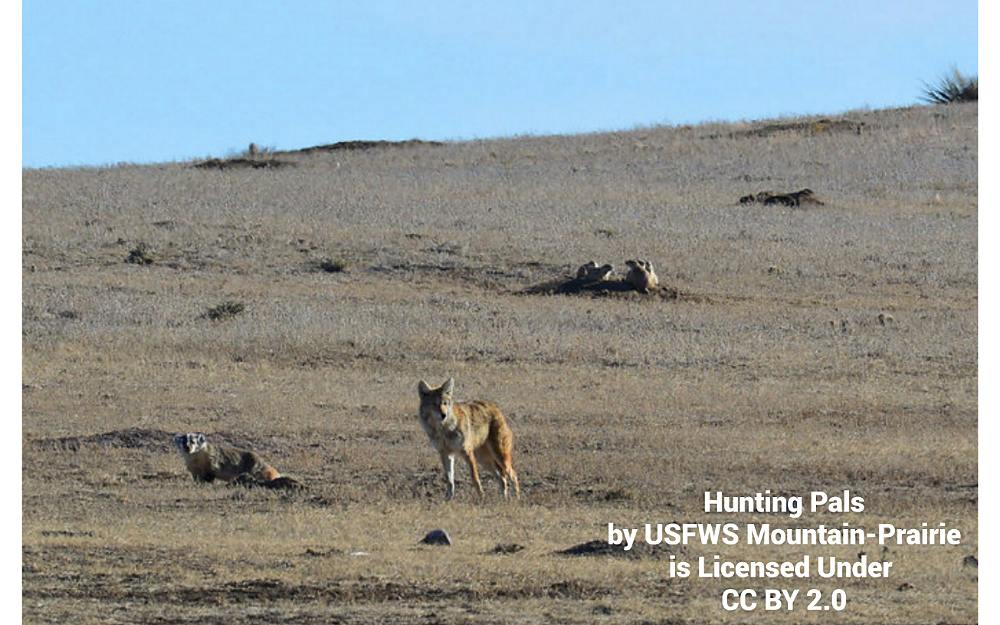
Somewhere in the Southern Santa Cruz Mountains of California, a coyote playfully bows to an American badger just before both duck into a culvert under a highway, the coyote casually trotting along with the badger waddling close behind. When the Peninsula Open Space Trust and Pathways For Wildlife shared a remote video of the crossing online in early February, it went viral. The video is part of a project to help wild animals move around safely in high-traffic, dangerous areas, something critical to maintaining populations’ genetic health. I greatly admire this work. However, what makes this particular crossing exceptional, to me, as a behavioral ecologist, are the deeper implications of the video itself.
The first thing that excites me is that it allows the charisma of this partnership to reach a broad audience. Scientists have observed coyotes and badgers working together before; one study even demonstrated that both species have an easier time catching prey when they hunt together. But the more the general public sees the playful, social side of two extremely persecuted carnivores, the better. I will never stop sharing videos of coyotes playing with dog toys or domestic animal companions, or scaling crab-apple trees for a snack.
The second thing that excites me is what the video means for animal research, management and behavioral ecology. There isn’t a consistent “natural rule” that coyotes and badgers get along; in fact, the two species sometimes kill and eat one another. This demonstrates the flexibility in natural processes. Humans (many scientists included) are often guilty of thinking animal behavior must follow hard and fast “rules”: Stimulus A elicits Behavior B, always. I see this a lot when people ask me about canine behavior or crow calls; a wagging tail doesn’t always indicate a happy dog, for instance, and certain crow calls mean very different things in different circumstances, much the way the intention behind a human’s use of the word “hey” varies with tone, inflection and context.
Experiments and “rules” that eliminate context often end up framing animal behavior and ecological associations as coded, robotic and inflexible. People tend to think of animal actions as simply instinct, denying the role of thinking, plasticity and decision-making in other creature’s lives.
Scientifically, we are finally emerging from a dark period of studying nature simply as a stimulus-and-instinct-driven movie that humans can observe — the kind of thinking used to justify government-funded culls and mass indiscriminate killing of native species. Recent research demonstrates the cognitive and cultural capabilities of non-human animals, as well as the importance of their proclivities and personalities, and more data keep piling up. Some individual animals, for example, have the right combination of bold, exploratory traits to do well in human-dominated landscapes, while more cautious ones may flourish in relatively rural and wild landscapes. In fact, researchers have observed population-level genetic changes in city-dwellers compared to their country cousins of the same species, in everything from coyotes to anoles and black widow spiders.
Different animals also hold different social statuses within an ecosystem. Much like what can happen within a human community, the death of a specific individual may have a large impact on social structure. I’ve watched whole regions of crows restructure their social dynamics and movements due to the death of a single key individual, and I’ve seen how age and experience shape individuals and the behavior they pass on to others. Wildlife managers must take all of this into account rather than relying on the traditional, numbers-only management style that treats all individuals of a species as if they have equal weight in an ecosystem.
In the viral video, I see an elegant demonstration of how complex and flexible nature is. How intelligent these two animals are — not simply two animal-robots reacting solely to stimuli. How the body language and ease between them suggests that they know each other as individuals, and that those individuals matter.
While it’s scientifically prudent to acknowledge only the data that exist in peer-reviewed studies, we humans must broaden our lens and see the metaphorical forest before we get lost in the trees. We must hold each other, management agencies and policymakers accountable for the broader picture that the evidence is highlighting and use it to better relate to the world we live in, and the organisms that exist alongside us.
The key struggle is getting these ideas into the zeitgeist of modern human culture, a mission that social media has greatly enhanced. So here I am, a behavioral ecologist who is grateful that a single 12-second viral video of a coyote and badger sauntering through a culvert together can help more people observe and consider what I and many in my scientific generation see: A thinking,complex, dynamic, individual nature that demands our respect and mindfulness as we move through this world.
Jennifer Campbell-Smith has a Ph.D. in behavioral ecology from Binghamton University. She currently resides in Denver, Colorado, where she is working to get high school students involved in urban wildlife research.
This Story was originally published by High Country News (hcn.org) on February 14 ,2020

Could ‘Apron Dad’ on North Korean TV Pave the Way for Kim Jong Un’s Daughter to Rule?

UN Security Council Meets on Maintenance of Peace and Security of Ukraine
Pet Iguana in Kansas Neighborhood Rescued from Tree
Curly Coated Retriever

Backpropagation

UN Security Council Meets on Sudan and South Sudan

From a Cardboard Box to an Iron Cage: a Father’s Fight for His Daughter’s Freedom
British Grower Set New World Record for the Title of Heaviest Pumpkin
Subscribe Our You Tube Channel

Fighting Fake News
Fighting Lies