



Police forcibly remove Zhanargul Zhumatai from her mother’s home in the regional capital Urumqi, activists say.
By Gu Ting and Hsia Hsiao-hwa for RFA Mandarin
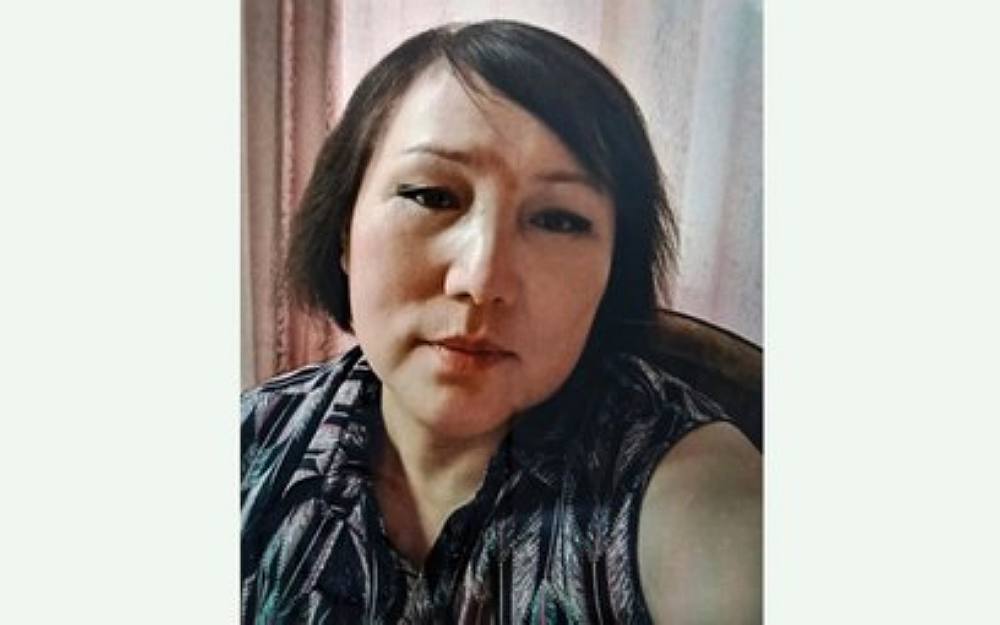
Authorities in Xinjiang’s regional capital Urumqi have detained an outspoken ethnic Kazakh musician, weeks after a Kazakhstan-based rights group warned that she was at risk of being hauled off to a psychiatric facility.
State security police in Urumqi’s Shayibak district took Zhanargul Zhumatai, 47, away from her mother’s house on Feb. 10, after she received a request for a “media interview” from someone claiming to be an Associated Press correspondent, according to the Kazahstan-based rights group Atajurt.
“State security police from the Shayibak branch of the Urumqi police department detained Zhanargul at 5.40 p.m. on Feb. 10,” Atajurt spokesperson Nurbek told Radio Free Asia. “She is gone.”
While Zhanargul’s whereabouts are currently unclear, critics of the ruling Chinese Communist Party have repeatedly reported being held in psychiatric facilities despite having no diagnosis of mental illness.
A few days before she was detained, Zhanargul made a recording of a phone call with local state security police, who wanted to arrange a time to visit her at home.
“I don’t want you people in my home,” she says on the recording. “I need to tell you straight, Officer Xu, I don’t want anyone from the residential office, particularly not the neighborhood committee or the political and legal affairs commission, in my home either.”
“I don’t want any of this. All I want is to be left in peace,” she says.
But the police paid no heed to her request.
“The Xinjiang police called to threaten her at around 5.00 p.m. Urumqi time on Feb. 10, then they sent two ethnic Kazakh [officers] round,” Atajurt founder Serikzhan Bilash said.
“They went to her mother’s house and took Zhanargul Zhumatai away by force,” he said.
Calls to the phone number given out by the purported AP journalist who contacted her on Feb. 8 resulted in a message saying the number was “temporarily unavailable” on Monday.
Land compensation
Her detention comes after she told Radio Free Asia in a Jan. 6 interview that she has been targeted by the authorities ever since she spoke out against government appropriation of ethnic Kazakh herding communities’ land to make way for highways and hydropower stations around Urumqi.
Zhanargul spoke out after some herding communities received low compensation or none at all for the loss of their grazing lands, with some of the compensation money believed embezzled by local government officials.
“I wrote in a letter that the Urumqi county government has been suppressing herding communities and violating management regulations for national grasslands including resettlement subsidies that herding communities should get,” she said in the interview with RFA Mandarin on Jan. 6.
“Urumqi officials sent me to a concentration camp, for so-called re-education … because I refused to apologize,” she said, adding that she was initially detained at the Urumqi No.3 Detention Center in 2017, before being transferred to one of the mass incarceration camps across Xinjiang which the ruling Chinese Communist Party says are for “re-education” and “vocational training.”
She was put under huge pressure in the camp to write a confession detailing her “extremist” thoughts based on religious material on her cell phone, but continued to insist on her innocence.
In the interview, Zhanargul described being made to sing revolutionary songs about the “motherland” and the Communist Party, as well as study the government’s guidelines on religious “extremism,” which include a number of behaviors that are required or commonly regarded as desirable for Muslims, such as reading the Quran, or wearing head-coverings or beards.
She also said she was injected with unknown substances by medical staff during her time in the camp.
“I nearly fainted, had diarrhea and felt nauseous afterwards,” she said. “While they were injecting me, they laughed at my screams and asked if it hurt. I couldn’t lift my arm for a couple of weeks after they injected me.”
Zhanargul said she lost nearly half her body weight during her stay, developed a number of health problems, and was denied permission to communicate with her family.
“When I went in there, I weighed 86 kilos, and I was a very strong woman,” she said. “By the time I got out in May 2019, I was a skeleton who weighed around 50 kilos. I almost died.”
Camps ‘still there’
Serikzhan Bilash said little has changed in Xinjiang since Zhanargul’s incarceration in the camp.
“The inhumane genocidal policies haven’t changed; they’re still being implemented in Xinjiang,” he said. “The Xinjiang concentration camps are still there.”
He said that while the Chinese government had released some ethnic Kazahs and allowed them to be reunited with their relatives in Kazakhstan, those who remain inside China remain “under huge pressure.”
He said in a Jan. 6 interview that Zhanargul was “extremely brave,” as she had been one of the first camp detainees to speak out about her experiences while still in China.
“She is still in Xinjiang, so the state security police could make her disappear, fake her suicide, or put her in a psychiatric hospital at any time,” he warned at the time.
Zhanargul’s detention came after U.S. lawmakers called on Washington to do more to enforce recent laws passed by U.S. lawmakers addressing the forced labor of the predominantly Muslim Uyghur minority group, who have made up the majority of detainees in the camps.
The government has detained large numbers of Uyghurs, Kazakhs and other ethnic minorities simply for posting religious videos not approved by officials, or for possessing Qurans, prayer mats and traditional clothing, all of which have been described as evidence of “extremism” by Chinese police in recent years.
Sources estimate that Chinese authorities in Xinjiang have detained hundreds of ethnic Kazakhs in recent years, freezing their bank accounts and assets pending “investigation,” also for “extremist” behavior that includes normal Islamic practices.
Translated by Luisetta Mudie. Edited by Paul Eckert.
Copyright © 1998-2020, RFA. Used with the permission of Radio Free Asia, 2025 M St. NW, Suite 300, Washington DC 20036. https://www.rfa.org.