



Engaging with both Beijing and Washington is ‘standard practice’ for countries in the region, experts said.
By Charley Piringi for RFA
HONIARA – The Solomon Islands’ decision this week to enter into a security pact with the United States while already locked into a security agreement with China is in line with its strict “friend to all and enemy to none” foreign policy, experts told Radio Free Asia.
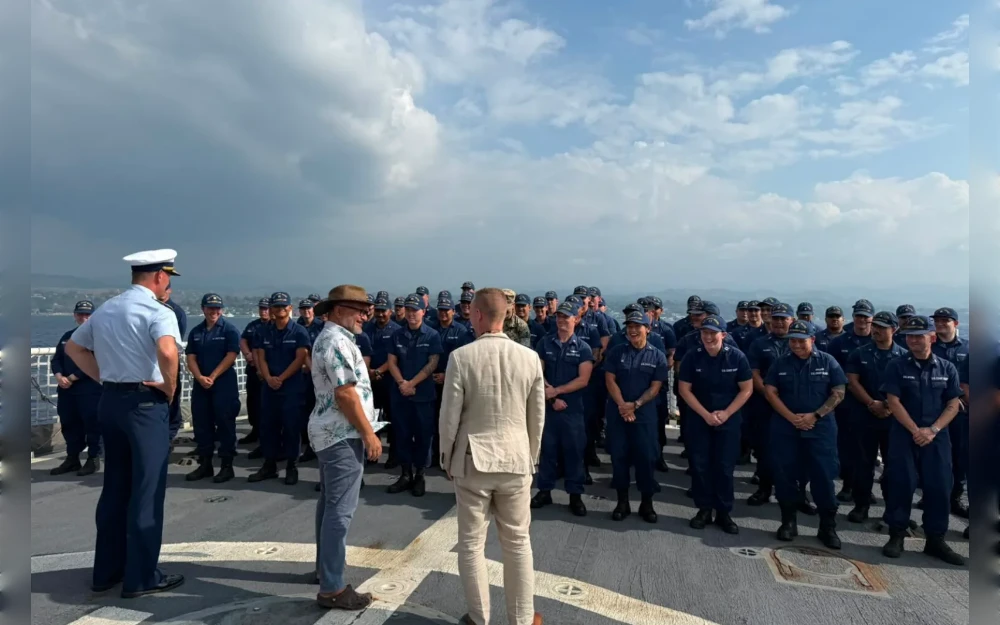
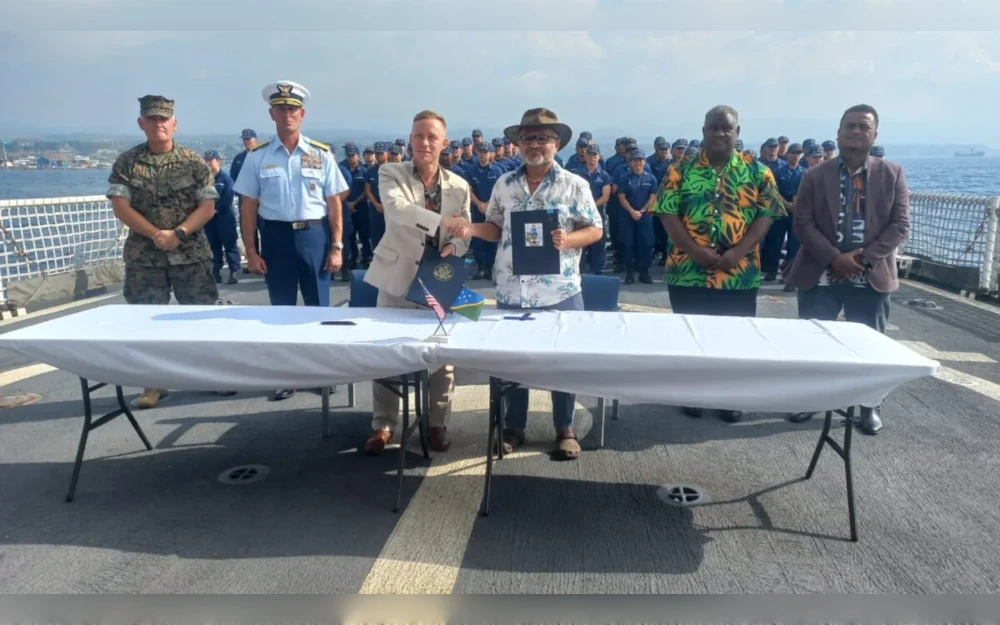
Prime Minister Matthew Wale and U.S. Chargé d’Affaires P. Daniel O’Hara signed the finalized agreement Tuesday aboard the U.S. Coast Guard Cutter Harriet Lane, which had visited Honiara for the occasion.
Commonly known as a shiprider agreement, the Agreement Concerning Counter Illicit Transnational Maritime Activity establishes a legal framework allowing Solomon Islands law enforcement officers to be embedded on U.S. Coast Guard vessels. The initiative forms part of Washington’s broader deployment designed to enhance regional stability and counter illegal, unreported, and unregulated fishing across the Pacific.
The move has drawn sharp criticism from opposition leader and former Prime Minister Manasseh Sogavare, who previously aligned the Pacific nation closer with Beijing by signing a controversial and secretive security agreement with China in 2022.
Though it may seem like Honiara is hedging its bets by entering into security deals with both Washington and Beijing, engaging with both geopolitical rivals is standard practice, Alexander L. Vuving of the Hawaii-based Daniel K. Inouye Asia-Pacific Center for Security Studies, told RFA.
“This mirrors the actions of many other small countries in Southeast Asia, South Asia, and Oceania, signaling that the Solomon Islands cares about its autonomy and wishes to avoid taking sides,” he said. He also dispelled concerns regarding tensions with Beijing over Taiwan, stating, “The shiprider agreement focuses purely on maritime security within the Solomon Islands’ Exclusive Economic Zone, which does not conflict with or affect the One China Policy.”
Maintaining neutrality
The signing occurred a day after the prime minister concluded diplomatic visits to the United States and Japan. Upon his arrival at Honiara International Airport on Monday, Wale emphasized to reporters that the Solomon Islands has no desire to become a proxy battleground for larger powers.
“We are not in a geopolitical game. We are not interested! Let the big boys sort out the big stuff,” he said.
He stated that the country’s foreign policy is meaningless unless backed by reliable development partners, asserting that the nation intends to cooperate with all major powers while letting larger global players manage their own geopolitical rivalries.
He acknowledged China as a critical trading and development ally, affirming that his administration would continue to work closely with Beijing to protect national interests and improve local livelihoods.
On a previous diplomatic visit last month to Canberra, Wale and Australian Prime Minister Anthony Albanese signed a memorandum of understanding concerning security and police cooperation, and agreed to begin negotiations on a treaty that would redefine the bilateral relationship.
“Regional powers have largely viewed the recent security agreements with Australia and the US as a positive pivot or rebalance of the country’s foreign policy,” Dr. Vuving said. But he warned that ultimately the ability to maintain more or less neutral stance depends on the domestic political situation.
“The long-term sustainability of this delicate approach requires a parallel balance in domestic politics,” he said. “Any lack of commitment to autonomy could result in increased pressure from rivaling great powers to pick a side.”
That’s politics
Though Wale’s government believes the shiprider agreement to be beneficial, the opposition has strongly criticized the deal.
Manasseh Sogavare, a former four-term Prime Minister who critics have said is very pro-China and who most recently led the country between 2019 and 2024, warned that welcoming the U.S. military could compromise the nation’s sovereignty.
During Sogavare’s most recent term, he orchestrated a dramatic geopolitical shift in the South Pacific by aligning the Solomon Islands with China and severing diplomatic ties with Taiwan.
U.S. officials quickly rejected Sogavare’s criticisms emphasizing that the arrangement is built entirely on mutual respect for local sovereignty.
O’Hara clarified that the agreement actively reinforces local authority by providing American operational capability while keeping all law enforcement decisions under domestic control.
“This agreement is about mutual benefit,” O’Hara stated after the signing. “Your officers will enforce your own laws in your own waters. You decide which vessels to investigate. You determine the violations. You set the penalties.”
Entering into international agreements with a mostly executive approach based on the political leanings of whomever holds the office of the prime minister has left some everyday citizens frustrated by a lack of transparency.
“Did Wale consider Solomon Islanders before signing any foreign agreements?” Brian Wanealafa, a Solomon Islands resident, told RFA. “He should make consultations first, or even bring that before parliament.”
Wanealafa said the criticism extended beyond just Wale.
“The same is with Sogavare, when he signed the security pact with China,” he said, referring to the 2022 agreement. “They should think of the citizens and do nationwide consultations, or bring to Parliament and dissect the agreements openly for people to understand.”
Legal and Sovereign Realities
Criticism that the agreement compromises the Solomon Islands’ sovereignty is invalid because it conflates political concerns with legal principles, Joseph Foukona, a history professor at the University of Hawaii at Manoa, who hails from the Solomon Islands, told RFA.
Foukona described the sovereignty argument as “twisted,” saying it centers more on “political concerns than legal ones.”
“Signing the Shiprider Agreement without parliamentary scrutiny is a non-issue, as it falls well within the executive government’s powers,” he said. “Previous administrations have similarly bypassed parliamentary oversight for memorandums of understanding and treaties.”
He emphasized that the US partnership perfectly aligns with international environmental and maritime treaties the Solomon Islands has already signed.
“These international treaties require a maritime enforcement mechanism to be effective,” Foukona said. “The Shiprider Agreement simply provides the platforms – U.S. Coast Guard vessels – for Solomon Islands law enforcement officers to enforce their own maritime laws and treaty provisions.”
Ultimately, under the pact, local officers will enforce their own laws in their own territorial waters, retaining final and absolute authority over all maritime policing decisions, he said.
Edited by Eugene Whong.
“Copyright © 1998-2023, RFA.
Used with the permission of Radio Free Asia,
2025 M St. NW, Suite 300, Washington, D.C. 20036.
https://www.rfa.org.”