



Yangon residents line up for cooking oil and can’t get basic medicines.
By RFA Burmese
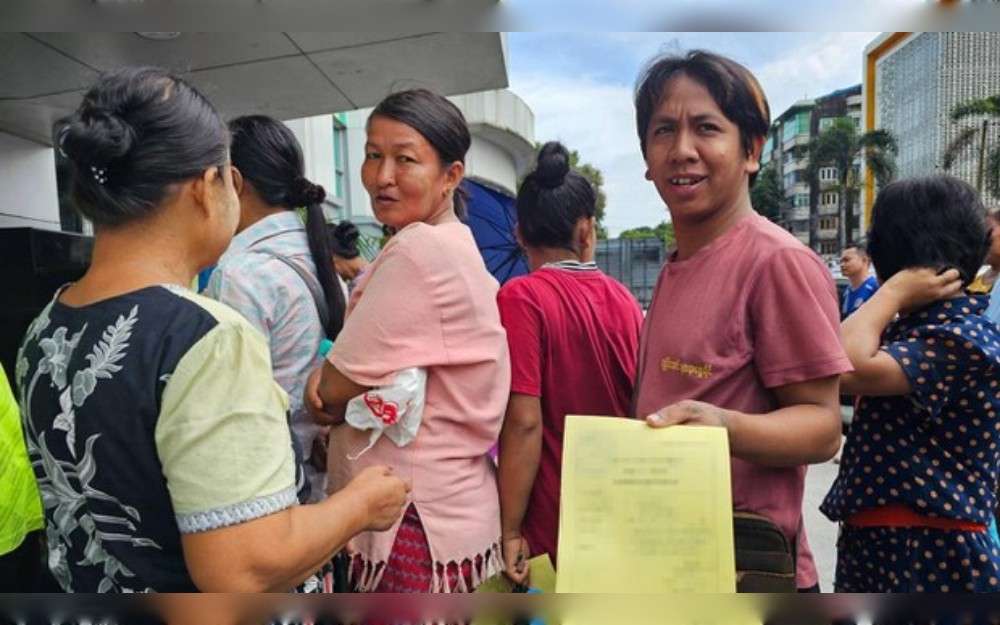
The queue for cooking oil stretches down a Yangon street. Householders turn up before dawn to fill a plastic bottle at a subsidized rate in Myanmar’s commercial capital – the latest evidence of a tanking economy.
“If you can come early, you will get your quota early. If you are late, you might end up with nothing … and have to start all over again the next day,” Daw Htoo, whose real name was changed in order to protect her identity, told RFA Burmese.
“You have to wait for your turn for about two and a half hours everyday,” she said of the palm oil, which costs 20% less than the price of peanut oil sold outside government-subsidized shops. “Some have been waiting since 5 a.m.”
Daw Myint, a resident of Yangon’s Thaketa township in her 70s, told RFA that with the price of peanut oil now more than 20,000 kyats (US$4) per viss, which is equal to about 1.7 kilograms or 3.5 pounds, “we simply can’t afford to use it anymore.”
In a country wracked by conflict since the military takeover three-and-a-half years ago, basic products are becoming more scarce.
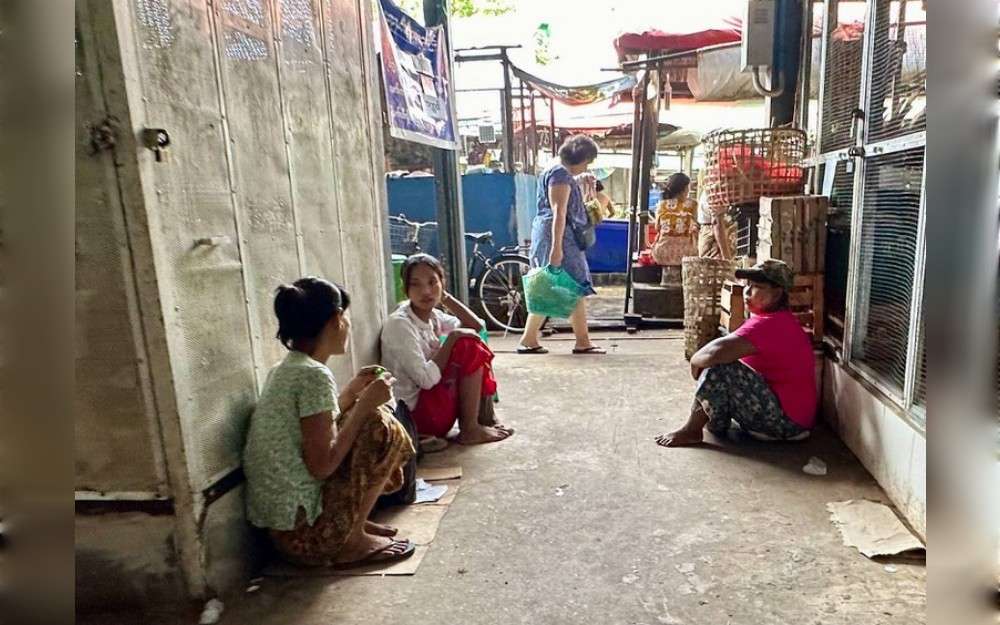
Also,import restrictions are impeding the supply of basic medicines, deepening a humanitarian crisis.
“It’s like we’re going back in time to when you had to line up for everything,” said a Yangon businessman who requested anonymity to avoid trouble with authorities. “Palm oil isn’t a rare product … This commodity is abundant and sold competitively around the world, but it’s being rationed in Myanmar.”
Older residents say it reminds them of life under a previous military regime, led by Ne Win, when Myanmar followed a socialist political model. Under the system, all major industries were nationalized, including import-export trade, leading to price controls and the expansion of the black market to account for as much as 80% of the national economy.
In late July, junta chief Senior Gen. Min Aung Hlaing announced that the country’s current situation is “most suited to socialist-era cooperative systems,” implying that, with Myanmar’s economy in freefall, the population should prepare to make sacrifices.
One such sacrifice is cooking oil, according to residents and business owners in the country’s largest city Yangon.
Major inconvenience
Amid the conflict that has engulfed Myanmar since the military’s February 2021 coup d’etat, local production of vegetable oils from peanuts, sunflower seeds and sesame has dwindled or ceased entirely, forcing consumers to rely on imported palm oil to prepare their meals.
But the junta has put restrictions on the hard currency needed to import palm oil, creating a shortage and a price jump in local markets.
Yangon residents told RFA Burmese that the price of one viss container of palm oil now costs 16,000 kyats (US$3.20) – up from 8,000 kyats in January and 6,500 kyats in December 2023. Meanwhile, the value of the kyat has dropped from 3,500 kyats to 5,600 kyats per U.S. dollar over the same period.
Early this month, a ration system went into effect, through which residents can purchase a maximum of half a viss each day at the subsidized price.
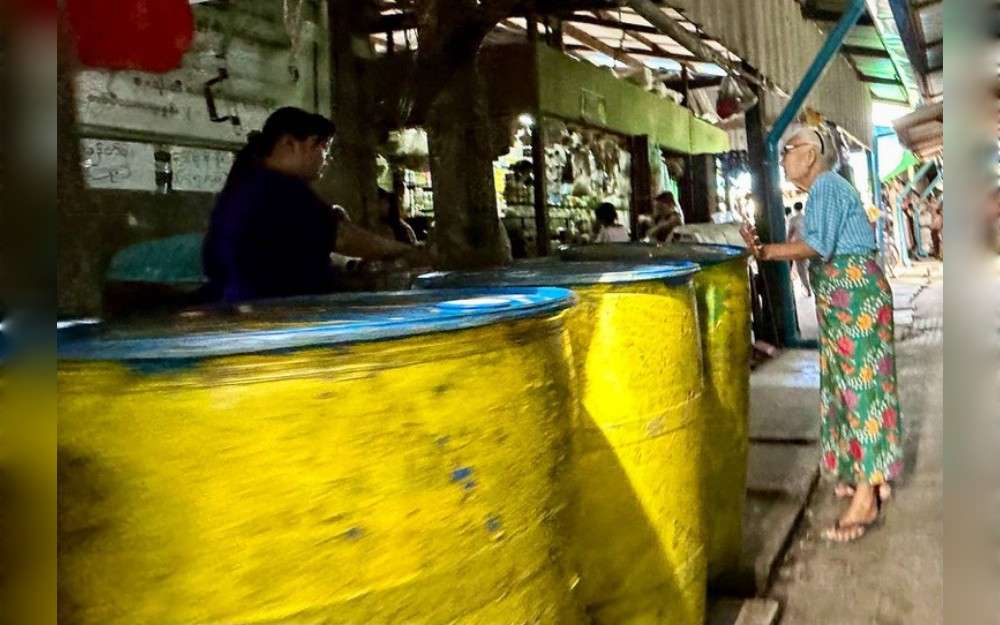
An elderly woman in Yangon’s Lanmadaw township told RFA that the ration system is a major inconvenience.
“If we were able to buy one viss at a time, we would only need to line up once a week,” said the woman who, like others interviewed for this report, spoke on condition of anonymity due to security concerns.
A restaurant owner in Yangon’s North Dagon township told RFA that she has had to buy palm oil from the local market to supplement what she can buy through the junta’s ration system, because half a viss is not enough to meet her business’s daily needs.
“Not only does it take time for us to buy palm oil [under the ration plan], but we can only buy a half viss at a time, which is only enough to cook five portions of rice,” she said.
Attempts by RFA to contact the office of the junta’s Department of Consumer Affairs in Yangon for further clarification about the palm oil ration plan went unanswered.
‘Life-threatening’
Meanwhile, it has become increasingly difficult for people displaced by conflict to access essential medical supplies due to the junta’s restrictions on medical imports and a national shortage,
According to aid workers and those who have fled fighting, the demand for medicine is particularly acute among those displaced by conflict in Sagaing region, Chin state, Kachin state, northern Shan state, Magway region and Rakhine state.
“We are dealing with cases of seasonal flu and diarrhea here – it’s definitely a life-threatening situation,” said a displaced person from Chin state’s Kanpetlet township. “Access to medicine would be helpful, but it’s simply not available. The biggest challenge is the inability to purchase the necessary medication.”
Aid workers said that the transportation of medicine to Chin state, where approximately 250,000 war displaced are located, has become difficult due to road blockades imposed by the junta.
“The main issue is that the junta shuts down the roads whenever fighting intensifies, making transportation extremely difficult,” said one person assisting the displaced. “Pharmacy owners … are required to submit a list of their products to the junta’s General Administration Department and under these conditions, they are reluctant to sell openly. Everything is operating in secrecy right now.”
According to a July 1 statement from the United Nations Office for the Coordination of Humanitarian Affairs, more than 3 million people are internally displaced across Myanmar due to ongoing military conflicts. They face significant challenges in accessing basic food and healthcare, primarily due to restrictions imposed by the junta, the agency said.
A 2023 survey by the British-based website prosperity.com – which assesses and documents the education, health and security conditions of various countries – ranks Myanmar 143rd out of 167 countries in terms of development status. The site ranks Myanmar 109th in healthcare.
Using traditional medicine
Kachin state, home to more than 200,000 displaced people, is also grappling with a severe shortage of medicine amid the widespread prevalence of malaria.
And in Sagaing, where conflict is raging, junta troops are blocking the transportation of medicine and confiscating it, according to a displaced person in Tigyaing township.
“Drivers are reluctant to carry food, medicine or painkillers because if they are caught, everything is taken,” he said. “As a result, in the absence of foreign drugs, we have to rely solely on Burmese traditional medicine for treatment.”
A medicine distributor in Yangon, who also declined to be named, said that restrictions imposed by the junta on the importation of medicine, coupled with the rising cost of the dollar, have significantly hindered companies’ ability to procure medications.
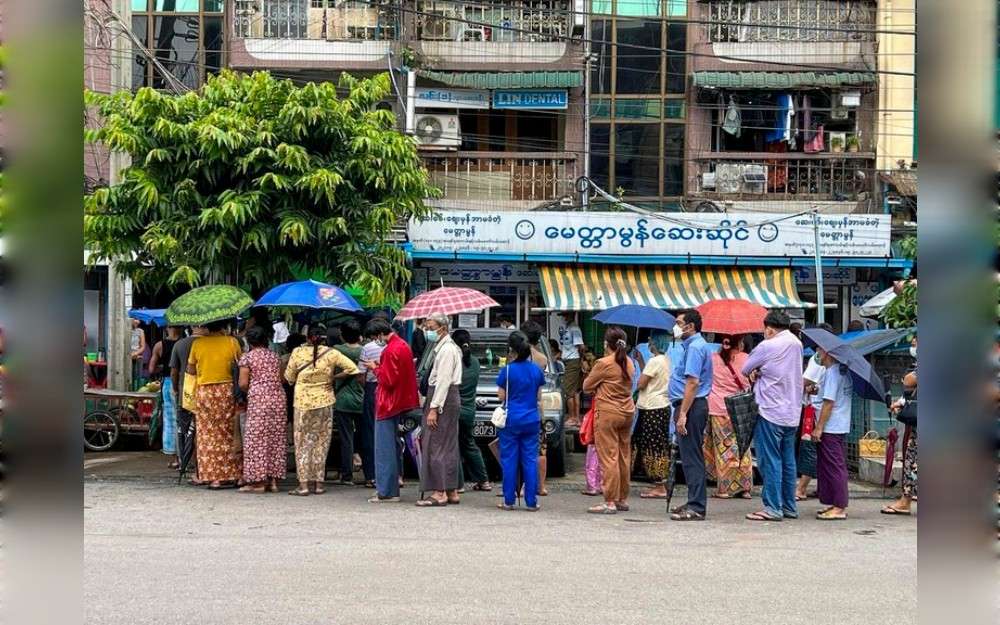
And while in the past, drug importers were able to source medication from neighboring countries Thailand and China, border routes have been closed due to conflict since the coup.
A nationwide shortage of long-term medications for chronic conditions such as kidney disease, high blood pressure, and diabetes – and even basic household medicines – has seen prices surge fivefold, residents said.
Attempts by RFA to contact junta spokesperson Major Gen. Zaw Min Tun for comment on the shortage of medicine were unsuccessful.
Translated by Aung Naing. Edited by Joshua Lipes and Malcolm Foster.
“Copyright © 1998-2023, RFA.
Used with the permission of Radio Free Asia,
2025 M St. NW, Suite 300, Washington, D.C. 20036.
https://www.rfa.org.”