




Experts say the Pak Beng dam and the many others like it put the livelihoods of local communities at risk.
By Noh Jung Min for RFA
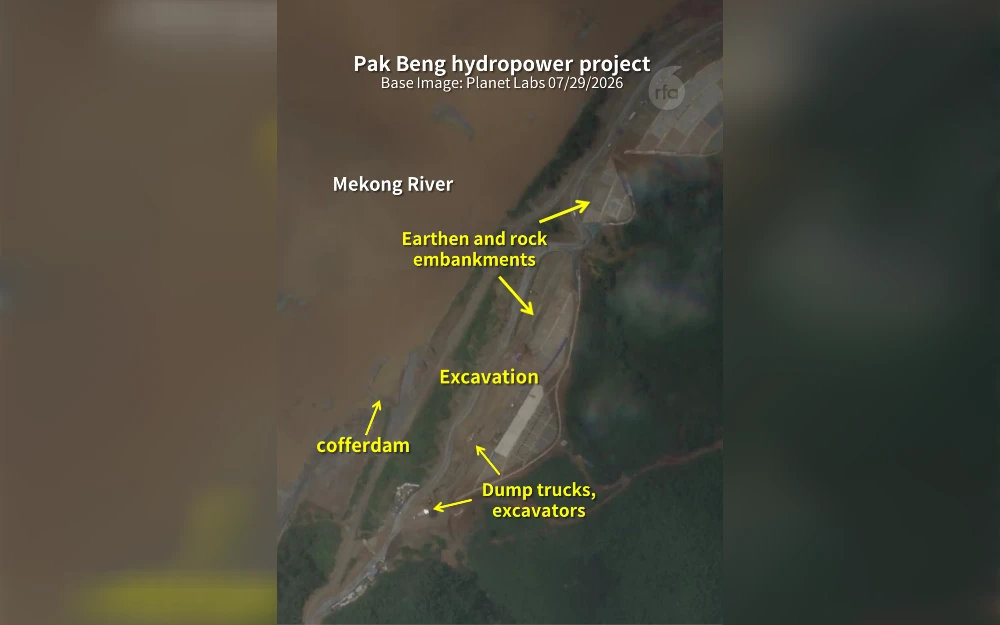
Construction is underway on Laos’ latest large-scale Mekong River dam, satellite imagery analyzed by Radio Free Asia shows. Experts told RFA that the Pak Beng hydropower project will be like the other mainstream Mekong River dams, with Vientiane hopeful that sacrificing riparian ecosystems and relocating nearby villages will be worth the expected benefits to the economy.
With dozens of hydropower dams either built or under construction on the Mekong River and its tributaries, Laos has gone all-in on its controversial economic strategy to become the “Battery of Southeast Asia” in hopes of selling electricity to neighboring countries.
Pak Beng, when complete, will be the most upstream dam on the Mekong in Laos. It is a joint venture between a Chinese investment company and a Thai energy firm, it will have a generating capacity of 912 megawatts and is expected to produce an average of 4,775 gigawatt-hours annually—enough to power a mid-sized U.S. city for a year.
“The construction has quietly begun,” Brian Eyler, director of the Southeast Asia program at the Washington-based Stimson Center, told RFA. “On paper, hydropower dams provide income for Laos by selling power to Thailand, Vietnam and Cambodia,” he said. “This brings foreign currency into the country, which is more resilient than the kip, Laos’ currency.”
Satellite imagery taken on July 29 shows a large earthen and rock embankment built across a bend in the river, creating a dry work area shielded from the river’s flow. Within the diverted section, workers appear to be excavating and laying the foundation for the dam’s main structure.
Numerous dump trucks and excavators are visible cutting into bedrock and sediment on the riverbed and leveling the surface to prepare a foundation base for the dam, Bruce Songhak Chung, a senior researcher at the Seoul-based Korea Institute for Security Strategy, told RFA.
“Satellite imagery shows what appear to be the early stages of a powerhouse building, a spillway, and foundational work for a ship lock and fish passage intended to allow vessel and aquatic movement past the dam once completed,” Chung said.
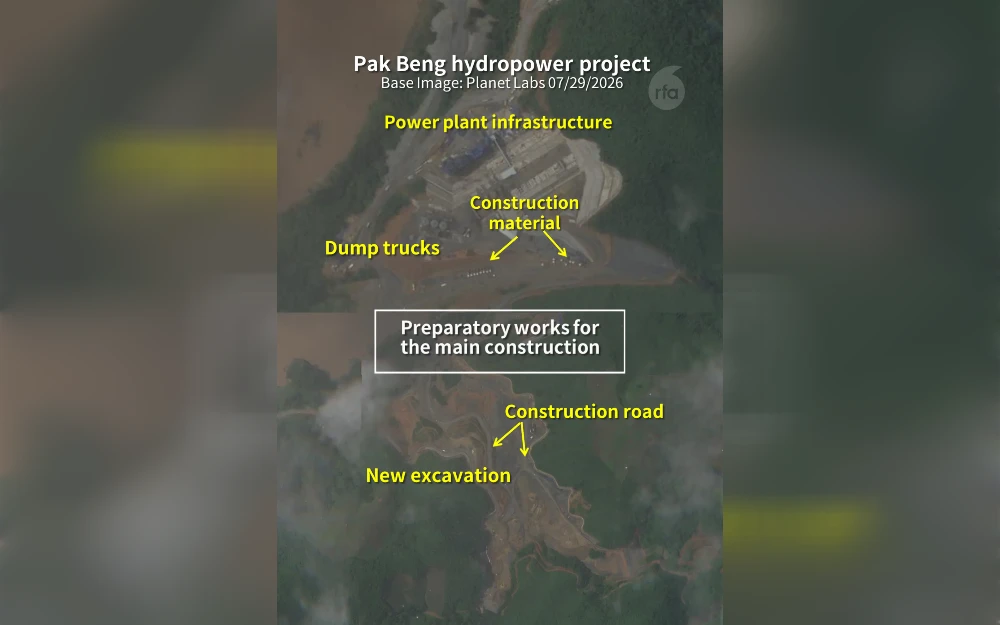
So far, only preparatory work has started and the main construction on the dam will begin in October 2026 after the wet season, Chandaly Mao, a communications officer with the Mekong River Commission, told RFA.
The commission is an intergovernmental organization that works with the governments of the four Mekong basin countries to jointly manage the shared water resources and the sustainable development of the Mekong.
“Work will start with the construction of the first-stage cofferdam,” Mao said, adding that the developer expects commercial operations to begin in 2033.
One of many
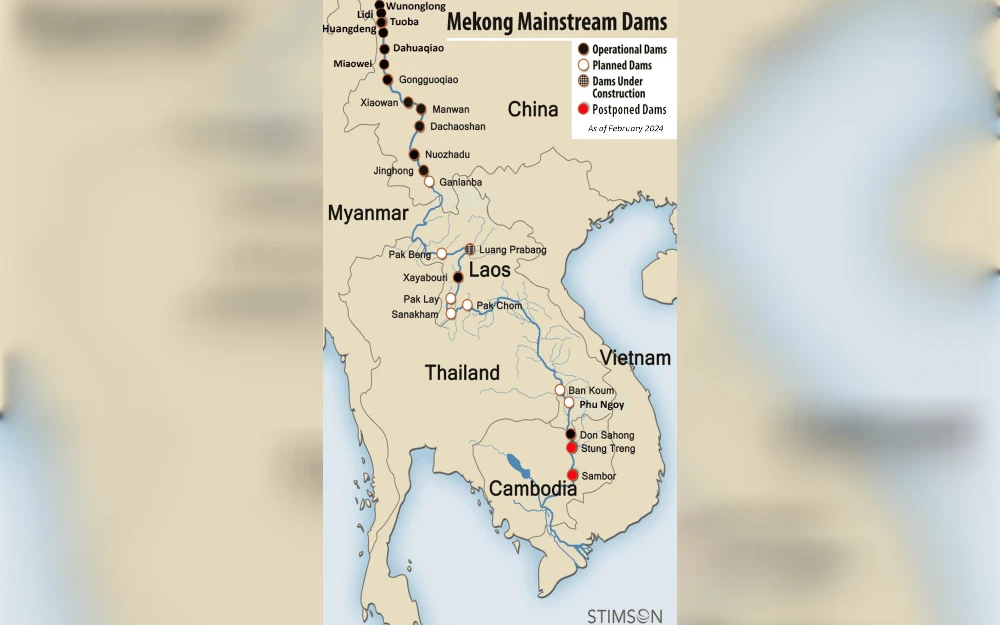
Meanwhile, further downstream, the Luang Prabang large-scale dam is more than 70% complete and will begin commercial operation in 2030 according to the commission. There are currently two operational dams and 9 others in various stages of completion according to the Stimson Center.
Eyler said there are more than 100 dams in Laos on Mekong tributaries, including the Xayaburi dam, the largest currently in operation. Additionally, Myanmar and Laos signed a joint agreement to develop a new 2,790-megawatt Mekong mainstream dam on July 5.
Little information has been released, but it is expected to sit in a canyon section of the Mekong along the Laos–Myanmar border and it would be one of the largest dams planned on the Mekong, he added.
“All these dams are built by foreign construction companies,” Eyler said. “Laos has the capability to build small dams but not large dams.”
Under this arrangement, the foreign construction company owns the dam for a set period — typically 20 to 30 years — collecting the income it generates, while the Lao government receives taxes and royalties, Eyler said. Once the contract ends, ownership transfers back to the Lao government.
Many of the foreign players involved are Chinese firms or have Chinese backing, and critics are concerned that the arrangement ensnares Laos in a debt trap, making Vientiane increasingly malleable to Chinese creditors.
“This is a sovereign decision of the Government of Lao PDR,” Mao told RFA. “A further consideration is that operating patterns are shaped by concession and power purchase agreements. It is therefore important that these agreements allow operating rules to be adapted for environmental purposes.”
Local economics
Experts also warn the dams affect the livelihoods of the local communities and carry significant environmental and social impact downstream with effects that accumulate as more dams are built along the river.
The dams generate electricity that is mostly sold to Thailand, which is beneficial to the country’s bottom line, but local communities near the dams see little benefit.
The Mekong River Commission has raised four concerns: sediment trapping, fish passage, changes to the flow regime, and socioeconomic impacts on communities that depend on fisheries. Fish passage is a particular concern, both for adults migrating upstream and for eggs and larvae drifting downstream through slow moving impoundments, Mao told RFA.
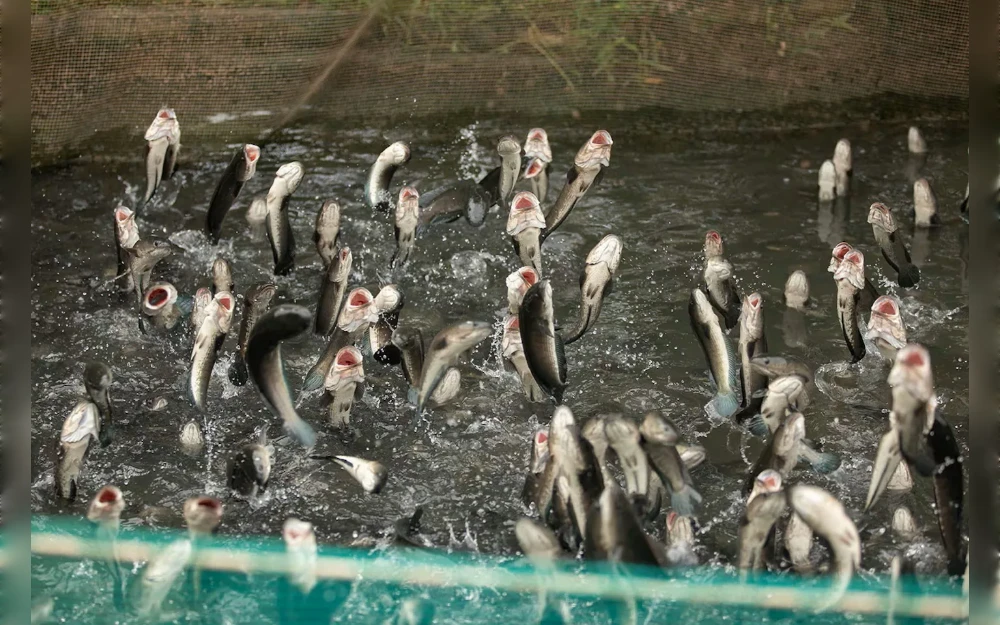
“Even though some of these dams have fish ladders built into them, the fish ladders don’t work very well,” Eyler said. “So the fisheries are in a dire situation, and people rely on those fisheries for their food and for income as well.”
According to the Stimson Center’s Mekong Dam Monitor project, fisheries are depleting and declining for local people along the entire run of the Mekong in Laos. In a section of the river where the borders of Laos, Myanmar and Thailand meet, entire villages have become ghost towns as fish stocks have collapsed.
Chung said dams also trap sediment and nutrients that would otherwise flow downstream, potentially accelerating erosion in Vietnam’s Mekong Delta and contributing to farmland loss and declining agricultural productivity.
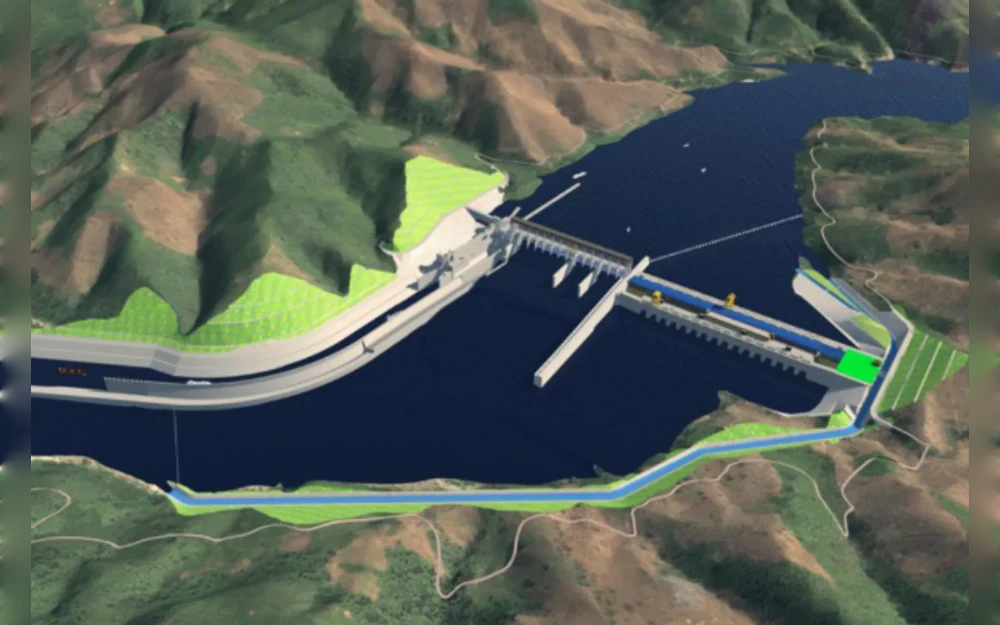
“Dams can also release large amounts of water suddenly, causing flooding downstream,” Chung said, “Residents of villages affected by flooding and construction could be forced to relocate, losing their homes and livelihoods.”
“It’s very rare that people that live around dams benefit from those dams,” Eyler said. “Typically they bear the costs and then people far away get the benefits.”
Edited by Eugene Whong.
“Copyright © 1998-2023, RFA.
Used with the permission of Radio Free Asia,
2025 M St. NW, Suite 300, Washington, D.C. 20036.
https://www.rfa.org.”