



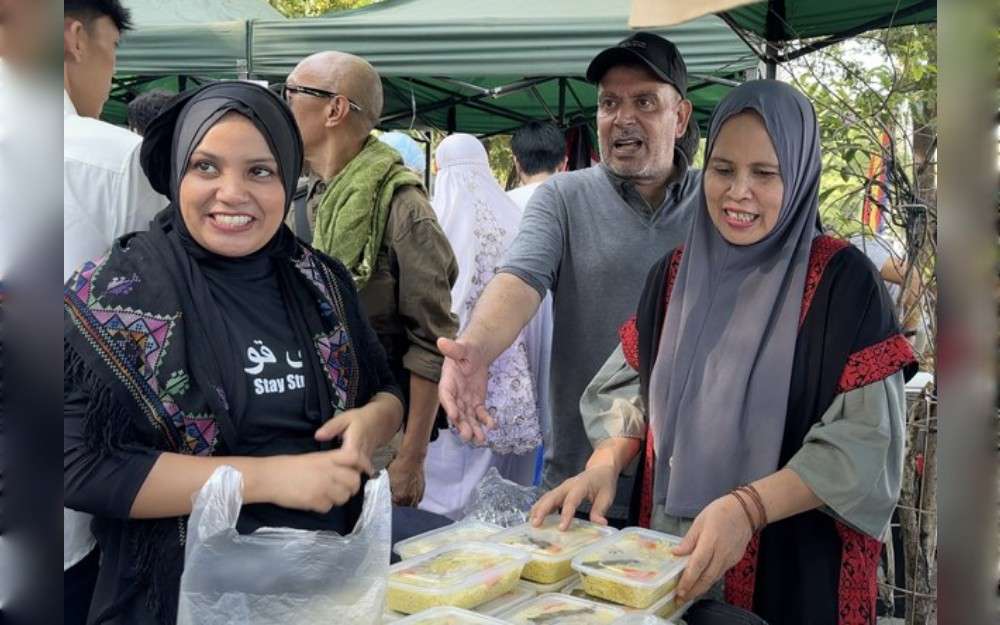
Fare offered in their Little Gaza Kitchen, mainly cooked by the Filipina wives of the Palestinians, is a hit.
Camille Elemia/Manila
More than a dozen Filipino-Palestinian families who were forced to leave Gaza after the Israel-Hamas war began in October are slowly rebuilding their lives in the Philippines, one dish at a time.
Many of the refugees, who are from well-off families and worked as engineers or professors in Gaza, are now helping their spouses who are jointly running a business cooking Palestinian delicacies to earn a living.
Local volunteers helped them set up the Little Gaza Kitchen in northern Metro Manila, where they sell fare such as Palestine’s national dish musakhan, which is roasted, spiced chicken with caramelized onions, and traditional rice pudding, called roz bel laban, among other items.
“We need work because we cannot just depend on others’ help all the time. We want to live in dignity,” Zenith Abudalal told BenarNews last month (May 19).
Filipino-Palestinian Abudalal returned to the Philippines with her Palestinian husband, two children, and two grandchildren after the Israel-Hamas war began.
Her family is one of 16 who arrived in the Philippines in batches, starting in early November. The group comprises 69 people, of whom at least six are Filipinas married to Palestinians.
Armed with only a backpack each, the refugees – 21 men, 25 women and 23 children – wanted no part in the deadly conflict.
Israel launched ground and air strikes on Gaza, killing at least 36,500 Palestinians, after Hamas militants killed around 1,100 people in an attack on Israel on Oct. 7.
Nearly eight months of Israeli strikes have razed hospitals, schools, universities, houses and other structures, and displaced more than 1.9 million Palestinians, according to the United Nations.
“[F]amilies already displaced several times are on the move again due to military operations and Israeli evacuatiorders,” the United Nations Relief and Work Agency said in a June 7 statement.
‘Everything we own was destroyed’
Being on the move, in what the International Rescue Committee calls “the deadliest place for civilians and aid workers in the world,” is also treacherous.
Abudalal recalled how she and her husband had to walk eight km (4.9 miles) amid continuous bombing from their destroyed home in the center of Gaza to the Rafah border crossing bordering Egypt. Back then, she said her husband was still recovering from heart surgery.
Left without options, Abudalal said she and her husband decided to wave a white flag while walking towards the border, amid dead bodies and severed body parts.
“There were military tanks on the roadside, with Israeli soldiers shouting to us in Hebrew, asking us to name Hamas members we know,” she recounted.
“We were so scared, but we just looked straight ahead until we got there in Rafah.”
Millet Kilani, a Filipina who had lived in Gaza for three decades, said her husband almost did not make it out of Palestine because he didn’t have a required permit. The needed to secure three permits: one each from the Israeli government, the Egyptian authorities, and the Philippine embassy.
He was blocked from crossing the Rafah border, Kilani said, referring to the Egyptian authorities.
“Of course, I could not leave my husband, so we stayed behind while our children left …I did all I could and pleaded with the [Egyptian] border officer,” Kilani said, as she got teary.
“I told him, ‘My husband is not safe here in Gaza.’ At the last minute, they agreed to let my husband pass.”
Kilani’s family owned a charcoal factory and poultry chicken business in Gaza before this war began.
“We don’t have a house anymore. Everything we own was destroyed.”
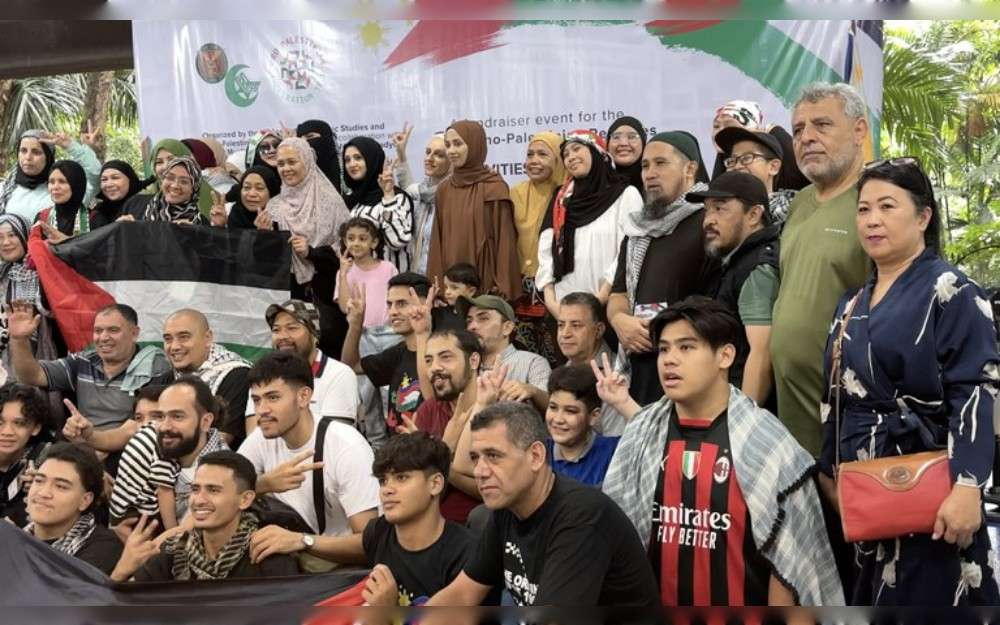
Things did not go smoothly even after they arrived in the Philippines.
The refugee families first stayed at the University of the Philippines in Quezon City, Metro Manila, but mere weeks later had to find another place in the city to stay.
With the help of Muslim Filipino volunteers, they secured a place for all 16 families to live together – a rented four-story building which would later become known as Little Gaza.
It was after moving to this building that the volunteers helped the refugee Filipino-Palestinian families start the small food business called the Little Gaza Kitchen. They would later form the Moro-Palestinian Cooperation Team to manage the business.
On Eid al-Fitr on April 10, they set up a food stall at a government-initiated halal food bazaar, and hundreds of people – Muslims and Christians – queued up for a taste of authentic Palestinian food.
The Little Gaza Kitchen did brisk business, selling not just musakhan and roz bel laban, but also meat-and-rice dishes such as biryani and maqluba, and desserts such as awama (sweet donut balls) and layali lubnan (sweet milk-based cake).
Their dishes were a hit at another local trade fair later in April.
Ahmad Manala-o, one of the volunteers, said his wife and young children decided to stand by their fellow Muslims because it was “the right thing to do.”
“We have shelter, we enjoy the best of food. But for them, every little thing was difficult,” Manala-o told BenarNews last month.
“So that’s the time we decided that the right thing to do is to be with them. …We became closer, and we’ve become one family with them since then.”
Officially, at least 136 Filipino and Palestinian-Filipino nationals have been repatriated to Manila since the conflict started, Philippine Department of Foreign Affairs (DFA) numbers show.
The count does not include Palestinians who fled to the Philippines along with their families.
Still, the Philippine government gave each refugee family cash aid worth U.S. $1,500, and offered hotel stay in Manila for a few days, the refugees said.
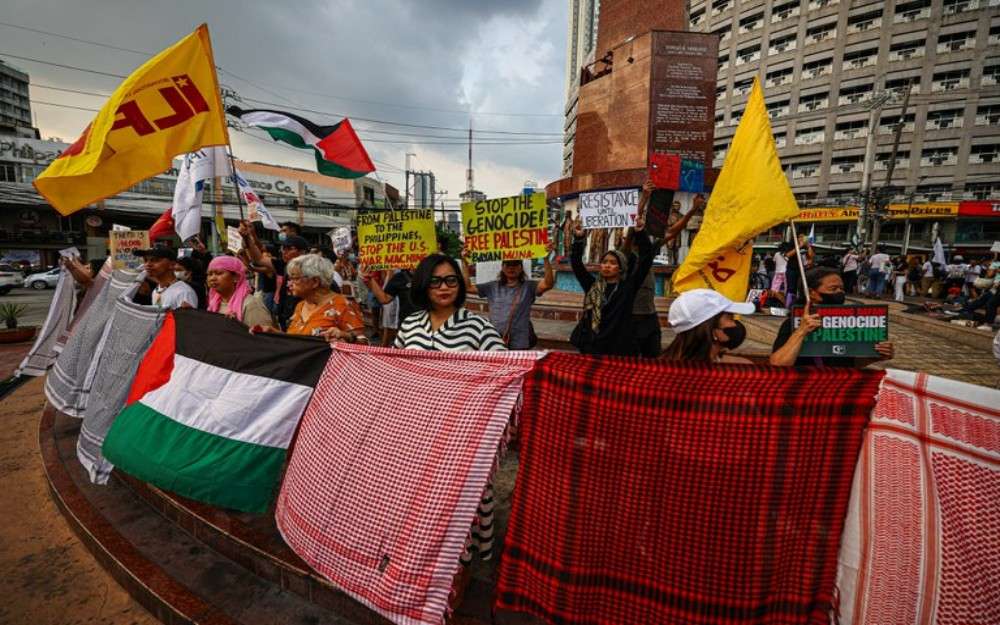
Gerard Carreon/BenarNews
The families who have relocated from Gaza would like to integrate into Philippine society and are appealing for livelihood and employment assistance. They would also like access to education for their young children.
Many of the Palestinian men in the group had worked in white-collar professions in Gaza before this latest war. Some of them graduated from Philippine universities in the 1990s before marrying their Filipino spouses.
But they are not able to work in the Philippines, because they don’t yet have official status.
So their Filipina spouses are now taking the lead in earning money through the Little Gaza Kitchen.
BenarNews on Thursday reached out to the Philippine Department of Justice for an update on the refugees’ status, but the office has yet to respond.
“You have figured out everything in your life and in a snap of a finger, they’re all taken away from you,” Filipino-Palestinian Mahadia Dalal, 34, told BenarNews in April.
“I used to be an English teacher in a refugee camp in Gaza, but now I’m selling food.”
Copyright ©2015-2024, BenarNews. Used with the permission of BenarNews