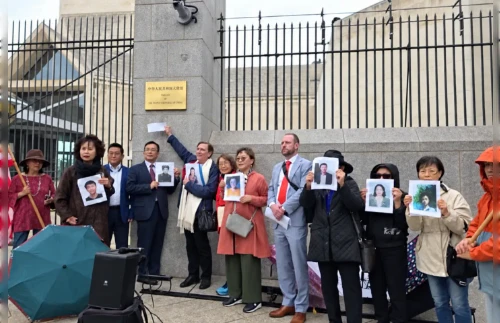




The Zhu-led Western Development Strategy was able to “bring Tibetans in line with Chinese government policies.”
By RFA Staff

The late former premier of China Zhu Rongji wielded the economic hammer during China’s rapid economic rise in the 1990s and 2000s to increase Beijing’s influence over Tibet, an expert told Radio Free Asia shortly after Zhu’s death on Wednesday.
Zhu, 98, died at 11:06 a.m. in Beijing of an unspecified illness, the state-run Xinhua News Agency reported.
As premier alongside President Jiang Zemin from 1998 to 2003, Zhu had spearheaded China’s accession to the World Trade Organization and ushered in an era of rapid economic growth and full integration into the global market through a series of bold but not fully completed reforms.
The pair are credited with orchestrating China’s gradual escape from international isolation following the 1989 Tiananmen Square crackdown and its path to becoming the world’s second-largest economy.
But for Tibetans, Zhu’s legacy as an architect of China’s economic rise is one of increasing Beijing’s political control over the region, Buchung Tsering, research director at the Washington-based International Campaign for Tibet, told RFA.
“As part of the Western Development Strategy, Zhu promoted greater economic development in Tibetan areas, seeking to use economic means to maintain ‘stability’ in Tibet and bring Tibetans in line with the Chinese government’s policies,” Tsering said. “Zhu Rongji can therefore be seen as a key figure in strengthening Beijing’s political control over Tibet through economic means.”
The Western Development Strategy was a state-run economic development program that included large scale infrastructure projects intended to integrate China’s western frontier, including Tibet and the Uyghur region, with its booming coastal cities.
Critics have said that this policy accelerated the westward migration of the Han population, objectively altering the local population structure and triggering discontent among local ethnic minorities regarding the marginalization of their native culture and the unfair distribution of economic benefits. Overseas Tibetans and Uyghurs have protested this issue on numerous occasions.
The Western Development Strategy is widely considered to be the blueprint for the Belt and Road Initiative, which is similarly criticized as a means for China to increase its influence, though on a global, rather than national scale.
Progress and setbacks
Zhu Rongji’s forceful reforms of the overall Chinese economy were accompanied by social pain, including the layoffs of tens of millions of state workers, and the subsequent increased financial pressure on local governments following the 1994 tax-sharing reform. Because the social security system was not yet fully developed at the time, workers suddenly lost their medical, housing, and pension guarantees, triggering massive layoffs and local labor protests, all of which were subsequently suppressed by the government.
In addition, during his tenure, the Chinese government launched a severe crackdown on the Falun Gong religious group in 1999, and arrested and sentenced political dissidents and NGOs who attempted to form the “China Democracy Party.”
After stepping down in 2003, Zhu Rongji rarely made public appearances, but continued to maintain ties with his alma mater, Tsinghua University. He served as the first dean of Tsinghua University’s School of Economics and Management from 1984 to 2001, a term that lasted 17 years.
Since the Xi Jinping era began, many reforms implemented in the 1990s under Zhu’s tenure have been reversed. The Xi Jinping government has vigorously supported state-owned enterprises while suppressing private enterprises and technology companies.
Life and career
Zhu Rongji was born in Changsha, Hunan Province, in 1928. He graduated from Tsinghua University in Beijing with a degree in electronic engineering. He joined the Communist Party of China in 1949, the same year that Mao Zedong, another native of Changsha, announced the founding of the People’s Republic of China.
During the political movements of the Mao Zedong era, Zhu Rongji was purged twice. During the Anti-Rightist Campaign in 1958, he was labeled a “Rightist” and expelled from the Party. During the Cultural Revolution, he was again persecuted, and from 1970 to 1975, he was sent to a “May Seventh Cadre School” for labor “re-education.”
During the tenure of Jiang Zemin and Zhu Rongji, the Chinese government was recognized for maintaining economic and RMB exchange rate stability during the 1997 Asian financial crisis. Compared to the period under Xi Jinping, the Jiang-Zhu era is also seen by some reformists and observers as a relatively open and optimistic time. Jiang Zemin passed away in November 2022 at the age of 96.
However, China’s economic marketization at that time did not bring about corresponding political liberalization.
Edited by Eugene Whong from a report by RFA Mandarin. Additional reporting by Tsetan Dolkar and editing by Tawang for RFA Tibetan.
“Copyright © 1998-2023, RFA.
Used with the permission of Radio Free Asia,
2025 M St. NW, Suite 300, Washington, D.C. 20036.
https://www.rfa.org.”