



A Shanghai resident recalls a nightmare experience during the city’s weeks-long COVID-19 lockdown.
By Jane Tang for RFA Mandarin
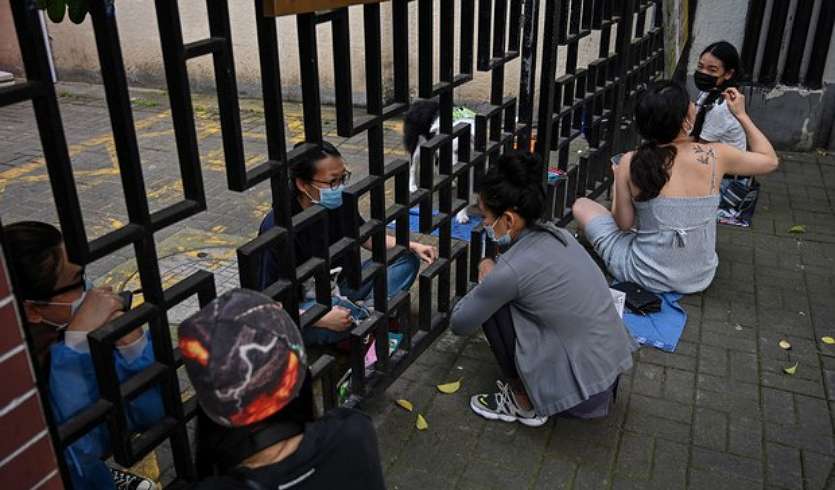
A Shanghai resident who gave only the surname Cao recently spoke to RFA’s Mandarin Service about her experiences under weeks of COVID-19 lockdown, during which the city’s 26 million residents submitted on a daily basis to confinement at home, food scarcity and mass compulsory PCR testing, along with the ever-present possibility of being bundled into a bus and sent to an isolation camp. Cao and her family were sick with COVID-19 during the lockdown, then had a nasty surprise awaiting after they recovered:
Cao: I had been feeling unwell since I tested positive, and I got really super-anxious when the baby started to run a fever, although I tried to keep quiet about it for fear we would be sent to an isolation camp. But I knew I would have to see a doctor if the fever persisted, so I was under a lot of psychological pressure. We stayed at home and kept a low profile until the entire family was testing negative. Then we thought we had gotten through it.
RFA: Then your neighbors informed on you, right?
Cao: Yes, but then we heard nothing, and it seemed that they wouldn’t be forcing me to go to the isolation facility, until there were suddenly five more confirmed cases in my courtyard. Everyone was in groups, allocated a volunteer to distribute food and supplies, and [our volunteer] just straight up told them that our family [was infected with COVID-19]. The neighbors were terrified and started spreading rumors, saying I’d opened the windows, or that I’d been downstairs to pick up a package, but I hadn’t stepped outside that whole time. Some neighbors attacked our family, and some were outrageous and aggressive despite my trying to reason with them. Because I had eventually decided to report it in the [neighborhood WeChat group] which includes the neighborhood committee, disease control and prevention, the police, all of them.
RFA: What did the neighbors say?
Cao: It was a very exaggerated reaction, and nonsensical. They said they wouldn’t give us food or help us with any packages, and wanted to force us to go into isolation. I don’t know if they’d been driven crazy by the lockdown, but they weren’t all like that. Some of them were kinder in private. But there was this one terrible person who was the loudest in the group, and dominated discussions. She would attack any of the nicer neighbors who tried to speak out and take our side, so after that, nobody dared speak out again.
RFA: So, you were taken off to an isolation camp on May 3, a month after you were diagnosed with mild symptoms? And you had already tested negative many times at home?
Cao: Yes. [They] told me on the phone that the policy was set in stone and there was nothing they could do about it, and that a lot of people are already testing negative by the time they get there. They said they were just implementing the policy, but were helpless to make any changes to it.
RFA: What was the isolation camp like?
Cao: It was in an extremely remote location, about two and a half hours by bus from Jing’an district, faraway and desolate. There were thousands of beds in the area I was staying in, which was really scary. Some people they were testing positive, others negative, and they were all mixed in together, even whole families, so it was very high-risk. I was so scared when I first got there that I would test positive again, despite my negative test.
I was dumbfounded when I saw the bed; it was made of iron, and parts of it were sagging and bent out of shape. If I shifted my weight slightly, the whole bed would tilt and flip upwards, so I had to lie there without moving, balancing. I was devastated, and cried several times a day.
The lights were on 24 hours a day … and we had to wear a mask and goggles. It was hard to breathe, let alone sleep. I copied some of the other people, and made a little tent for myself out of a sheet to block the lights out at least a little.
RFA: What kind of care did they provide?
Cao: The isolation facilities are supposed to be places for patients to rest and recover, but it was very uncomfortable. I couldn’t sleep properly, so I was in a poor state, and there was no proper medical attention, just a bunch of traditional Chinese medicine (TCM) distributed around the building.
RFA: How do people get out of these places?
Cao: You can leave after two negative tests, so I was in a hurry as soon as I entered, and kept asking them when I could get my next PCR. They told me I couldn’t on the same day I arrived, and that I would have to wait two more days. I heard from the person next to me that they do a PCR on the third and fourth day, but even if they were both negative, we couldn’t leave on the next day, because we had to wait for the results, so the quickest anyone could get out was on the sixth day after arriving. I ran into people who had been there two weeks, some even more than a month.
Everyone who came back from isolation camps was traumatized, and very anxious, and reluctant to do another PCR test. There is no information transparency in the camps. Everyone is woken at 5.00 a.m. to do PCR tests, but you don’t get the results. You can ask the staff, but they won’t tell you. They’re waiting from orders from higher up, who issue a list of names of people who need PCR tests, and those allowed to leave, and they’re just doing as they’re told.
RFA: Have you and your husband changed your opinion of Shanghai at all?
Cao: We have both lived in Shanghai for seven or eight years. The way the neighbors spoke about us in the group chat really frightened me, and my husband, too. We were flabbergasted. I had thought I could share how my family was doing in an honest way, but these radicals didn’t care about that. Maybe they were forced [into it]? This lockdown, this policy, the media, have all brought out the worst in human nature. We’d gotten used to living in Shanghai, and we had thought most of the people here were nice, but this has been a real eye-opener.
Translated and edited by Luisetta Mudie.
Copyright © 1998-2020, RFA. Used with the permission of Radio Free Asia, 2025 M St. NW, Suite 300, Washington DC 20036. https://www.rfa.org