




UN whistleblower Emma Reilly discusses how China gets the names of dissidents from the Human Rights Council.
By Nuriman Abdurashid

A United Nations whistleblower fired last week for accusing the Office of the United Nations High Commissioner for Human Rights (OHCHR ) of providing the names of Chinese government opponents and activists who sought accreditation to participate in U.N. activities has called for an external investigation of the body. Emma Reilly, an employee at the OHCHR and a human rights lawyer, said that the sharing of the names of dissidents with the Chinese government has endangered their lives and their families. The OHCHR said it stopped the practice in 2015, although a 2017 press release stated that Chinese authorities in Geneva regularly asked the office to confirm whether certain people were attending Human Rights Council meetings. “The office never confirms this information until the accreditation process is formally under way, and until it is sure that there is no obvious security risk,” it said. Reilly spoke to reporter Nuriman Abdurashid of RFA’s Uyghur Service about her allegations and call for an independent investigation. The interview has been edited for length and clarity.
RFA: Why were you fired?
Reilly: I was fired for doing my job. … It was telling the truth to member states and in public that didn’t work. It was telling people about the U.N. policy of handing names over to the Chinese government. The irony is that in court, the U.N.’s argument is that the policy is public. So, I’ve been fired for making public something that, when they’re in front of a judge, the U.N. says is public.
RFA: Are these names given at China’s request or does the U.N. take it upon itself to hand them over? How does it work?
Reilly: What happens is that the Chinese delegation sends an email about a couple of months before sessions of the Human Rights Council or other U.N. meetings. The Chinese delegation always talks about it as being a favor. They know they have absolutely no right to have this information, but they ask for this favor, and then the U.N. replies and does the favor. They ask about specific people. The number of people on the list varies sometimes. There are about 20 or 25 people. And then the U.N. will tell them that these people will be coming. Of course, they send Chinese police to their homes. They arrest them. They put their families in concentration camps. They disappear people. They torture people. And they have them phone their family members. Why on earth is the U.N. human rights office doing this?
RFA: How many names in total have been handed over to the Chinese?
Reilly: In total, I can’t be 100% sure because the U.N. stopped copying me on the emails, handing them to China pretty quickly. But what I can see is that after they get them, China writes a letter to U.N. security saying, ‘We don’t want these people to come.’ I know whose names have been handed over when I can access those letters, [which] are on a central database within the U.N. where you can see the communications between member states and the U.N. Not all of them are there. From the ones I have, it’s somewhere between 50 and 70. But it’s more than that. I don’t know how many more.
RFA: Which names of Uyghurs were given to the Chinese? Was it only those who are about to present information to the Human Rights Council or those who have asked for assistance in finding information on their families in Xinjiang?
Reilly: I know that it’s people who applied to attend the Human Rights Council [and] some of the treaty bodies. I have evidence that a few, [such as] the Committee on Economic Social and Cultural Rights, gave names to China the last time. I don’t think it affects the working group on arbitrary detention, … which are the cases where people are most likely to be asking about specific family members. But I can’t rule it out. That’s why they need to investigate it, and people need to know for sure. People need to be able to confidently contact those bodies.
I’ve given people private email addresses of the members of those bodies when I’ve had them to stop them from going via the U.N. and to get to the members directly. … Frankly, nobody knows, apart from the people who are handing over names, and that’s the problem. I knew that names for the Human Rights Council were handed over at least in 2020. I don’t know if the fact that I’ve gone so public in 2021 means that it has stopped.
RFA: You’ve made it your life’s work now to make the U.N. answer for this situation, so what kind of outcome do you expect?
Reilly: Nobody really pays attention to things they think they can hold tight, because that’s what has tended to happen in whistleblower cases. But the difference is that other whistleblowers have been reporting individual acts of misconduct. This is the U.N. policy that everyone’s going along with — that we make an exception for China because China wants this information and people want an easy life or money. I don’t know why they’re doing this. I don’t think it will go away as easily as they think it might.
I certainly plan to take it to national jurisdiction. There’s no point in taking court cases against the U.N. and the U.N. court. In my case, they fired a judge. He was about to rule in my favor and they literally told the judge not to come to work the next day. That’s the kind of thing that really happens in a totalitarian society. That shouldn’t be happening in the U.N.
It’s up to the member states to finally do something, to finally exercise oversight with the U.N., to finally hold responsible the people who are handing over [names], and to finally do an investigation as to the extent of it. Imagine for a second if their current story was true, [that they stopped doing this] in 2015. Even if that were true, we basically have the U.N. on the record saying, ‘Yes, we handed over people’s names for over a decade, but we’re not going to hold anyone responsible for that. We’re not going to do any kind of investigation as to why.’
The first time I saw it happen in 2013 it was really weird because everybody pretended it was the first time. It was only years later that I realized it wasn’t the first time, and we even had a meeting with a deputy representative of the Chinese delegation in Geneva, so quite a high-level person. It was me and two other U.N. staff members meeting with him about this request, and he pretended it was the first time. It was only a few years later that I discovered emails where he was the addressee of the email giving them names. The U.N. persuaded this Chinese diplomat to pretend that this was the first request in order to try to make me think that my concerns were taken seriously.
Q: Should Uyghurs continue to send their information or petition for the whereabouts of their family through the U.N.? Is it safe for them to do so?
Reilly: Don’t let this stop you from getting the message out in U.N fora. That’s what China wants. China wants to make sure that the Uyghur genocide is never discussed anywhere in the U.N. Just be super careful about how you do it.
There are a number of different things you can do. You can give speeches for other people to read on your behalf. That means that because you’re never applying to attend the meeting, your name is never given to China. Another option for the Human Rights Council is to submit something by video message. When you do that, you just have to speak in the name of the NGO, but you don’t have to again apply to attend the meeting, so your name won’t appear on the accreditation list that would be given China.
Other options are things like trying to get in as an invited guest of a U.N. staff member if you really want to give a speech yourself. There are ways of doing that for some of the meetings. Contact the members of the committee and the members of the working group and the special rapporteurs directly. There’s no reason to believe that any of them are involved in this. The ones I met were always quite shocked when I told them about this. You can generally write to them directly. It’s quite easy to find their direct emails if you just Google them. They’re usually affiliated with a university or have a job, and you can write to them directly and explain that you don’t want to go through the secretariat because the secretariat hands over names for at least the Human Rights Council and a couple of treaty bodies. Don’t stop trying to force the U.N. to do its job, and I’m not going to stop trying to force member states to investigate them.
Edited by Roseanne Gerin.
Copyright © 1998-2020, RFA. Used with the permission of Radio Free Asia, 2025 M St. NW, Suite 300, Washington DC 20036 https://www.rfa.org
Mexican’s Zoo’s Star attraction Yuji, Abandoned Newborn Monkey

Sinhala Hound
UN Permanent Representative of Israel Briefs Press

Web Cache Poisoning
Michigan Delivery Driver Shot Missing Dog, Found Alive After Bullet Bounced Off Skull
Berger Picard Dog Breed

Endpoint Detection and Response (EDR)
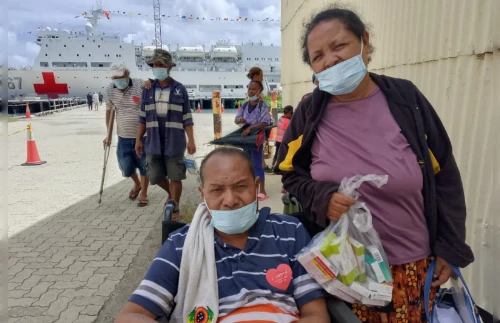
Soft Power ‘Win’ for Beijing as Chinese Medical Ship Treats 5,400 for Free in PNG
Related Article
Soft Power ‘Win’ for Beijing as…
US to Set Up Philippines Fuel…

Japan’s Combat Role in Philippines War…
PNG-Australia Defense Treaty Creates Jobs, Risks…
China-US Competition for Rare Earths Sparks…

North Korean Hackers Offer $70,000 Per…
Other Article
Mexican’s Zoo’s Star attraction Yuji, Abandoned…
Sinhala Hound
UN Permanent Representative of Israel Briefs…
Web Cache Poisoning
Michigan Delivery Driver Shot Missing Dog,…