



Frud Bezhan
RFE/RL
This weekend’s presidential election will only be Afghanistan’s second potential democratic transfer of power.
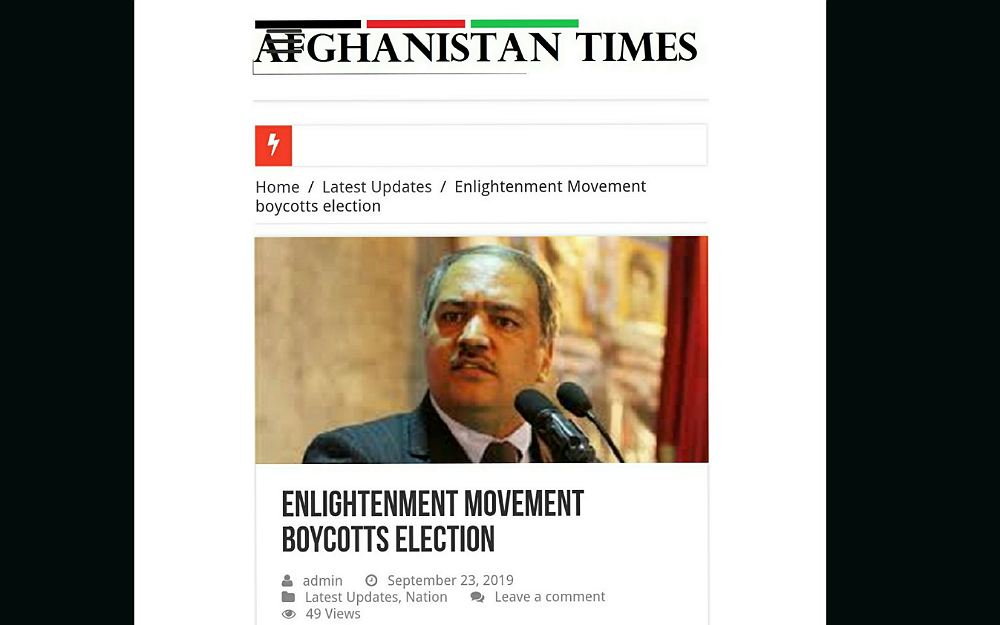
But many Afghans remain wary of the September 28 poll, fearing Taliban violence aimed at disrupting the vote and disillusioned at the widespread fraud and corruption that has tainted other elections since the U.S.-led invasion in 2001.
Analysts say voter fatigue and safety concerns could depress turnout to undermine the legitimacy of the vote and give any winner only a weak mandate to rule a country reeling from economic turmoil, an escalating war, and political infighting.
‘New Crisis’
A contentious, fraud-marred presidential election in 2014 pushed Afghanistan to the brink of civil war before the United States brokered a power-sharing deal that made Ashraf Ghani president and his rival, Abdullah Abdullah, the chief executive.
The October 2018 parliamentary elections, delayed for three years, were undermined by militant attacks, widespread irregularities, and technical and logistical problems.
“People who risked their lives to vote were never respected,” says Habib Khan Totakhil, a restaurant owner and former journalist in Kabul who says he will not vote this time around. “I respect those who look up to the election as something that will bring prosperity and order, but I’m so worried that it will likely take our country to a whole new crisis.”
Turnout was around 39 percent in the 2018 parliamentary elections, while about 58 percent of the 9 million eligible voters cast ballots in the first round of the 2014 presidential election, according to Afghanistan’s Independent Election Commission.
Ahmad Wali, who voted in the two previous election, will also stay away. “My vote means nothing,” says Wali, another Kabul resident. “My vote would never help elect someone so I’ll never vote.”
Problem-Ridden’
“Ali Adili, a researcher at the Afghanistan Analysts Network (AAN), an independent think tank in Kabul, predicts a low turnout because of “insecurity, uninspiring election campaigns by the candidates, and a lack of confidence in the election-management bodies whose credibility has been undermined by previous fraudulent elections.”
A survey of 5,200 people in August by the Transparent Election Foundation of Afghanistan (TEFA), a Kabul-based civic-action body that monitors elections, suggested that only 43 percent of eligible voters planned to go to the polls.
Respondents doubted whether electoral bodies have the freedom or capacity to conduct the election, they felt that voter’s preferences were sacrificed for a political deal in the presidential election five years ago, and they saw severe security threats and challenges.
“A low turnout may call into question the inclusiveness and legitimacy of the election,” Adili says.
The AAN think tank says in a report issued on September 16 that “necessary electoral reform has remained embryonic, making the coming election as problem-ridden as the previous ones, with electoral institutions widely considered non-credible and partial.”
‘Security Doesn’t Exist’
Afghanistan is the world’s deadliest conflict, and security fears persist even in the heavily guarded capital.
“Security doesn’t exist in this city,” says resident Abdul Saboor Azizi, who says he will not vote. “People are killed every day in broad daylight.”
In the capital alone, 221 people have been killed and more than 1,000 others injured in 20 attacks so far this year.
The militant fundamentalist Taliban group that ruled much of the country until the U.S.-led invasion in 2001 and opposes Afghanistan’s central government is estimated to control or contest nearly half of Afghanistan’s 400 districts, depriving many in rural regions of the right to vote.
The government has announced that around 2,000 of 7,400 planned polling stations will be closed on election day — most of them in provinces where the Taliban is active.
In a sign of the insecurity, campaigning has been largely muted.
Ghani, the incumbent, has mostly campaigned remotely, addressing small gatherings outside the heavily militarized capital via Skype or telephone.
A suicide bombing that killed 26 people last week near an election rally in Parwan Province, north of Kabul, where Ghani was due to speak, came as a sharp reminder of the dangers.
In July, 20 people were killed in a bomb attack that was followed by a gunbattle at the office of Ghani’s running mate, Amrullah Saleh.
‘We Need To Support Democracy’
But there are many Afghans determined to vote to show their backing for the most democratic system that Afghanistan has ever had.
“There are many challenges and particularly security threats, but people will come out and vote because the alternative is scary and people want a legitimate government in Kabul,” says Haroun Mir, a Kabul-based analyst.
Some Afghans fear that their rights could be sacrificed in an eventual peace deal with the Taliban.
This month, U.S. and Taliban envoys were said to have been on the brink of a draft peace agreement before Washington abruptly cut off negotiations. The U.S.-Taliban deal could be a precursor to an Afghan-Taliban agreement over the political future of the country.
Observers expect the peace talks to resume after the election.
“We need to support democracy and have a say in who will head the government” that will negotiate peace with the Taliban, says Ali Reza, an unemployed 30-year-old.
“Despite all the challenges, Afghans must stand up to the Taliban’s barbaric acts and we should promote democratic values by voting,” says Muslim Shirzad, a former parliamentary candidate and university lecturer. “But transparency is key. If we have another fraudulent election, we will go toward a civil war.”
RFE/RL’s Radio Free Afghanistan contributed to this story
Copyright (c) 2019. RFE/RL, Inc. Reprinted with the permission of Radio Free Europe/Radio Liberty, 1201 Connecticut Ave NW, Ste 400, Washington DC 20036