



Twitter-based citizen journalist ‘Mr. Li is not your teacher’ on the recent wave of protests in China.
By Wang Yun for RFA Mandarin
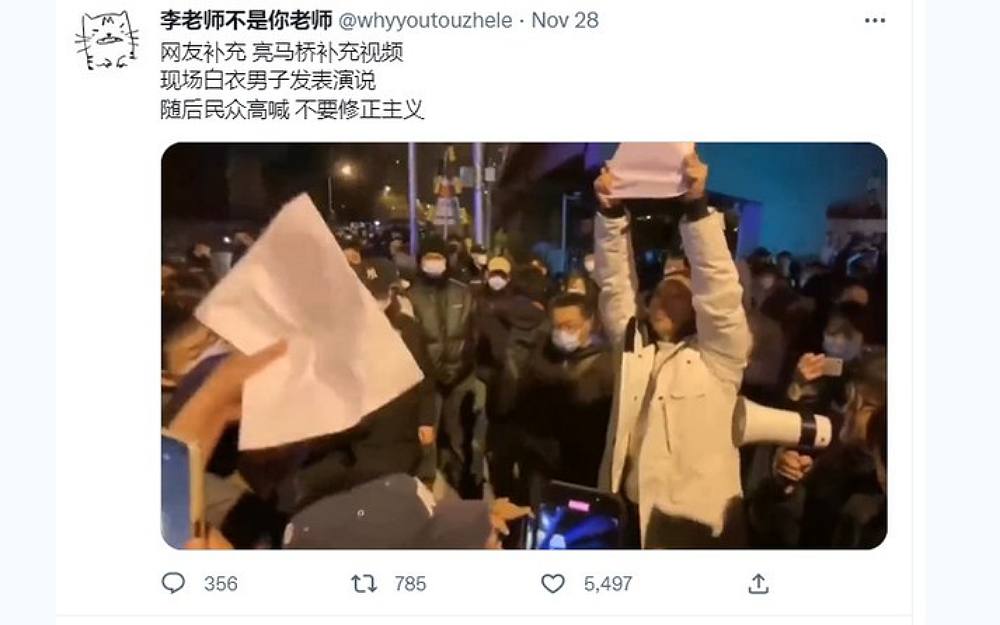
During a spate of spontaneous protests across China last weekend following a fatal lockdown fire in Xinjiang’s regional capital Urumqi, a Twitter user with the handle “Mr. Li is not your teacher” was thrust into the international limelight as he uploaded clip after clip of demonstrations and candlelight vigils around the country, filling a void left by the mainstream media, which largely ignored the protests.
Retaining his online pseudonym for fear of reprisals, the overseas-based “Mr. Li” told Radio Free Asia’s Mandarin Service how he wound up tweeting about the protests with such a high volume of output:
Retaining his online pseudonym for fear of reprisals, the overseas-based “Mr. Li” told Radio Free Asia’s Mandarin Service how he wound up tweeting about the protests with such a high volume of output:
RFA:What was your reason for doing this?
Mr. Li: Actually, it came about by accident. I would often read and receive contributions from Chinese internet users, not just about social incidents that were happening, but also about what was going on in their lives, or their feelings and moods. People know I take these submissions, so they had already gotten into the habit of sending me stuff. So more and more people already knew about me or had already sent me stuff.
They did this because they want to talk about and report on what is happening in China, but they’re afraid that their identities will be discovered, so they want someone else to post it for them.
RFA: You said on Twitter that people in China sent you so much information that it nearly overloaded your computer’s CPU. What happened?
Mr. Li: Protests were happening all over China. At around 5.00 or 6.00 p.m. local time here in Italy [on Nov. 27], which was when the protests back home were at their height, I was getting about 30 to 50 direct messages a second contributing content. No sooner had I gotten a message and gone to edit it than it would be deleted. I don’t know whether it was getting bounced by other incoming messages.
A lot of people were using Twitter, and a lot of them were sending me content from the scene [of protests], even small ones, some of them in schools, where students had decided they wanted to do something.
These weren’t different submissions regarding the same incident, but different reports of an infinite number of incidents. I had reports from Beijing, Shanghai, Guangzhou, Chengdu and Wuhan; the biggest cities in CHina.
There were countless tweets, so many tweets. Some people would submit the same content repeatedly without realizing they had done so, so my DMs were very, very full.
RFA: How do you choose from among so much content, and how do you verify any of it?
Mr Li: I tend to judge the authenticity of content from experience. Also, if more than a dozen people contribute from the same event at the same time, it is basically possible to judge the authenticity of the reports. If only one person contributes something that sounds exaggerated, then it’s probably fake news.
I always hope that I can report this information objectively, accurately, and in a timely manner. However, as an individual and as a citizen journalist, I put timeliness first. I’m trying to deliver the message as quickly as possible, so you can see a lot of it within minutes of an event happening. Because of this, I will also make some mistakes, which is unavoidable. But I try to fix them when I do.
RFA: Which posts had the biggest impact on you personally?
Mr. Li: There were a lot of reports that moved me, because I had never seen such things before. Back in 1989 [at the time of the student-led democracy movement], I wasn’t even born. I only heard about it from watching documentaries and seeing news photos. But seeing these people actually taking to the streets and chanting those slogans had me tearing up as I was editing. I received so much of it, I really couldn’t say which [had the biggest impact].
There are two I can think of, one of which was a livestream of people setting fire to the gates at the Foxconn factory, then facing off with the police, which really impressed me, because I haven’t seen a mass incident like that in years, particularly not live streamed.
The other was from Shanghai on [the night of Nov. 26], when everyone was shouting, “Down with the traitor-dictator Xi Jinping, down with the Communist Party.” Then there was Chengdu. What happened there [on Nov. 27] was very different, because they made sure to protect everyone around them in the demonstration, telling them how to prevent a crush from forming and how to help each other out.
I found another clip from Shanghai extremely moving, where, if the police went to try to arrest [a protester], the others would grab them and pull them back [out of reach].
RFA: This was definitely a wave of protests. Do you think it is a civil uprising?
Mr Li: I don’t actually think it is, because people were calling for something really simple. They want to be able to get food, to go about their lives, and they were saying that they can’t go on like this. It was a very basic demand, and all of this anger came from the [COVID-19] restrictions. These long-term restrictions have left them with no income, an economic downturn, and include restrictions on [overseas] travel, and all kinds of chaos and disruption resulting from the zero-COVID policy.
There is also anger now that they have seen what this means in reality, and about the psychological damage they have suffered, including the long-term harm of controls on their freedom of speech and on the flow of information. It was only on the [Saturday and Sunday] nights that everyone started calling for the Communist Party to step down and for Xi Jinping to be ousted. Those slogans were actually mostly heard in big cities.
We didn’t really hear these slogans in Urumqi at the beginning [immediately after the deadly fire], nor in the smaller cities, nor even in large cities like Wuhan, so I don’t think this was a requirement for most people. For most people, the fundamental demand was an end to zero-COVID and an end to lockdowns.
Most Chinese people were raised with the patriotic education program [in schools and universities], so they see the government and China as the same thing. They think that patriotism means supporting the government. The idea that they could love their country but not the ruling party doesn’t occur to them. Maybe they think opposing the government is disrespectful, or something taboo, or is something that conflicts with their own values. The demands [of these protests] haven’t yet reached the level of trying to topple an entire dynasty.
RFA: Aren’t you worried that your true identity will be exposed?
Mr. Li: ‘Teacher Li’ is one of my nicknames; I have had it since I was very young, because I started working as a part-time teacher when I was very young, so people have always called me that. I’m not worried about my real name coming out because I’m not a completely anonymous person. I’m almost on real-name terms with a lot of people online, with my followers.
RFA: You said on Twitter you are getting trolled from inside China. What’s happening with that now?
Mr. Li: I received a very large number of attacks from pro-government trolls starting on Nov. 27, including personal threats. Some claimed to be from the state security police, saying they know where I live, and they want me dead. Some people in China have started to try to discredit me, because a lot of people there were using me as a source of news. They have been smearing me, calling me a ‘mastermind’ behind the protests. It’s pretty funny that they think the whole of China [erupted in protest] just because I tweeted a few things.
RFA: You warned the Chinese police to leave your family back home alone. Did they?
Mr. Li: Actually, the police paid a visit to my house [in China] today. I don’t know what they wanted to achieve. Some policemen went to my house to investigate, wanting to know where I was … but [my family] didn’t tell them anything. I don’t know if they already knew about me and were just going there to confirm it, or what.
RFA: Given the current political logic in China at the moment, you could be accused of being a “foreign force,” and of trying to manipulate the protests behind the scenes. How would you respond to that?
Mr. Li: The way I cope with this is by only reporting the news, and by sticking to the standards of neutrality, objectivity, truthfulness, and timely reporting. I try to avoid errors. Let them slander me as an instigator, as calling on people to act. I’m just reporting what’s going on. But of course they have stuck their labels on me.
I will keep on doing this regardless, and the reason is very simple. I think there is a strong need for a neutral, objective, timely and truthful voice reporting on what is happening in China on Chinese Twitter. Someone needs to write this stuff down.
A lot of people on Chinese Twitter post highly emotive content. I understand why, because they were prevented from engaging in normal speech before, in China. But I think there should be someone who [posts more objectively]. I was called to do this, so I took it on. It’s like the torch has been handed to me.
RFA: What’s the difference between what you do and news from the mainstream media?
Mr. Li: There is a difference. Mainstream media like yours need very accurate information, information that is proven to be absolutely true, so timeliness may come second. In this regard, we seem to be just the opposite, because on social media, speed comes first, which means there is a lot of fake news and rumor.
Chinese people have gotten into the habit of using social media. If something happens, it will be spread quickly in a very secret and private way through WeChat. You receive a message, forward it with one click, and send it to countless groups, and then countless people in countless groups see the message, and they immediately spread it further. This happens unimaginably fast, so social media can outpace mainstream media, now that everyone has a smartphone.
But [during these protests] a lot of these people I represent were passing information via Twitter back into China, because these messages were unable to spread inside China. If something unexpected happens, you can’t even type about it, and it will disappear immediately and be covered up.
You have no option but to go outside the Great Firewall if you want to see the news. Our biggest role is to let people behind the Great Firewall know what is going on in China.
Translated and edited by Luisetta Mudie.
Copyright © 1998-2020, RFA. Used with the permission of Radio Free Asia, 2025 M St. NW, Suite 300, Washington DC 20036. https://www.rfa.org.