



Activists and ethnic armies can no longer count on the government to combat trafficking.
By RFA Burmese
Drug production and usage is on the rise in Myanmar in the aftermath of the military coup, ethnic rebel groups and activists said Monday, as countries around the world observed International Day Against Drug Abuse and Illicit Trafficking.
The growth in Myanmar’s drug market in the more than two years since the Feb. 1, 2021, takeover is directly correlated with what observers have described as a precipitous decline in rule of law in the country amid the junta’s poor governance, the groups said.
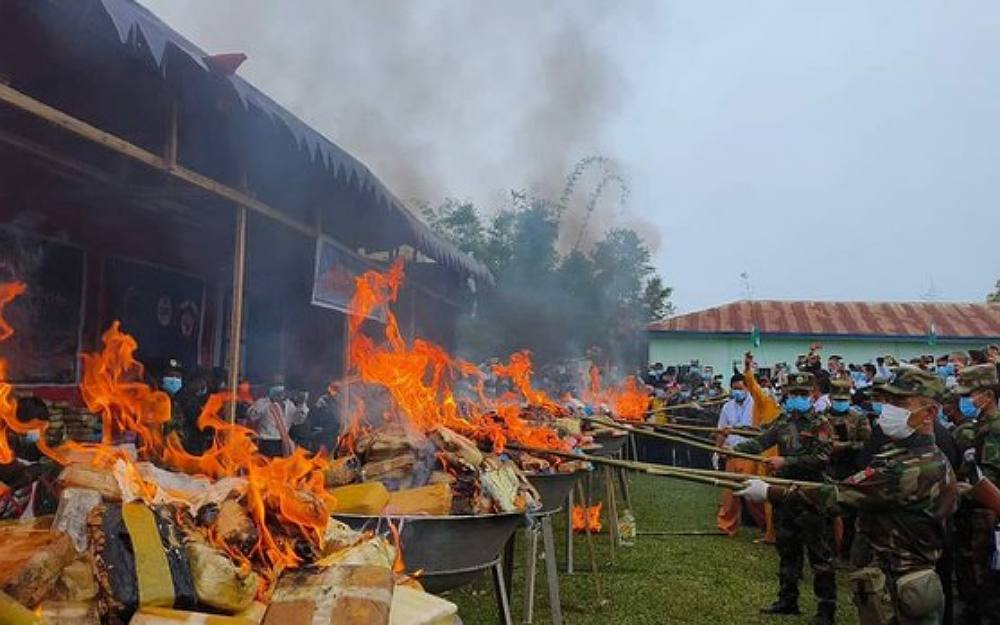
On Monday, the Ta’ang National Liberation Army, or TNLA, said it had destroyed 900 million kyats (US$430,000) worth of drugs seized in northern Myanmar’s Shan state from 2018 to 2023, to mark the annual U.N. day to combat drug abuse and the illegal drug trade.
The rebel group said the haul included nearly 160 kilograms (350 pounds) of opium, 57 kilograms (125 pounds) of heroin, and more than 3.4 million methamphetamine pills known as “yaba.”
Armed conflict between the military and the ethnic Restoration Council of Shan State / Shan State Army, or RCSS/SSA, following a junta offensive in the region prevented the TNLA from destroying the drugs until this year, it said.
TNLA spokesperson Lt. Col. Mai Aik Kyaw told RFA Burmese that drug production and abuse in Myanmar largely takes place in areas “with junta troops or a police presence, where the rule of law is said [by the regime] to ‘prevail.”
“The drug trade has increased since the military coup,” he said. “We sometimes have to go into towns to seize drugs [because the junta isn’t effectively policing the trade].”
In addition to cracking down on drug trafficking in Shan, the TNLA has also had to make up for the junta’s failure to promote drug rehabilitation programs in the state, Mai Aik Kyaw said.
Military involvement?
But the TNLA spokesperson alleged that the increase in drug trafficking and abuse isn’t merely a result of willful ignorance on the part of the junta.
He said that some of the drugs in Shan are being produced by militia forces directly under the junta, such as the Pyu Saw Htee, to fund food and salaries for their fighters.
The RCSS/SSA also reported holding drug awareness activities on Monday to mark International Day Against Drug Abuse and Illicit Trafficking. It said in a statement that since 2022 it had seized nearly 460,000 MDMA, or ecstasy, pills and 975 kilograms (2,150 pounds) of methamphetamine known as “ice.”
Ethnic rebels also reported seeing a growth in drug production and abuse, but said they have been unable to address it because they are too busy fighting junta troops amid a military offensive.
Thant Suem Mont, chairman of the anti-junta Chin Defence Force, or CDF, said that eradication efforts in Chin state under the deposed civilian government had abruptly ended with the military takeover, putting the onus on his rebel group to fight the trade.
But he added that poppy cultivation “will have to be dealt with later” because the CDF does not have the resources to combat both the trade and the junta.
“Poppy production has increased since the military coup,” he said, with cultivation “almost doubled” over the same period.
‘It’s as if the sellers have licenses’
Shan and neighboring Kachin state have long been centers for illicit drug production.
Following China’s 1912 revolution that brought about the end of the Qing Dynasty, the country’s new government prohibited opium production, prompting a wave of Chinese opium poppy growers to relocate to the remote regions across the border in Myanmar.
The opium trade thrived in Shan and Kachin, in part due to lax regulation in Myanmar, until a total ban on the drug’s use and production was introduced in the mid-1970s.
But anti-narcotics activists told RFA that they have seen a substantial upt3ick in the drug trade across Myanmar since the coup, with abuse spreading from the country’s urban to its rural areas. Increased production has driven down prices, they said, with one pill of yaba costing as little as 350 kyats (17 U.S. cents) and a gram of heroin only 5,000 kyats ($2.40).
Tin Maung Thein, a resident of Magway region’s Kyaukme township who has worked in drug prevention for more than 30 years, said that since the takeover “drugs have become the best goods to trade” in Myanmar amid a breakdown in the rule of law.
“It’s as if the sellers have licenses,” he said. “[Addressing this issue] is the answer to the drug crisis … [and] that’s why I am very worried about the future.”
The junta appears to at least acknowledge that the drug trade is a problem in Myanmar.
On Monday, junta Interior Minister Lt. Gen. Soe Htut said in a statement marking International Day Against Drug Abuse and Illicit Trafficking that while the regime has made arrests, “there has been no decrease in illegal drug trafficking” in the country.
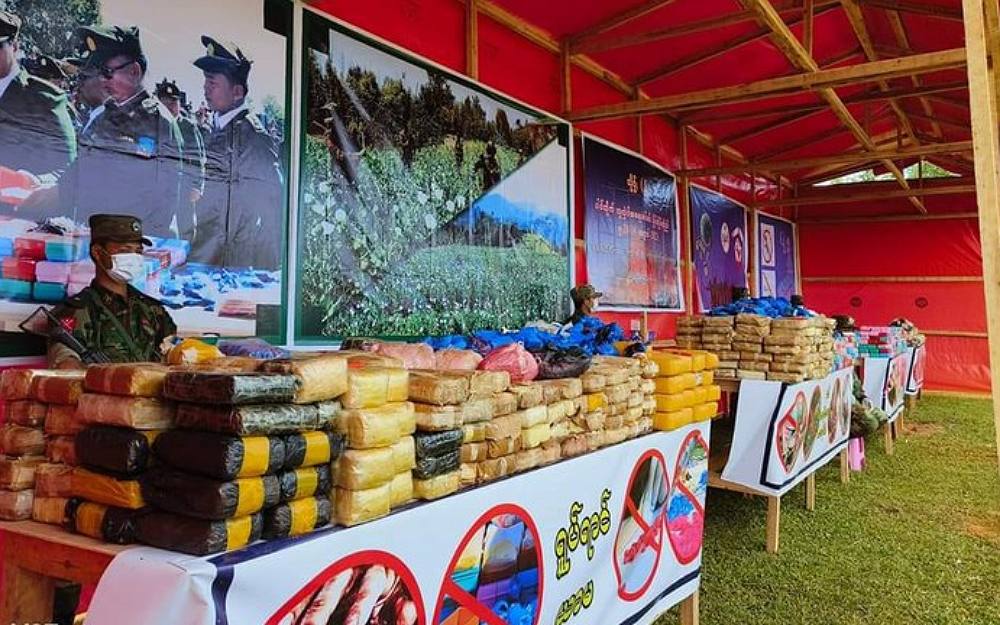
The junta did not make a show of burning seized drugs in observance of the day, as it has in previous years, but pro-junta media reported that authorities had destroyed 1.2 trillion kyats (US$572,000) worth of illicit drugs in the cities of Yangon, Mandalay, and Taunggyi.
Reports said that the junta had seized US$462 million worth of drugs – including heroin, opium, ecstasy, ice, marijuana, and opium byproducts – in 2021, and US$534 million worth in 2022. They said that the value of drugs seized by the junta in 2023 had reached nearly US$180 million as of May.
UNODC report
A report issued in late March by the United Nations Office on Drugs and Crime, or UNODC, found that opium poppy cultivation had increased significantly in Shan, Kachin, Kayah, and Chin states in the more than two years since the military coup.
It said Shan state was the largest producer of opium poppies in the country by far, with 39%, while Chin was responsible for 14% of production, and Kayah and Kachin produced 11% and 3%, respectively.
Since the coup, poppy cultivation in Myanmar’s mountainous areas has increased by more than 100,000 acres, the report said. Potential yield from such an increase is equivalent to 790 tons of refined opium, it said, or an 88% growth over production prior to the takeover.
Translated by Myo Min Aung. Edited by Joshua Lipes and Malcolm Foster.
Copyright © 1998-2020, RFA. Used with the permission of Radio Free Asia, 2025 M St. NW, Suite 300, Washington DC 20036. https://www.rfa.org.