



Sirwan Kajjo

The so-called Islamic State (IS) may have been defeated militarily, but the terror group has left behind massive devastation in Syria and Iraq that is beyond repair — at least for now.
Last month, U.S.-backed Syrian Democratic Forces (SDF) declared victory over IS after capturing its last stronghold of Baghuz in eastern Syria.
While communities across Iraq and Syria are trying to rebuild their lives after nearly five years of brutal IS rule, some find it extremely difficult to repair the damage the terror group has inflicted on religious and archaeological sites.
From its rise in 2014 until its final days in 2019, IS plundered, destroyed and burned all Christian landmarks, including churches and museums. In a propaganda video disseminated online, IS militants were seen dismantling Christian artifacts and statues with sledgehammers and destroying historical collections when they took control of the Iraq city of Mosul in 2014.
Palmyra
A year later, IS militants overran the ancient Syrian town of Palmyra, which was known for its Roman-era ruins.
In a 2015 interview, Irina Bokova, then-director of UNESCO, said that IS’s destruction of history in Syria and Iraq was tantamount to cultural cleansing.
“I believe that this strategy of the destroying of heritage and culture of communities that live there goes hand in hand with the persecution of minorities,” Bokova said.
She added that “the darkest part of this tragedy is selling the subjects of art … to finance their extremist terrorist activities.”
In 2015, the U.N. Security Council adopted a resolution banning all trade in antiquities from Syria and reaffirmed another ban on Iraqi artifact sales adopted nearly 15 years ago.
Christians hardest hit
Since the outbreak of Syria’s civil war in 2011, Christians were among minority groups hit hardest by IS and other radical groups in Syria.
Before IS came to prominence “in 2013 al-Nusra Front [a former branch of al-Qaida in Syria] attacked the Mar Malki church in northeast Syria,” said Elizabeth Gawrieh, leader of the Syriac Union Party, a Christian political group based in Qamishli, Syria.
“The militants destroyed it after stealing all of its contents,” she told VOA.
Raqqa
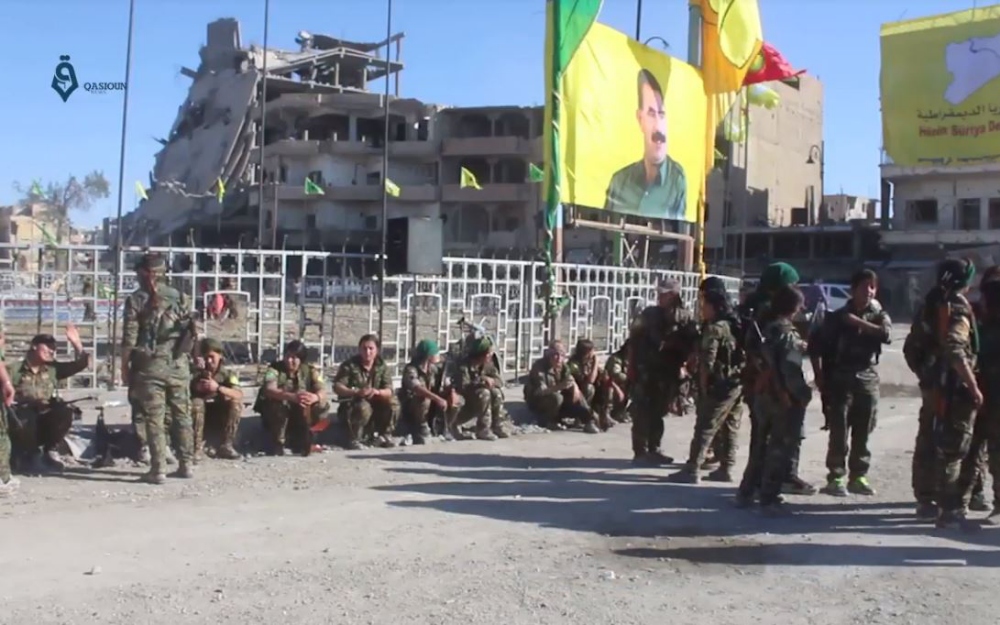
In 2014, IS took control of the Syrian city of Raqqa, which became the de facto capital of the terrorist group. IS immediately reinvented the jizya, an Islamic tax imposed on non-Muslims.
Under that law, Christians were forced to pay monthly or yearly fees for living in IS-held territory.
IS “turned the Martyrs Church in Raqqa into a prison where many dissidents were held, including Christians,” Gawrieh said.
After the city was freed from IS in October 2017 the church was barely recognizable, she said.
“Its contents were perhaps sold in the first month of their [IS] arrival in Raqqa,” Gawrieh added.
Smugglers
Ahed al-Hendi, a Washington-based analyst who recently returned from Syria, says that most of the stolen Christian artifacts were sold outside Syria.
“Turkey and Russia are two countries whose black markets received large amounts of these items,” he said.
“They were businessmen and mafia lords who would pay ISIS and other extremist groups millions of dollars to buy those stolen relics,” he said, using another acronym for IS.
Al-Hendi added that at some point during the conflict the Syria-Turkey border was largely porous, “which allowed IS to smuggle out as many artifacts as they could take from churches in areas under their control.”
When IS was in control of large swaths of territory in Iraq and Syria, the terror group transferred large quantities of Christian objects stolen from churches from the Nineveh Plains in Iraq to Syria and eventually smuggle them to black markets abroad, according to experts.
Before the rise of IS, Christians largely lived in the Nineveh Plains region.
70 churches destroyed
At least 70 Christian churches have been destroyed since the beginning of Syria’s war, according to the Syrian Network for Human Rights, a group that monitors war in Syria.
“Every time extremist groups target a church, they make sure to steal everything inside it before they destroy. They want to erase anything related to Christianity in this country systematically,” said Gawrieh of the Syriac Union Party.
Nusian Matosian, a Christian Armenian resident of the Syrian town of Tel Abyad, recalls what happened to her local church when IS fighters seized control of the border town in 2014.
“My family has been the gatekeeper of our church since it was built 105 years ago,” she said. “But when [IS] terrorists came to Tel Abyad, they removed us from the church immediately. Then they shut it down. They prevented people from frequenting their place of worship.”
Tel Abyad was freed in mid-2015 by U.S.-backed forces and the church reopened its doors. But not everything has returned to normal.
IS “has taken dozens of holy icons and artifacts from the church that were valuable to us as Christians,” Matosian said.
“We were able to rebuild the church, but how can we bring back those priceless items that were taken from it?” she said.
Gawrieh said that it is the responsibility of international community to help return the stolen Christian artifacts from churches in Syria and Iraq.
“Just like how the international community helped us get rid of [IS] militarily, it is their responsibility to help us bring back these items that belong to all humanity,” she said.