



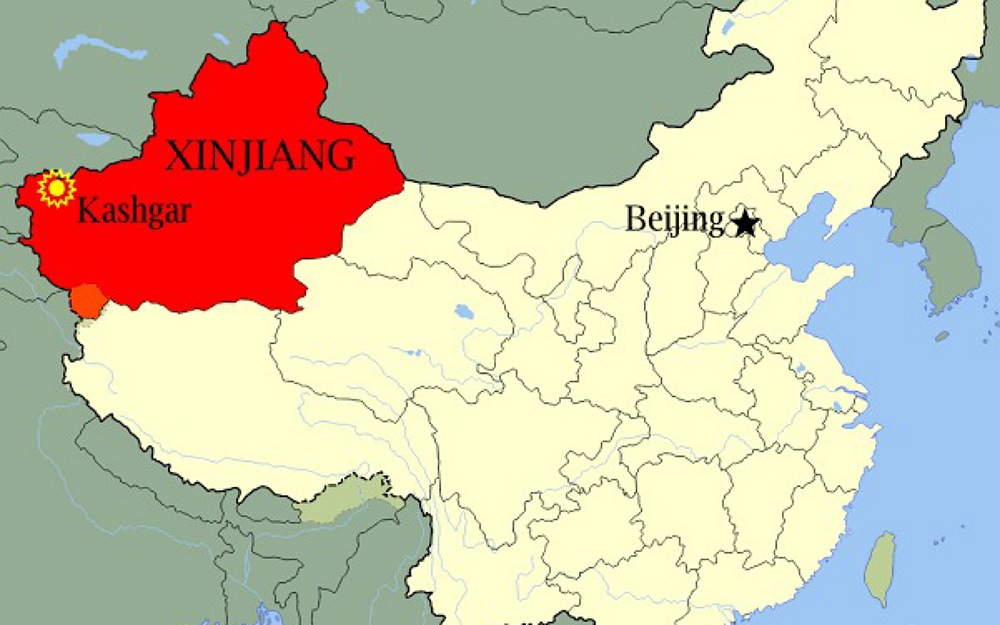
Authorities in Kashgar (in Chinese, Kashi) prefecture, in northwest China’s Xinjiang Uyghur Autonomous Region (XUAR), are restricting Uyghurs from observing Islamic wedding rites, according to sources, amid a campaign that has labeled a broad spectrum of religious practices as “extremist.”
Last month, RFA’s Uyghur Service received a tip from a listener claiming to be a Uyghur living in Shanghai who said he had inquired with an official from Kashgar about permission to include nikah—considered an essential religious and cultural tradition in Muslim weddings—as part of his marriage back home in Kona Sheher (Shufu) county’s Toqquzaq township.
Historically, Uyghur couples have performed nikah on the morning of their wedding, gathering with their immediate families, as well as their best man and maid of honor, in the presence of an akhun, or Muslim officiant. Multiple wedding receptions—complete with food, dancing, and merriment, and attended by extended family and members of the couple’s social circle—typically follows during the same afternoon and evening, or over the course of subsequent days.
The source, who spoke on condition of anonymity for fear of reprisal, provided RFA with what he said was a recording of the phone conversation, in which he repeatedly asks whether he can hire an akhun to preside over a nikah ceremony because he had heard from his fiancé—via local officials—that it was no longer possible to do so.
In the recording, after learning that the caller is based in Shanghai, the Han Chinese staffer at the Kona Sheher County Government Office refuses to discuss the matter over the phone or provide him with contact information for officials who can provide an answer to his question.
As a citizen, I need you to tell me,” the Uyghur caller says in Mandarin Chinese, to which the Han Chinese staffer angrily responds, “I can’t—I don’t know your identity.”
RFA also spoke with a Uyghur businessman trading in neighboring Kazakhstan, who said that the ban on nikah has been in place for “at least more than one year.”
The businessman, who also declined to be named, claimed that authorities began punishing couples who had married through nikah but without a government-issued marriage license for “illegal marriage” prior to the start of a campaign of mass incarceration in the XUAR. Authorities are believed to have held up to 1.8 million Uyghurs and other Muslim minorities in a vast network of internment camps in the region since April 2017.
After the internment campaign began, he said, authorities began pushing couples to wed solely by obtaining an official marriage license and without nikah, which they identified as a sign of “religious extremism.”
“They started restricting nikah a long time ago,” he said.
‘Not possible’ in Kashgar
RFA recently asked a Han Chinese government employee in the seat of Kashgar prefecture about restrictions on nikah who said he could not comment and referred questions to higher-level officials.
However, a Han Chinese employee of the Kashgar Prefecture Bureau of Civil Affairs, which provides marriage licenses in the region, confirmed that hiring an akhun to officiate a nikah wedding ceremony is “not possible right now.”
The employee said nikah is prohibited in Kashgar prefecture but was unable to speak for other prefectures or pinpoint when the policy began.
RFA also spoke with officials from smaller administrative divisions in Kashgar to seek further information about wedding restrictions, including a Uyghur cadre from Kona Sheher’s Pahtekli township, who confirmed that it had been at least a year since the a nikah ceremony had taken place anywhere at the village level under his jurisdiction.
“There are no such things now,” he said, adding that couples “don’t have to do anything other than get the stamp,” referring to an official marriage license.
“It’s been something like a year, a year or two. They’re just getting the stamp and taking [their brides] home.”
The cadre said that local officials have been explaining the restrictions on nikah, as well as on traditional wedding receptions, by telling residents “that they can’t gather, that people can’t come to their houses” because “it’s dangerous for stability.”
“The akhuns have it easy,” he said, adding that there is essentially no use for religious specialists anymore.
Meanwhile, the cadre suggested, residents have grown accustomed to forgoing nikah for their weddings.
“No, no, given that they understand the law—everyone understands,” he claimed. “They’re all used to it, OK? They’re used to it.”
Assault on religious practices
Earlier investigations by RFA have shown that other religiously inflected practices, including wearing beards and various styles of dress—such as long tunics for women—have been heavily restricted by authorities in the XUAR over the past several years.
In 2015 and 2016, regional authorities even restricted the giving of zakat, or alms—the act of which constitutes one of the five pillars of Islam. Restrictions on almsgiving have effectively prevented Uyghurs from being able to provide financial and social support to one another.
Reports of restrictions on nikah provide the latest example of what observers say is a bid by authorities to separate Uyghurs from even the most mundane expressions of religious practice and belief.
In June, the U.S. State Department noted “the scope and severity of reported religious freedom violations” specific to the XUAR in its 2019 International Religious Freedom Report.
The report cited the use of detentions “in furtherance of implementing a Xinjiang counterextremism regulation that identifies ‘extremist’ behaviors (including growing beards, wearing headscarves, and abstaining from alcohol) and the National Counterterrorism Law, which addresses ‘religious extremism.’”
Last month, the United States leveled sanctions against several top Chinese officials deemed responsible for rights violations in Xinjiang, including regional party secretary Chen Quanguo, in the first time Washington had sanctioned a member of China’s powerful Politburo.
Washington also sanctioned the Xinjiang Production and Construction Corp and top XPCC officials “for their connection to serious human rights abuse against ethnic minorities in Xinjiang,” the Treasury Department said in a statement.
China’s Foreign Ministry responded with retaliatory sanctions targeting several Republican lawmakers, Ambassador-at-Large for International Religious Freedom Sam Brownback, and the bipartisan Congressional-Executive Commission on China advisory panel.
Reported by Shohret Hoshur for RFA’s Uyghur Service. Translated by Elise Anderson. Written in English by Joshua Lipes.
Copyright © 1998-2020, RFA. Used with the permission of Radio Free Asia, 2025 M St. NW, Suite 300, Washington DC 20036. https://www.rfa.org

Tibetan Rights Group: South Africa Arson Attack is Transnational Repression by CCP
UN Security Council Meets on Situation in Sudan and South Sudan

Black Bear Breaks into California Library and Eats Peanut Butter,Honey

Bouvier Des Flandres Dog Breed

Foundation Models
China Covered Up the Cause of a Detained Uyghur Father’s Death
UN Security Council Meets on Situation in Middle East, Including Palestinian Question

Six-Year-Old Becomes World’s Youngest DJ
Subscribe Our You Tube Channel

Fighting Fake News
Fighting Lies