



Reyad Hossain/Bangladesh
Bangladesh will have a hard time complying with the loan recommendations of the International Monetary Fund (IMF) without antagonizing the public and big business ahead of the national election, analysts and stakeholders said.
When the Washington-based global lender agreed last month to loan Bangladesh U.S. $4.7 billion, it also recommended the nation reduce tax breaks and fuel subsidies, and increase tax revenue over three years.
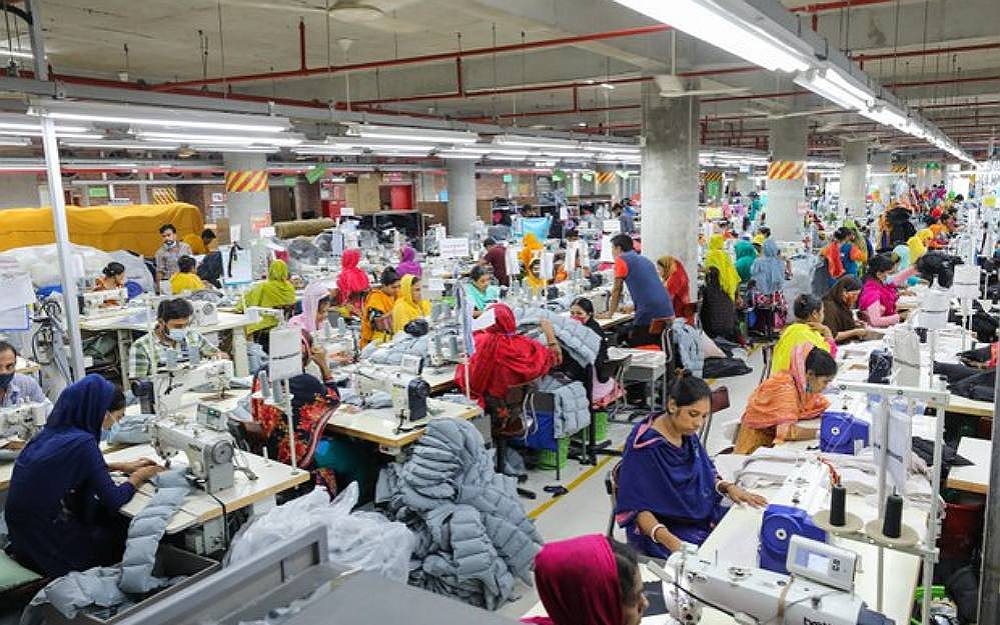
Bangladesh had been hailed for its economic success over the previous decade, but the U.S. $416 billion economy suffered the effects of the COVID-19 pandemic. At the same time, its garment industry, which accounts for about 80% of the country’s exports, saw a plunge in demands from Western importers.
Post-pandemic recovery, meanwhile, has been threatened by the ripple effects of Russia’s war in Ukraine.
Dhaka said it sought the loan as “a precautionary measure.”
And while the IMF said, “Bangladesh’s risk of debt distress is low and its capacity to repay the [loan] is adequate,” the loan came with strings attached.
Three days after it was approved, the IMF in a report detailed a “sequencing of reforms” that Bangladesh needed to implement ahead of regular reviews, to continue receiving installment payments. The report said there would be six half-yearly reviews.
Prime Minister Sheikh Hasina’s government, however, denies the IMF will force the government’s hand.
“We are taking the IMF loan under almost no conditions,” Hasina said in parliament on Jan. 18.
Ahsan H. Mansur, a former senior IMF economist, said Bangladesh has previously borrowed from the funding institution while agreeing to comply with conditions.
“In 2012, as a condition to receive a U.S. $1 billion loan from the IMF, Bangladesh agreed to approve value-added tax legislation in line with the global best practices,” Mansur, who heads the Policy Research Institute (PRI) in Dhaka, told BenarNews.
“The government took seven years to implement it and then was forced to amend it under pressure from businessmen. That was why the IMF even stopped disbursing one or two installments of the loan.”
Mansur said such a situation could occur again, but there would be a lot of negotiations before any loan instalments were canceled.
Raising tax revenue
The thorniest of the IMF’s proposals is raising tax revenue, analysts said.
“The [recommendation] that will be the most challenging for the government to meet is this revenue target,” Mohammad Abdur Razzaque of the Research and Policy Integration for Development, a Dhaka-based research think-tank, told BenarNews.
“For one, it won’t be easy to reduce tax exemptions, and the NBR lacks the capability,” he said, referring to the National Board of Revenue, the principal government organ tasked with collecting taxes.
The country of more than 160 million people had only 2.3 million income tax returns submitted last year, accounting for one of the lowest ratios of taxes to gross domestic product (GDP) in South Asia.
Taxes collected by Bangladesh were only 7.8% of its GDP in the 2021-22 fiscal year, which the IMF expects the government to increase to 9.5% by 2026. That would mean that Bangladesh must collect an additional $23 billion in revenues in the next three years.
The IMF also recommended eliminating or reducing “less-effective tax exemptions,” but analysts suggest that scaling back those exemptions awarded to key industries will face resistance from influential industry lobbies.
Industry lobbies already are signaling their displeasure.
“It won’t be possible to attain such a steep goal,” Mohammad Hatem, who heads a garment industry lobby, told BenarNews.
“In order to do so, those already under the tax net will be faced with additional pressure.”
Md Jashim Uddin, who heads the Federation of Bangladesh Chambers of Commerce & Industries, agreed.
“If the government wants to collect revenues under the status quo, businesses will come under a lot of pressure,” he told BenarNews.
Bangladesh authorities have not committed publicly to eliminating or bringing down tax exemptions.
“We aren’t worried about IMF’s emphasis on the tax-to-GDP ratio. The exemptions we are granting are benefitting the economy. We will demonstrate that,” NBR chairman Abu Hena Md Rahmatul Muneem said during a recent pre-budget discussion in Dhaka.
Recent trends suggest that NBR is making some progress, but it may not be enough.
By its calculations, NBR increased revenues by 11% in the first six months of the fiscal year. But Bangladesh’s projected year-to-year revenue increase needs to be more than 20% on average.
Burden on the poor
One IMF recommendation, that Bangladesh “rationalize” energy subsidies by “adjusting” the prices of petroleum-based products, could affect a huge segment of the poor, analysts said.
The government previously increased gas prices by more than 50% and diesel by 42.5%. In September, the country’s inflation rate hit 9.1%, up from 5.59% a year previously.
The government also increased electricity prices twice, and natural gas prices for industrial use.
A rise in the cost of power will lead to a rise in the price of goods, because businesses, too, will see their expenses going up.
“If energy and electricity prices continue to swell, it would be difficult,” Mostofa Azad Chowdhury Babu, a businessman, told BenarNews.
The country’s opposition has seized on the public frustrations ahead of the national election slated for next year, but the ruling Awami League government has downplayed concerns stemming from the IMF reform proposals.
PM Hasina framed the increase in fuel prices as the government’s broader push to reduce subsidies rather than compliance with IMF recommendations.
Copyright ©2015-2022, BenarNews. Used with the permission of BenarNews.https://www.benarnews.org/