




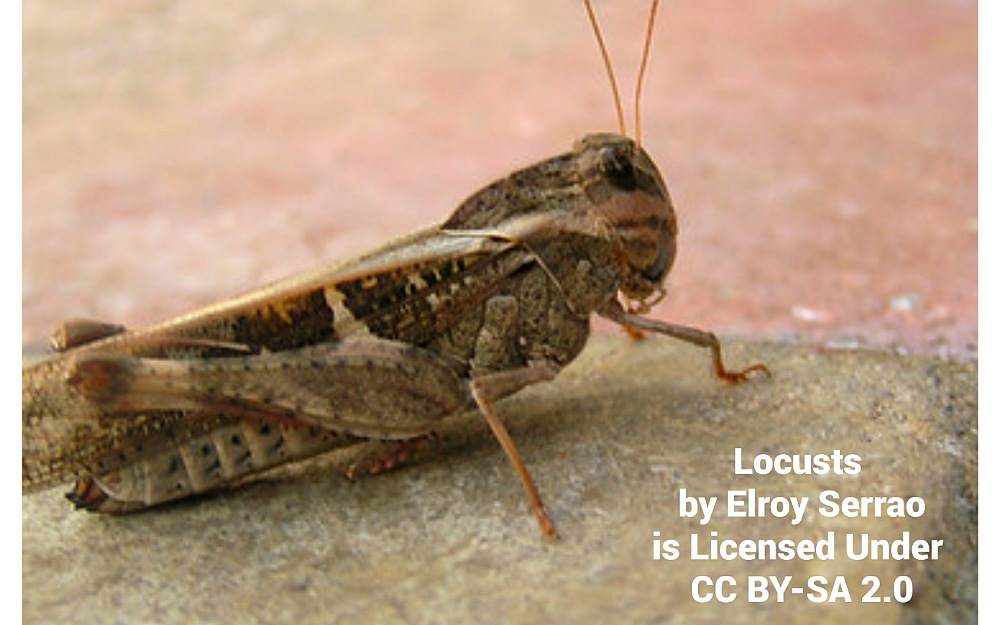
At a glance, the desert locusts in this arid patch of northern Somalia look less ominous than the billion-member swarms infesting East Africa in the worst outbreak some places have seen in 70 years.
But their time will come.
Small and wingless, the hopping young locusts are the next wave in the outbreak that threatens more than 10 million people across the region with a severe hunger crisis.
And they are growing up in one of the most inaccessible places on the planet. Large parts of Somalia south of this semi-autonomous Puntland region are under threat, or held by, the al-Qaida-linked al-Shabab extremist group. That makes it difficult or impossible to conduct the aerial spraying of the locusts that experts say is the only effective control.
Somalia has declared the outbreak a national emergency. Across the region, it has the potential “to be the most devastating plague of locusts in any of our living memories if we don’t reduce the problem faster than we’re doing at the moment,” U.N. humanitarian chief Mark Lowcock said.
As an armed Somali policeman stood by, experts on Thursday walked across the dry land crawling with the young locusts and explained the threat to come if the world doesn’t act right now.
“The world needs to know this is where it all begins,” said Alberto Trillo Barca, a spokesman for the U.N. Food and Agriculture Organization. “In the next three or four weeks, these nymphs, as we call them, will develop wings.”
Then they are expected to set off for neighboring Kenya and Ethiopia, where a handful of planes spraying pesticide can only do so much if such swarms keep arriving.
Climate experts have pointed to unusually heavy rains, aided by a powerful cyclone off Somalia in December, as a major factor in the outbreak. The locusts were carried in by the storm’s winds from the Arabian Peninsula and parts beyond, and now they are feeding on Somalia’s fresh vegetation.
With more rains expected in the region in the coming weeks, the number of locusts if unchecked could grow by up to 500 times by June, when drier weather is expected.
But that drier weather is not necessarily the solution, said Dominique Burgeon, the FAO’s emergency and resilience director.
The density of the locusts is now so high that even normal moisture can lead to another generation, he said.
“We cannot believe in Mother Nature to solve it,” he explained.
Without enough spraying to stop the swarms, the already worrying outbreak could turn into a plague, “and when you have a plague, it takes years to control,” he said.
Against that sweeping outlook, a few masked workers with white protective suits and pesticide containers strapped to their backs stood in the camel-crossed Somali desert, spritzing the thousands of locusts clinging to thorny bushes.
The world’s changing climate brings the risk of more cyclones coming in from the warming Indian Ocean off East Africa, climate experts say. With that, the likelihood of further locust outbreaks grows.
The “sort of new normal,” Burgeon said.
And that means Kenya, Ethiopia and other East African countries that rarely see such outbreaks and found themselves largely unprepared for this one could join “frontline countries” in parts of West Africa and the Middle East, experts say. Those countries have well-trained monitoring and prevention systems in place for more frequent locust outbreaks.
The FAO has asked international donors to give $76 million immediately to help control this outbreak. So far $19 million is in hand, Burgeon said.
“The biggest challenge is the scale of the breeding, as you can see all around us,” Barca said. These locusts, he said, will be migrating to southern Somalia and parts of Kenya and Ethiopia just as crops are germinating there.
“If at that time there are huge quantities of locusts around, it will have a devastating impact on the crops,” Burgeon said.
Other East African countries including Uganda, South Sudan, Eritrea and Djibouti are also at risk, Burgeon said. Millions of people in some of these places are already facing hunger in the wake of civil war or more common challenges such as poverty.
Here in rural Somalia, where about 50% of the people depend on animals for their livelihoods, the locusts are eating the pasturage. The animals weaken, their milk decreases and small children, who depend on the milk to survive, suffer skyrocketing malnutrition, the experts said.
Those fighting the locust outbreak may try to negotiate with Somalia’s extremist fighters to allow spraying in rural areas where they are active, Burgeon said. Already emergency workers are going in where they can.
In a few weeks the young locusts will shed their skin, said Keith Cressman, a senior locust forecasting officer with the FAO.
“It takes a few days to warm up their wings,” he said. Some test flights follow and they’re on the move.
The locusts at that stage are bright pink and in their most voracious state, like “very hungry teenagers” Cressman said. By now, many people in Kenya and Ethiopia know them well.
After a month or so, the locusts will be mature adults, ready to reproduce.
Soon after copulating and laying eggs the locusts will die, “but their progeny will be hatching,” Cressman said. “And we have another generation of locusts to contend with, with about another 20-fold increase.”~VOA

On Utah Highway, Semi-Truck Carrying French Fries Catches Fire

Tibetan Mastiffs

LLM Phishing

UN Secretary-General Meets with Assistant Secretary-General for Africa in Departments of Political and Peacebuilding

North Carolina Police Encountered Two Men Travelling Down Couch Mounted on E-Scooter

Scottish Deerhound Dog Breed

AI-Powered Mortgage Fraud

Exclusive: North Korean Army Video Says K-Drama Watchers Deserve to be Executed
Subscribe Our You Tube Channel

Fighting Fake News
Fighting Lies