



Experts say that increased awareness of Philippines’ legally-backed maritime claims may not yield concrete results.
By Taejun Kang for RFA
When a Philippine official blasted China at a defense forum in Seoul this month, the moment went viral and increased awareness about Manila’s territorial disputes with Beijing, but experts told Radio Free Asia that more visibility on the issue may not necessarily result in concrete diplomatic or security gains.
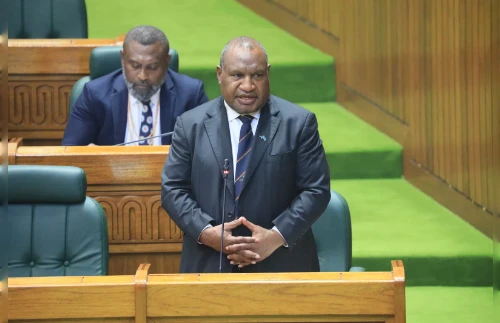
Philippine Defense Secretary Gilberto Teodoro Jr. was addressing the Seoul Defense Dialogue on Sept. 8 when he was handed a note setting out Beijing’s rejection of a 2016 arbitration ruling on the disputed waters.
China claims an area within its “nine-dash line,” which essentially encircles the entirety of the South China Sea, including areas that fall within the Philippines’ exclusive economic zone.
Teodoro read the note aloud, challenged it line by line and accused China of “coercion, bullying and aggression,” drawing applause and widespread attention online.
Forum organizers said the note came from a military attaché at the Chinese Embassy in Seoul, according to South Korea’s Yonhap news agency. The attaché had asked a staff member to pass it to Teodoro, but the staff member mistook it for a message from the Philippine delegation and delivered it while he was speaking.
“The Seoul episode is therefore better seen as an extension of Manila’s existing approach than as evidence of a new phase in the transparency campaign,” Sylwia M. Gorska, a doctoral candidate in international relations at the University of Central Lancashire in the United Kingdom, told RFA.
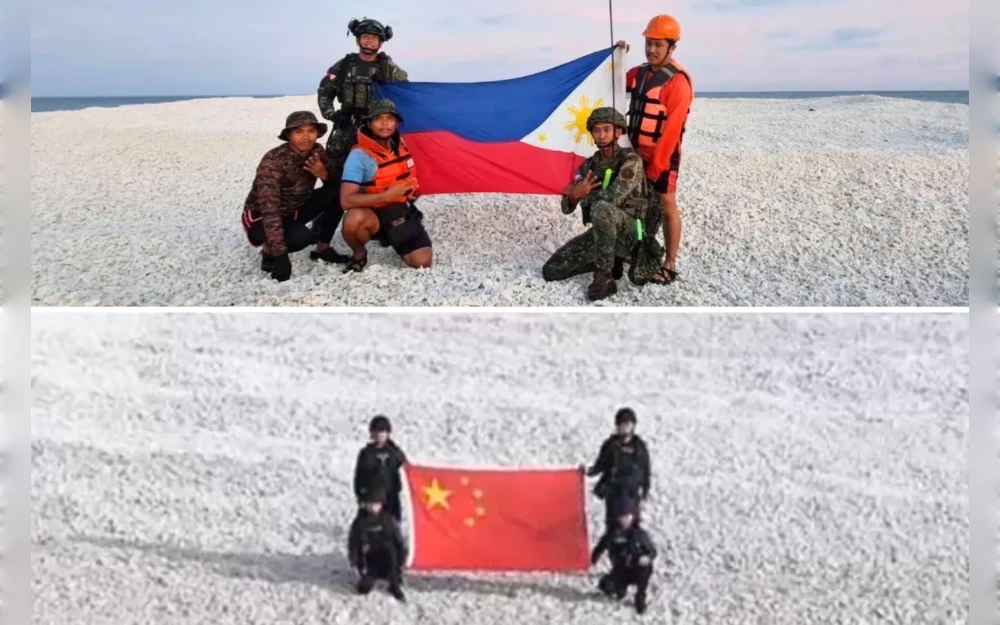
Since 2023, Philippine President Ferdinand Marcos Jr.’s administration has pursued what officials and analysts call an “assertive transparency” strategy. Philippine agencies release photographs and video of encounters with Chinese vessels quickly and have given journalists greater access to maritime missions, seeking to establish a public record and rally support at home and abroad.
Gorska said the tactic worked differently in Seoul. At sea, evidence can reveal conduct that would otherwise be difficult for outsiders to observe. But China’s refusal to accept the arbitration award has long been public, meaning Teodoro exposed no previously hidden position.
“It carried over the emphasis on speed, publicity and direct rebuttal, but shifted from documenting Chinese actions to publicly contesting China’s legal position,” she said.
Preaching to the choir
The episode highlights the contrast between Manila’s success in attracting international and domestic attention to the issue and its more limited ability to change either Beijing’s conduct or the positions of governments that have avoided taking sides in the dispute.
“The immediate results on the press are very favorable,” Enrico Cau, a Taipei-based independent security researcher, told RFA.
But he said the positive response largely echoed the views of groups that already supported the Philippine administration’s approach and did not demonstrate broader international support.
Marcos’ transparency campaign has kept maritime confrontations in public view.
In July, the Philippine Coast Guard released its account of Chinese coast guard vessels using water cannons near Scarborough Shoal and said one Chinese ship came within 7 meters (23 feet) of a Philippine fisheries vessel.
Beijing issued a competing account, saying it had taken “control measures” against Philippine vessels operating illegally in the area.
Manila’s messaging also benefits from the 2016 ruling, which found there was no legal basis for China to claim historic rights to resources within sea areas falling inside its “nine-dash line.” China rejects the decision as illegal, null and void.
On the ruling’s 10th anniversary in July, the Philippines and 13 other countries, including the United States, Japan, Australia and Britain, issued a joint statement reaffirming that the award was final and legally binding. The European Union issued a similar statement.
Gorska said the Philippine campaign might have reinforced that backing by keeping both Chinese conduct and the ruling visible, but much of the international support for Manila’s legal position already existed prior to the current strategy.
“The evidence is strongest on visibility and much weaker on persuasion,” she said. “What remains unclear is whether the campaign has moved governments that were previously cautious or neutral closer to the Philippine position.”
Gorska noted that Southeast Asian governments have not collectively adopted Manila’s framing. Indonesia has emphasized dialogue and international law without endorsing the Philippine account of individual encounters, while Singapore says it does not take sides on competing claims. Malaysia rejects excessive maritime claims but continues to stress engagement with Beijing.
The evidence is strongest on visibility and much weaker on persuasion,” she said. “What remains unclear is whether the campaign has moved governments that were previously cautious or neutral closer to the Philippine position.”
Gorska noted that Southeast Asian governments have not collectively adopted Manila’s framing. Indonesia has emphasized dialogue and international law without endorsing the Philippine account of individual encounters, while Singapore says it does not take sides on competing claims. Malaysia rejects excessive maritime claims but continues to stress engagement with Beijing.
Japan and South Korea have both strengthened security ties with the Philippines, although Tokyo has been more explicit in supporting the arbitration award. Japan joined the July multinational statement, while South Korea issued its own message supporting the U.N. Convention on the Law of the Sea, freedom of navigation and a rules-based order.
The day before the exchange in Seoul, the Philippine and South Korean defense ministers agreed to expand cooperation, including personnel exchanges and joint exercises. Japan’s Reciprocal Access Agreement with the Philippines entered into force in September 2025 and was used during the Balikatan military exercises this year.
But Gorska said those developments also reflected wider concerns about China and Manila’s decision to strengthen security relationships under Marcos, with little evidence that the information campaign directly produced particular agreements or commitments.
Cau said public exposure had maintained “a high level of instant visibility” around China’s conduct, but had not produced significant changes on the ground.
Conflict amid diplomacy
Cau also warned that more confrontational rhetoric could complicate diplomacy and encourage an escalation that the Philippines was less equipped to manage.
Tone was an issue in Seoul, Gorska said. Teodoro’s defense of the Philippine legal position was clear, but remarks such as “because you lost” and his suggestion that the note’s author might end up in a “gulag” made the exchange more personal without strengthening the legal argument.
China’s Foreign Ministry later accused Philippine figures of seeking attention, creating trouble and damaging bilateral relations and regional stability. In June, Beijing imposed sanctions on Teodoro, his wife and child over what it called his repeated “erroneous remarks” about China.
Public confrontation has nevertheless operated alongside quieter diplomacy. After a violent encounter at Second Thomas Shoal in June 2024, Manila and Beijing reached a provisional arrangement governing Philippine resupply missions to the grounded warship BRP Sierra Madre.
Philippine officials said 13 missions conducted under the arrangement through March 4 this year proceeded without dangerous encounters.
The arrangement did not resolve competing maritime claims, but analysts said it showed how private channels could reduce immediate operational risks even as both countries maintained their public positions.
“Public exposure and private diplomacy can work alongside each other,” Gorska said. “Transparency can establish a public record, while private channels give both sides space to manage incidents and reach limited arrangements.”
Cau warned, however, that repeated dramatic confrontations could eventually lose their impact.
“The constant use of ‘assertive transparency’ to me is prone to exposure fatigue, past which the audiences will simply ignore it,” he said.
Edited by Eugene Whong.
“Copyright © 1998-2023, RFA.
Used with the permission of Radio Free Asia,
2025 M St. NW, Suite 300, Washington, D.C. 20036.
https://www.rfa.org.”