



The tribunal judging the criminal responsibility of former Khmer Rouge leaders for the deaths of an estimated 1.7 million Cambodians will issue verdicts Friday in the latest — and perhaps last — of such trials.
Nuon Chea, 92, and Khieu Samphan, 87, are the last two surviving senior leaders of the radical communist group that brutally ruled Cambodia in the late 1970s.
They are already serving life sentences after being convicted in a previous 2011-2014 trial of crimes against humanity connected with forced transfers and disappearances of masses of people.
The proceedings against them were split into two successive trials for fear that the aging defendants might die before any verdict was reached in a single, more comprehensive trial and foreclose the opportunity for any sort of justice. The fear was justified: Two co-defendants died before the trial was completed.
The charges
On Friday, Nuon Chea and Khieu Samphan will be judged on additional charges of crimes against humanity, such as murder, extermination, enslavement, torture and persecution on political, racial, and religious grounds; genocide, for the killings of members of the Vietnamese and Cham ethnic groups; and more breaches of the Geneva Conventions, including willful killing, torture or inhumane treatment.
As members of the Khmer Rouge leadership under the late Pol Pot, they have been prosecuted under the legal doctrine of joint criminal enterprise, which holds individuals responsible for actions attributed to a group to which they belong.
Cases launched against four additional, middle-ranking Khmer Rouge officials have been scuttled or frozen and are unlikely to be revived.
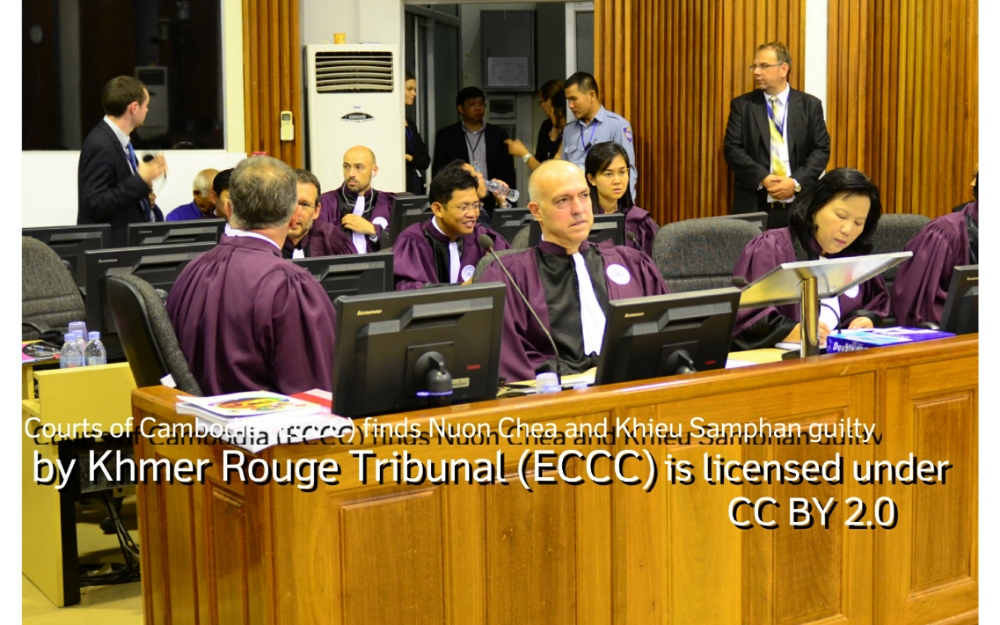 If the current trial is the last staged by the U.N.-assisted international tribunal, officially called the Extraordinary Chambers in the Courts of Cambodia, it will have convicted three individuals at a cost of more than $300 million.
Hun Sen: No more trials
The Khmer Rouge seized power in 1975 after a bloody five-year civil war. They immediately attempted a radical transformation of Cambodia into a peasant society, emptying cities and forcing the population to work the land.
They backed up their rule with ruthless elimination of perceived enemies, and were driven from power in early 1979 by an invasion from neighboring Vietnam, which had suffered border attacks from Khmer Rouge forces.
Although atrocities were carried out on a massive scale, political realities — specifically the repeated demands by Cambodian Prime Minister Hun Sen that no more suspects be prosecuted — appear to preclude further cases being pursued by the tribunal. Hun Sen insists that further prosecutions could cause unrest.
In addition to Nuon Chea and Khieu Samphan, the tribunal can lay claim to only one other prosecution, resulting in the 2010 conviction of Kaing Guek Eav, alias Duch, who as head of the Khmer Rouge prison system ran the infamous Tuol Sleng torture center in Phnom Penh.
Hun Sen himself was a midlevel Khmer Rouge commander before defecting while the group was still in power, and several senior members of his ruling Cambodian People’s Party share similar backgrounds. He helped cement his political control by making alliances with other former Khmer Rouge commanders.
The ground rules under which the tribunal was established in 2005 are complicated, providing for hybrid courts pairing Cambodian judges and prosecutors with international counterparts.
Cambodian court officials, known for their loyalty to Hun Sen’s government, are in a position to base their judgments on the tribunal’s inexact guidelines limiting prosecutions to senior leaders or persons considered “most responsible” for atrocities, or simply cease cooperation.
‘Brother Number Two’
Although Nuon Chea had an especially low profile in the already secretive group, his importance can be gauged by his nom de guerre of “Brother Number Two,” reflecting his position as Pol Pot’s right-hand man.
According to a 2001 study by Cambodia scholar Stephen Heder and legal expert Brian D. Tittemore, there was “substantial and compelling evidence” that Nuon Chea devised and implemented the Khmer Rouge’s execution policies.
Khieu Samphan had at one point been the smiling, polite figurehead who nominally was the head of state in the Khmer Rouge regime. He was able to trade on his reputation as an honest left-wing academic and lawmaker in 1960s Cambodia before repression drove him underground and into the jungle with the then-nascent Khmer Rouge movement. The Heder and Tittemore study acknowledged that evidence against Khieu Samphan was not as extensive as against Nuon Chea and others, but nevertheless suggested he “encouraged lower level (Khmer Rouge) officials to perpetrate executions and, at least in some instances, monitored and contributed to the implementation of Party policies by regional authorities.” Heder, who for a time was an investigator for the tribunal, charged in a 1990 paper that Khieu Samphan was promoted up the ranks of the Khmer Rouge “because he remained steadfastly loyal to his leadership and policies while others who had earlier cooperated with Pol Pot and his Communist Party were detained or killed because they disagreed with or were suspected of disagreeing with what Pol Pot was doing.”
“Khieu Samphan’s political star rose literally on heaps of corpses,” Heder wrote.
Little remorse
Confronted in court with such charges, Nuon Chea and Khieu Samphan showed little remorse. Khieu Samphan denied knowing about matters including forced marriages and violent oppression of minorities, and both men mounted political defenses.
Khieu Samphan described the claim of genocide as “Vietnamese propaganda,” a defense he and other former Khmer Rouge leaders have made previously.
Cambodians have long been suspicious of Vietnam, their much bigger eastern neighbor, and prejudice against Vietnamese is widespread.
Khieu Samphan also cast blame on the United States for Cambodia’s problems. The U.S. heavily bombed the Cambodian countryside during the 1970-75 civil war that led to the Khmer Rouge’s seizure of power.
“I want to bow to the memory of all the innocent victims but also to all those who perished by believing in a better ideal of the brighter future and who died during the five-year war under the American bombardments and (in) the conflict with the Vietnamese invaders,” Khieu Samphan said. “Their memory will never be honored by any international tribunal.”(Source: VOA NEWS)