



The detainees are also often forced to kowtow to police officers who closely monitor the meetings, sources say.
By Shohret Hoshur for RFA Uyghur
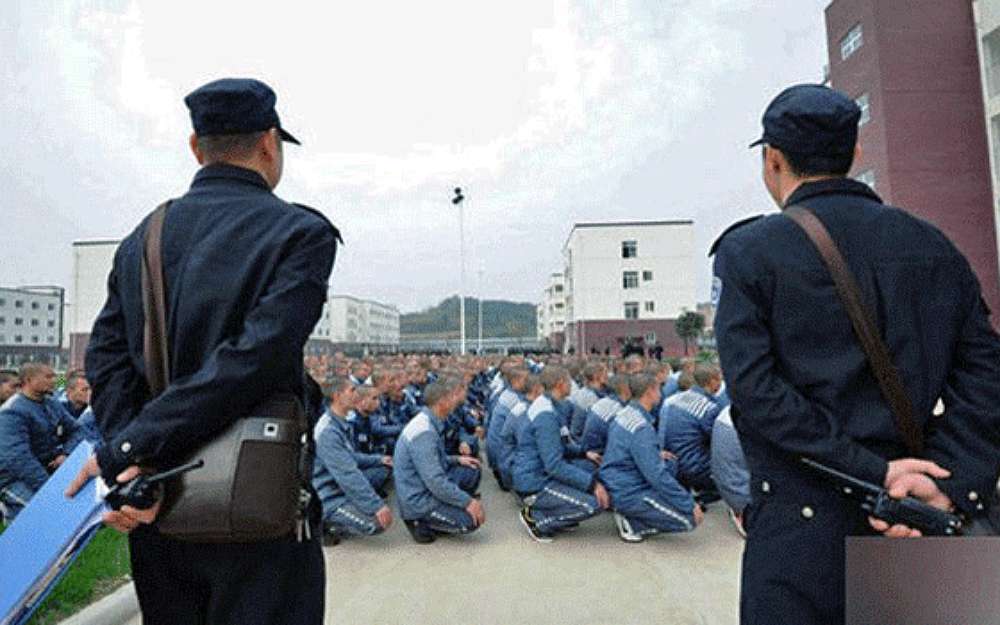
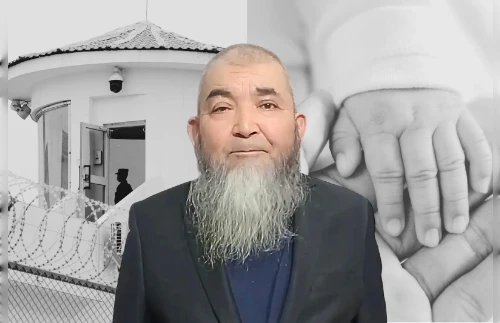
Uyghurs prisoners in Xinjiang are forced to speak in Mandarin and perform obvious displays of subservience to their Chinese guards in monthly video calls with relatives, Uyghurs living in exile say.
A Uyghur now living in Europe told RFA that her siblings in Sanji Prison in the town of Sanji (in Chinese, Changji) were recently allowed to meet online with other relatives in Aksu (Akesu). Though neither the jailed Uyghurs nor their family members could speak Chinese well, authorities made them communicate in Mandarin for the entire meeting.
“They barely managed to speak in Chinese, according to my relatives who met them onscreen,” the source said. “This is not just an isolated incident.”
Chinese authorities have banned the use of the Uyghur language in schools and government complexes as part of their efforts to diminish the culture and traditions of the largely Muslim community.
But Uyghur families still speak their native tongue inside their homes. The prohibition from doing so on the monthly virtual visits adds a level of frustration for family members who are already anxious about their loved ones’ well-being.
Another Uyghur exile living in Turkey told RFA that her nephew, who was serving a sentence in a prison in Urumqi (Wulumuqi), was forced to speak Chinese to his mother and grandmother, though the latter had to rely on another relative to translate because she did not know Mandarin.
“They allowed them to meet onscreen once every few months for only three minutes,” the source said. “My mother was there once to meet onscreen with my nephew. My mother was very uncomfortable hearing my nephew speaking to them in Chinese. My nephew’s wife fainted at the time, hearing him speak only in Chinese.
“On-screen, my nephew had to bow while walking backward saying goodbye in traditional Chinese fashion,” she added. “He also had kowtow to the Chinese police for giving him the chance to see his relatives onscreen.”
Tahir Mutällip Qahiri, a Uyghur Muslim lecturer in the Uyghur language and literature at the University of Göttingen in Germany, said he noticed a difference in the way his detained father interacted with him during a video call.
His father, well-known Uyghur scholar and activist Mutallib Siddiq Qahiri, used to work at Kashgar University and wrote and edited more than 20 books on Uyghur and Arabic culture until he was arrested in 2018 and charged with “incitement to ethnic hatred,” according to a September 2020 article in the Byline Times. In early 2020, authorities sentenced him to 30 months in prison with four years of probation.
Tahir said he was able to see his father after he was released from detention, but that the man “was not as free as the Uyghur prisoners who recently had spoken with their relatives onscreen.”
Although the two spoke Uyghur to one another, Tahir said he believed his father was under surveillance by authorities because he told his son to remain silent and to defend the Chinese state.
“In March 2019, I was able to talk to my father onscreen twice for a very short time, and what I sensed from those virtual interactions was that he had no freedom at all in his speech,” he said. “I didn’t see any Chinese police present when I spoke to him onscreen, but what I knew was all he said was in a Chinese framework, even though it was uttered in the Uyghur language.
“From the context of his speech and his body language, I was able to conclude that even though he didn’t speak in Chinese, it was all Chinese propaganda,” he added. “I sensed a great fear he had for the Chinese authorities.”
Tahir said that compared to the time he first spoke to his father when he was released from detention to house arrest, the current situation of Uyghur detainees appears to have gotten worse. Noting that authorities’ efforts to eradicate the Uyghur language is part of the genocide China has been committing against the ethnic and religious minority group in recent years.
‘Culturally savage’
At least 1.8 million Uyghurs and other Turkic minorities are believed to have been held in a network of detention camps in Xinjiang since 2017, purportedly to prevent religious extremism and terrorist activities, though Beijing claimed they were “vocation training centers,” which are now all closed.
Credible accounts of the Chinese government’s repressive policies in Xinjiang, including mass detentions, severe human rights abuses and efforts to obliterate Uyghur culture and religion have prompted the United States and some Western legislatures to declare a genocide and crimes against humanity in the region.
Forcing Uyghur prisoners to speak Mandarin and to bow in an outdated Chinese fashion is “culturally savage and politically extremist,” Tahir said.
In an audio recording provided to RFA by a Uyghur living in the U.S., a Uyghur woman living in Urumqi used an interpreter to speak in Chinese to her son, who is in a prison in Xinjiang.
The woman then cries as her son in Urumqi No. 3 Detention Center is forced to kowtow to Chinese police officers during his online meeting with her.
“Her son is only 25 or 26, and now he’s forced to speak in Chinese and bow to the Chinese while walking backward onscreen,” said the Uyghur in exile.
According to the audio, the son was on his knees when he bowed his head in gratitude to the Chinese police, with his forehead almost touching the floor, his mother told the Uyghur in exile.
“My son’s forehead was almost on the floor when he bowed to the police,” the mother told her Uyghur relative in exile. “I hope my defenseless son will soon see sunshine [and] will meet his loving relatives in freedom.”
Ilshat Hassan Kokbore, a political analyst based in the U.S. and vice chairman of the executive committee of the World Uyghur Congress, told RFA that he also received a video of a Uyghur prisoner speaking in Chinese with a relative during a videoconference, though the person did not understand Mandarin.
Speaking in a mother tongue is a basic necessity and right of the people, though Chinese authorities have stripped that right away from the Uyghurs, he said.
Police officers take the relatives of Uyghur prisoners to government complexes each month to see their imprisoned relatives over video. Both the prisoners and their relatives meet under police surveillance, Uyghur sources and a police officer involved in monitoring the visits told RFA.
A police officer who is in charge of such surveillance in Kashgar (Kashi) said on two scheduled days each month he takes the family members of Uyghur prisoners to a neighborhood committee complex where they can virtually meet with the detainees.
“Twice a month, we allow them to meet onscreen,” he said. “We take the relatives to the neighborhood community complex. Some months they were not allowed to meet because of COVID-19 prevention policy.”
Relatives often have to wait one to two hours for their turn. The calls usually last about two minutes and are conducted in Chinese, said the officer, who did not give his name so as to speak freely.
Police officers do not allow detainees’ relatives to say anything except to express their well-being and to thank the Chinese Communist Party, he said.
Translated by RFA Uyghur. Written in English by Roseanne Gerin.
Copyright © 1998-2020, RFA. Used with the permission of Radio Free Asia, 2025 M St. NW, Suite 300, Washington DC 20036. https://www.rfa.org