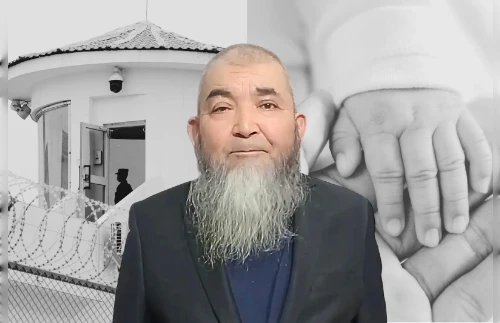




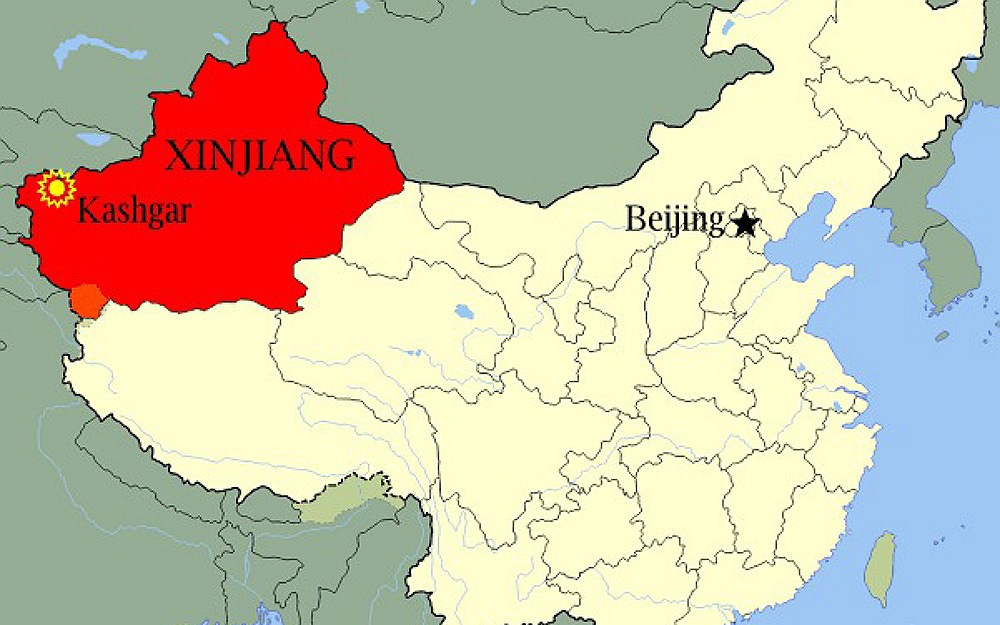
A Uyghur former high school volleyball star who was recently released from an internment camp in northwest China’s Xinjiang Uyghur Autonomous Region (XUAR) suffered health problems in the facility that were so severe that he is unlikely to ever play his sport again, according to local officials.
Ablet Bawudun, from Aksu (in Chinese, Akesu) prefecture’s Uchturpan (Wushi) county, was detained in early 2017 in one of the region’s vast network of internment camps, where authorities are believed to have held up to 1.8 million Uyghurs and other Muslim minorities since April of that year.
A source with knowledge of the situation, who spoke to RFA’s Uyghur Service on condition of anonymity citing fear of reprisal, said Bawudun was released in late 2019 after developing serious health problems, including renal issues and swelling. He was allowed to leave the camp, the source said, with a “guarantee” after he had grown so weak that he could no longer fulfill the demands placed on him in the camp.
In 2008, Bawudun had scored one point too low on China’s college entrance exam, but because his family was poor, he was unable to study for and take the exam a second time. Following his graduation from high school and entry into the workforce as an accountant, he continued to play amateur volleyball in Uchturpan.
However, following his release, the 6’2” (1.9 meters) man around the age of 30, who had been wowing audiences with his volleyball game slightly more than two years earlier, now walks with the aid of crutches, according to the source, who said his weak physical condition has shocked his relatives, neighbors, and friends in his home town of Imamlirim.
After calling several local offices in Uchturpan to verify information about Bawudun’s experience, RFA was able to reach an officer from the county’s bazaar police station who said he was unable to answer questions because “we don’t know the current situation.”
But a security officer from a township in Uchturpan confirmed to RFA that Bawudun had been taken to a camp in 2017 and released under close police monitoring last year to his wife and two children.
“He developed kidney problems and couldn’t walk,” said the officer, who declined to provide his name.
According to the officer, Bawudun was “really good” at volleyball and had been in excellent physical shape before his detention.
“It was [about] two years in re-education before he got like this,” the officer said. “He was there for two years, and then he apparently got out after a visit to the hospital.”
“He was in reeducation in Uchturpan, in the No. 1 re-education center … in the old jail at the base of the mountains in Uchturpan.”
Current condition
The officer told RFA Bawudun had played as a blocker on the Uchturpan and, while not well-educated, was well-respected in the community. He said the former athlete was known to have cared for his parents after they became sick.
However, he said, for the past year or so, the swelling in Bawudun’s face and eyes has not abated and on several occasions, the swelling has appeared all over his body. His condition means that not only is Bawudun unable to return to the former day job he held as an accountant before entering the camps, but he is unlikely to ever again play the amateur volleyball he had enjoyed after graduating from high school and entering the workforce.
“Township officials, township police, and work groups, they come to see how Ablet is doing—they come to his house and bring him things,” the officer said.
But despite the community support, Bawudun has no recourse to file any sort of complaint for what happened to him as a result of his detention, as he is forbidden from discussing what happened to him in the camp, let alone taking formal action to rectify it. Additionally, he has yet to complete his full term of internment—the length of which was never made clear to him from the start—and he is still currently under guarantee and close watch by local authorities.
Beginning in October 2018, Beijing acknowledged the existence of the camps, but described them as voluntary “vocational centers,” despite reporting by RFA’s Uyghur Service which has found that detainees are mostly held against their will in poor conditions, where they are forced to endure inhumane treatment and political indoctrination.
Chinese Foreign Minister Wang Yi claimed last month that all those sent to the camps have been released and placed in employment, but RFA recently spoke with police officers from Uchturpan who directly contradicted the claims. The officials not only confirmed that at least three camps are still in operation in the county but also estimated that together they are likely to hold more than 20,000 detainees.
Uchturpan is a county consisting of six townships and three “bazaars,” or market centers, and has an official population of around 235,000—more than 90 percent of which is ethnic Uyghur. If the estimates are correct, the number of detainees in the three camps would account for nearly 10 percent of the county’s Uyghur residents.
‘Illegal’ material
While investigating the alleged “crime” Bawudun had committed that led to his internment, RFA contacted a police officer from Imamlirim township, who said the former volleyball player had run afoul of authorities after “illegal” material was discovered on his phone.
“They gave downloading [peer-to-peer file sharing application] ‘Kuai Ya’ as the reason when they took him away,” the officer said.
According to the officer, while the act occurred in April 2016 and was determined to be a careless mistake following an interrogation of Bawudun at the time, by 2017 when the internment campaign was underway, the content had been classified as a “political problem” and he was sent to the camps.
He said that as an accountant, Bawadun was often engaged in writing that required he use online services and other sources, which led him to unknowingly access restricted materials that later proved politically problematic for him.
A security officer from Imamlirim township, who picked Bawudun up from the volleyball court and turned him over to police, told RFA that in addition to downloading illegal material, the former athlete had also loaned his phone to a friend from his team, who used it to contact a relative living outside of China.
Having foreign contacts has landed numerous Uyghurs in the camp system.
“Ablet Bawudun had a friend named Ali Juma from No. 6 village,” he said.
“Ali’s older brother had gone abroad … [Police found] Ali’s brother’s number in [Ablet’s] phone. Ali made a mistake in using Ablet’s phone to call his brother.”
The security officer said that the incident came up during interrogations and Bawudun was accused of and later detained for having been a “medium for illegal contact with [someone in] a foreign country.”
When asked about the conditions in Bawudun’s camp and whether they had led to his health problems, the officer declined to comment.
RFA spoke with Juret Obul, a Washington-based Uyghur doctor, who suggested that several factors could have contributed to a medical condition like that of Bawudun’s as the result of his internment, including a lack of nutrition, serious illness left unattended, and physical trauma, such as hard striking and tight restraints.
“I think that it’s possible he was in a situation where he received insufficient nutrition,” he said, adding that he could only speculate without having examined the young man.
“If we look at the situation of the Uyghurs currently being held in camps, there are all sorts of illnesses and sudden deaths. Many unimaginable things are happening.”
Obul said it is also possible that Bawudun’s kidney problems stem from “intense physical torture.”
“If someone were locked up for a crime they committed, they would at least be prepared in their hearts [for what they would experience in detention], but as for Ablet Bawudun, he’s innocent.”
“The only crime he committed, for the Chinese, was being born Uyghur.”
Reported by Shohret Hoshur for RFA’s Uyghur Service. Translated by Elise Anderson. Written in English by Joshua Lipes.
Copyright © 1998-2020, RFA. Used with the permission of Radio Free Asia, 2025 M St. NW, Suite 300, Washington DC 20036. https://www.rfa.org
On Utah Highway, Semi-Truck Carrying French Fries Catches Fire
Tibetan Mastiffs

LLM Phishing
UN Secretary-General Meets with Assistant Secretary-General for Africa in Departments of Political and Peacebuilding
North Carolina Police Encountered Two Men Travelling Down Couch Mounted on E-Scooter

Scottish Deerhound Dog Breed

AI-Powered Mortgage Fraud
Exclusive: North Korean Army Video Says K-Drama Watchers Deserve to be Executed
Subscribe Our You Tube Channel

Fighting Fake News
Fighting Lies