



“This video fails completely” if China really wants to integrate Uyghurs into society, researcher says
By Gulchera Hoja for RFA Uyghur
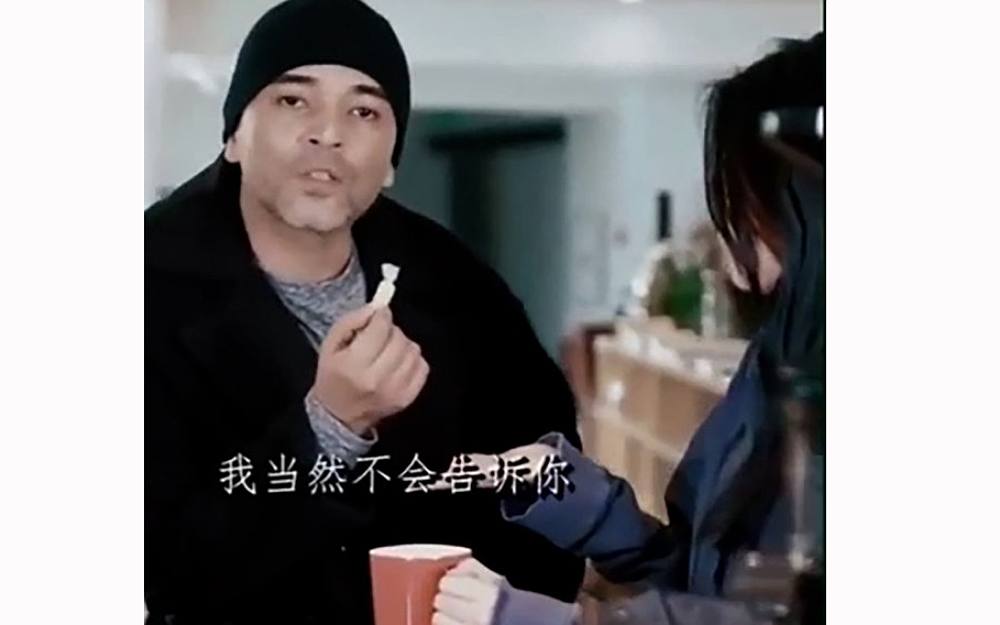
A public service video featuring a Uyghur actor who portrays a “black-hearted drug dealer” preying on Chinese women recently went viral in China.
But researchers and activists have criticized the choice of a Uyghur for the role, saying it plays on old racist tropes about Uyghur men, who have historically been victims of drug trafficking rather than perpetrators.
“I’m a black-hearted drug dealer, but I’d never tell you this,” the actor, Turghunjan Mehmet, says to the camera from a dimly-lit room.
“I’d never tell you that I’d package methaqualone as candy and give it to you,” he says. “Its street name is ‘Buddha’s Virtue.’ It can trigger severe coma and lethal respiratory failure.”
The camera shows him giving the candy to an apparently Han Chinese woman in a coffee shop.
“If [Chinese authorities] are sincere in their attempts to try to integrate Uyghurs into society, this video fails completely,” said Henryk Szadziewski, an American expert on Uyghur affairs. “It reinforces the racist stereotypes people already have in their heads: that Uyghurs are criminals.”
The 90-second video garnered nearly 2 million likes within a day of its release on Feb. 8th, according to an article by Manya Koetse, a Chinese media analyst.
Online commenters praised Turghunjan’s good looks and convincing portrayal, with some saying they found it hard to tell that he was an actor, rather than an actual drug dealer. “You can only play [this role] well if you’ve seen a lot of drug dealers,” one said.
Turghunjan has portrayed a dealer in several other videos posted by the Xinjiang Narcotics Control Commission. In one, he raps in handcuffs, reeling off the slang terms for different controlled substances while standing next to a police officer.
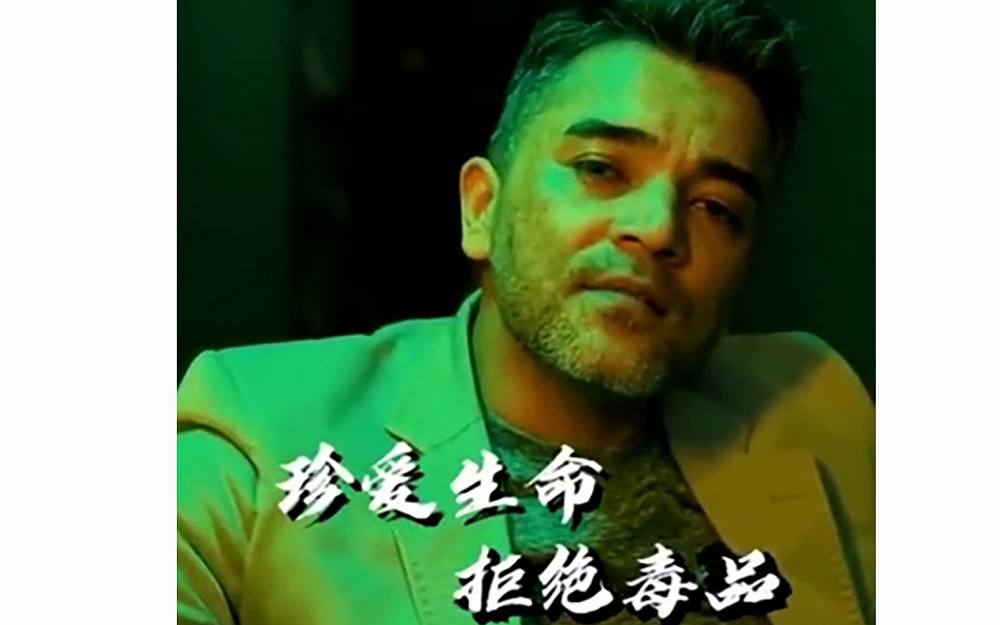
According to an interview with Turghunjan in a state newspaper, he manages social media accounts and produces videos for the narcotics control commission as well as the Xinjiang Fire Department. To prepare for the drug dealer role, he said he repeatedly watched crime and espionage thrillers.
“With short videos, there’s a ‘five-second’ principle,” he told the Xinjiang Daily. ”If you don’t draw someone’s interest within five seconds, they’ll close the browser window.”
Radio Free Asia made repeated attempts to contact Turghunjan and speak with someone at the narcotics control commission, but was unable to reach either one.
Ironic and painful
For many Uyghurs, continued government encouragement of the stereotype that Uyghurs deal drugs is both ironic and painful, because they have suffered greatly from the problem of drug use.
Drugs took off in China starting in the 1980s as its economy opened to the world. A heroin epidemic swept through the Uyghur Region in the 1990s, accelerating the spread of HIV.
Xinjiang authorities, obsessed with fighting “ethnic splitism,” did little to stop drug trafficking, said Bahtiyar Shemshidin, a Uyghur activist in Canada who prior to 2000 worked in the anti-drug unit of the Ghulja Public Security Bureau.
“The main victims of addiction were our Uyghur youth. Many of them died, and many of them contracted AIDS,” Bahtiyar said. “The authorities sporadically arrested small drug dealers, who were mostly Hui Muslims. But the big drug dealers were Chinese.”
In the face of government inaction on drugs, Uyghurs in Ghulja organized meshrep, social gatherings that emphasized moral conduct and abstinence from drugs, Behtiyar recounted.
Authorities initially welcomed meshrep, but then banned them as they gained popularity and participating Uyghurs started advocating against government policies such as alcohol sales.
On Feb. 5th, 1997, the Ghulja police, along with the Chinese army, opened fire on Uyghurs protesting the meshrep ban, killing as many as 200. Mass arrests followed, sending many Uyghurs to earlier versions of the re-education camps that have proliferated since 2017 and have been central to China’s current genocidal campaign.
‘Absurd suggestion’
In 2023, it is absurd to suggest that Uyghurs have the freedom of movement, let alone the motivation, to deal drugs, said Bahtiyar.
“Uyghurs can’t become drug dealers and sell drugs under heavy Chinese surveillance,” he said. “They can’t even move from one village to another without the government’s permission– and forget about Uyghurs living in Chinese cities.”
From the 1980s to the present day, the primary source of narcotics for both Xinjiang and China has been the “Golden Triangle” border regions of Burma, Laos, Thailand and China, experts say. Chinese towns in Guangdong province such as Boshe have been notorious for methamphetamine and ketamine production.
A 2021 Ministry of Public Security report singled out Guangdong, Zhejiang, and Yunnan provinces as centers of drug crimes and addiction. It did not list Xinjiang. The Urumqi Public Security Bureau reported a decrease in drug confiscation and crime relative to inner Chinese provinces.
Cycles of violence
In addition to being inaccurate, state-sponsored stereotyping of ethnic minorities as ruthless criminals contributes to cycles of violence, said Mathias Boelinger, a correspondent for Deutsche Welle and author of the German-language book “The High-Tech Gulag: China’s Crime Against the Uyghurs.”
“These patterns cause tragedy that ends in murder,” he said on Twitter, citing a 2009 incident in Guangdong Province in which Han Chinese workers at a toy factory murdered two Uyghur colleges following false rumors that the Uyghurs had raped two Han women.
The “Shaoguan Incident” led to riots and reprisals in Xinjiang’s capital Urumqi in which at least 197 people were killed, the majority of them Han Chinese, according to the Chinese government. A security clampdown swiftly followed.
Government endorsement of ethnic stereotypes replicates Western colonial practices that the Chinese Communist Party has long condemned, Boelinger told RFA. “These stereotypes that many Han have toward other ethnic groups, particularly the Muslim groups and Tibetans, [are] a little bit similar to the colonial stereotypes of the Europeans,” he said.
“The Han see themselves as victims of colonialism–which they are–but at the same time they also have their own colonial history, where they are the colonizers, and nowadays in China there is very little reflection on this.”
“You find some of these stereotypes in speeches by party officials,” he added. “From the perspective of any colonial power, the people that they colonize are wild people.”
Continued promotion of these tropes suggests a lack of government interest in changing policies on the Uyghurs, said Szadziewski.
“It just shows this idea that Uyghurs need reforming, Uyghurs need to be changed, Uyghurs need to be reeducated,” he said. “This kind of thinking led to some terrible things in the last five years.”
Translated and written in English by Nadir. Edited by Malcolm Foster.
Copyright © 1998-2020, RFA. Used with the permission of Radio Free Asia, 2025 M St. NW, Suite 300, Washington DC 20036. https://www.rfa.org.