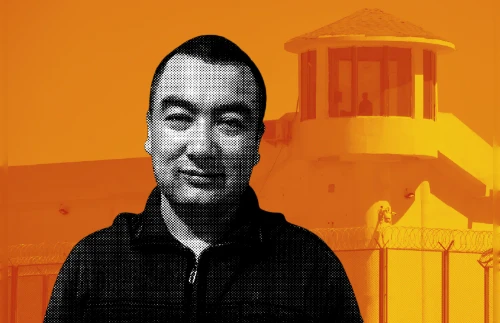




Authorities ‘secretly’ buried at least one body amidst public anger over the program.

Two Uyghur high school students who were sent to pick cotton as part of a forced labor scheme in northwest China’s Xinjiang Uyghur Autonomous Region (XUAR) died last autumn in a dormitory fire, according to official sources in the region, where forced labor practices have sparked an increasing global outcry.
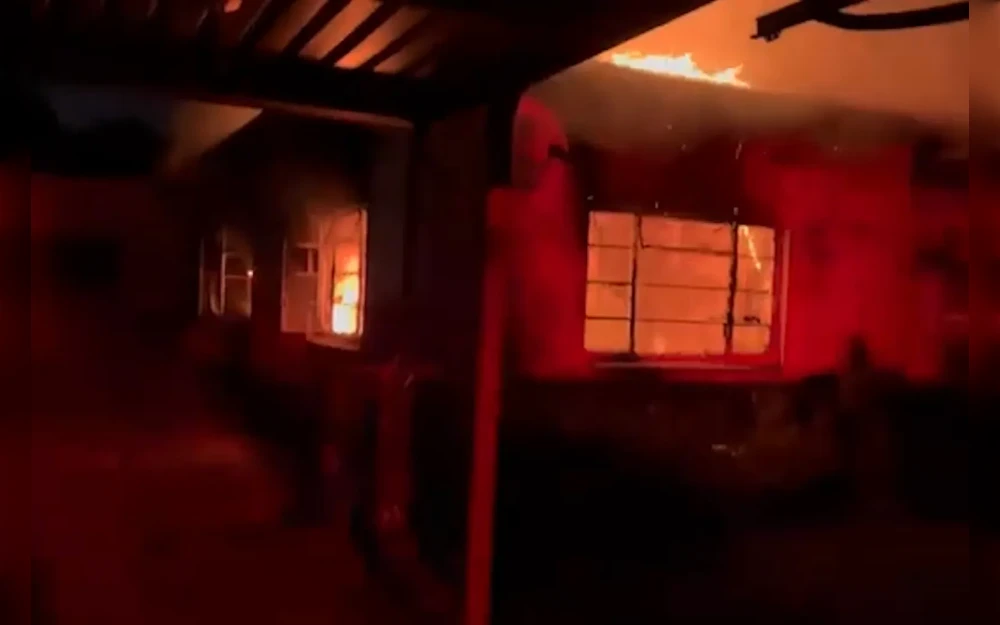
RFA’s Uyghur Service recently learned that 16-year-old Nabijan Rozi of Bulaqsu (in Chinese, Bulakesu) township, in Kashgar (Kashi) prefecture’s Kona Sheher (Shufu) county, and another boy died in an early morning blaze that engulfed the building they and 30 of their classmates had been sleeping in after being sent to neighboring Aksu (Akesu) prefecture to harvest cotton in October.
According to Rozi’s relative, who formerly lived in nearby Toqquzaq (Tuokezhake) town and requested anonymity for fear of reprisal, the young man’s body was “secretly” buried by officials who sought to downplay the incident and avoid public anger over their negligence.
“In October of last year, a relative of mine in Toqquzaq burned [to death],” said the relative, who was unable to provide any details about the other boy killed in the fire. “He’d been sent to Aksu to pick cotton—a 16-year-old boy.”
Rozi, who was among more than 2,000 students sent to Aksu as part of the forced labor program, was the son of Rozi Tohti and a resident of the No. 2 neighborhood of the No. 14 hamlet of Bulakesu’s Qarabagh village.
The relative said that Rozi’s older brother, Abdukahar, had also been sent to Aksu to pick cotton and is reportedly alive, although it was unclear whether he was among the students injured in the blaze. They said the boys’ father is currently detained in one of the XUAR’s vast network of internment camps, where authorities are believed to have held up to 1.8 million Uyghurs and other Muslim minorities since early 2017.
They said Rozi’s father was never informed of his son’s death and that after his mother was notified, four individuals from the Bureau of Education, Womens’ Union, and United Front acted as “companions” to the cfamily for approximately one week, where they did “ideological work” to control the family’s response and ensure that the news did not spread widely.
“The news that came to us, we got it … at the end of November. His father went in [to the camps] at the end of 2017 … It’s clear that he doesn’t know. I think there’s no way for [the family] to notify him,” the relative said.
Downplaying the fire
RFA contacted a “stability” officer in Toqquzaq who initially claimed to have no knowledge of the situation, but after being confronted with several details about the case, clarified that he knew about what had happened but had nothing further to share.
“I heard there was such an incident, but I don’t know the details,” the officer said.
Based on a tip from the stability officer, RFA called the head of a school in Toqquzaq who said the boys who died were students from a high school in Bulaqsu.
RFA also spoke with a teacher that helped with rescue efforts on the day of the fire who confirmed that two students died and four were seriously injured in the incident, which he said occurred close to 3:00 a.m.
According to the teacher, nearby personnel saw smoke coming out from the building where Rozi and other students were sleeping. Rescuers pulled a total of six people, including two who had already died, from the fire, he said.
“We were there on the scene,” he said. “First, we pulled the two [deceased] out. By the time they put the fire out, [four] injured people had also been pulled out, in addition to the two.”
The teacher said he had been brought from Kashgar to pick cotton along with the students and had done so multiple times over the last “year and a half.”
A security chief of a village in Bulaqsu township told RFA that “two or three thousand students from [Kona Sheher] county took part” in the cotton harvesting in Aksu and that “there were 32 of them” in the building that caught fire.
Other sources indicated authorities had been working to deal with the incident in a quiet manner. They said authorities charged with investigating the fire declared it a “natural disaster,” while on-site personnel, who had been responsible for safety measures in the structure where the children were sleeping, have reportedly not been questioned.
Although details of the incident were reported to a number of relevant bureaucrats and Party members in Toqquzaq, including in Rozi’s village, the parents of the students who had been sent to Aksu were not notified at the time.
One village cadre suggested that the ‘cauthorities’ silence was motivated by their knowledge that parents were already upset about their children being sent off to labor in Aksu. They were reportedly worried that this incident would become material for “negative propaganda” if they were to notify the public of the incident and subsequent deaths.
When asked whether Rozi’s family members had been at his funeral, the cadre said they had not been, and confirmed that the boy had been buried by local officials.
A village leader, who declined to be named, confirmed that residents were angered over the forced labor program and suggested that news of the fire would only inflame existing tensions.
“The people on the local level, the parents of the students, have long had opinions about the politics [of this cotton-picking program],” he said. “The farmers are not happy about this.”
Forced labor scheme
Reporting by RFA over the past several years has shown that forced cotton harvesting, long a feature of life for school-aged children from southern Xinjiang, is still in practice.
As male heads of household began to disappear in the early days of the mass internment campaign, authorities in some locales began forcing women and children to pick cotton as a way of making up for lost wages.
In at least some cases, local officials have tried to portray these workers as “volunteers.”
Reports suggest that amid increasing international scrutiny, authorities in the XUAR have begun to send detainees to work at factories as part of an effort to label internment camps “vocational centers,” although those held in the facilities regularly toil under forced or coerced labor conditions.
On Thursday, the U.S. House of Representatives reintroduced the Uyghur Forced Labor Prevention Act, which was passed by the House in March last year, but never brought to the floor by the Senate, and would block imports from the region unless proof can be shown that they are not linked to forced labor.
The bill would authorize U.S. President Joe Biden to slap sanctions on officials deemed responsible for forced labor in the XUAR and require financial disclosures by U.S. companies about their ties to related Chinese firms. Passing the act would create a “rebuttable presumption” requiring companies to prove that goods imported from the XUAR are not made with forced labor.
In December, a report by the Washington-based Center for Global Policy noted that the XUAR produces 85 percent of China’s and 20 percent of the world’s cotton, potentially “affecting all supply chains that involve Xinjiang cotton as a raw material.” In February last year, an Australian think tank revealed a list of 82 global brands that sourced from factories in China that used workers from the region under conditions that “strongly suggest” forced labor.
Last month, U.S. Customs and Border Protection (CBP) issued a Withhold Release Order (WRO) to detain all cotton products and tomatoes from the XUAR at the country’s ports of entry, saying that the agency had identified indicators of forced labor including debt bondage, restriction of movement, isolation, intimidation and threats, withholding of wages, and abusive living and working conditions.
But on Thursday, Washington-based conservative think tank The Heritage Foundation published a report saying that the U.S. needs to do more to counter what it termed “state-sponsored forced labor” that has seen the Chinese Communist Party (CCP) “profit from its exploitation of the Uyghurs.”
Among its recommendations to the Biden administration were for the U.S. to take stronger action to block goods produced with forced labor in the XUAR from entering its markets, as well as implement a tailored “rebuttable presumption” and expand WROs to combat CCP human rights violations.
Urging Biden to step up pressure on forced labor and other abuses in the XUAR and other parts of China, a group of 24 global human rights organizations and activists wrote an open letter to the U.S. president Wednesday urging a focus on Chinese abuses.
“The scope and scale of human rights violations committed by the Chinese government inside and outside the country require a fundamental shift; many of the tools previously employed are no longer relevant or sufficiently robust,” they wrote.
The rights defenders urged maintaining and increasing sanctions, saying Washington should “target key government officials, state-run agencies, and companies, including state or military-operated businesses, credibly alleged to have committed serious human rights abuses, and seek legal accountability under the Global Magnitsky Human Rights Act.”
Reported by Shohret Hoshur for RFA’s Uyghur Service. Translated by the Uyghur Service. Written in English by Joshua Lipes.
Copyright © 1998-2020, RFA. Used with the permission of Radio Free Asia, 2025 M St. NW, Suite 300, Washington DC 20036. https://www.rfa.org

Collie Dog Breed

AI Powered Mule Account Detection
China Closes 3 Tibetan Schools in 3 Months; Threatens Language, Cultural Preservation
UN General Assembly Hears Report of International Atomic Energy Agency
A Bizzare Doorbell Video Shows Stranger Eating Banana Through Joe Biden’s Mask
Irish Setters Dog Breed

Real-Time Agentic AI-Driven Fraud Investigation Platforms
Aung San Suu Kyi Phone Call is ‘Political Calculation’ by Military-Backed Government
Subscribe Our You Tube Channel

Fighting Fake News
Fighting Lies