



The institution is the latest museum to face criticism for adopting Beijing’s terminology for Tibet.
By Loboe Socktsang and Tenzin Pema for RFA Tibetan
The British Museum’s use of the term “Xizang” to label Tibetan artifacts in its Silk Roads exhibition has prompted criticism from Tibetans and rights groups who have demanded that the museum remove the Beijing-promoted term and issue a formal apology.
Using “Xizang” — a term China formally adopted in 2023 in all its official documents to refer to Tibet — plays into Beijing’s attempts to undermine and erase Tibet’s historical and cultural identity, advocates say.
Instead, they demand that the London museum use “Tibet” exclusively.
Earlier this year, the French museum Musée du Quai Branly-Jacques Chirac also came under fire using the term in its exhibit. In October, the museum said it would undo the change in its exhibits, following weeks of protests and petitions by Tibetans.
‘Inaccurate and deeply offensive’
The British Museum’s Silk Roads exhibition, which explores the history of the ancient trade route during the key period from 500 to 1000, features over 300 objects from the museum’s own collection and those loaned from at least 29 other institutions.
The exhibit opened in late September and runs until Feb. 23, 2025.
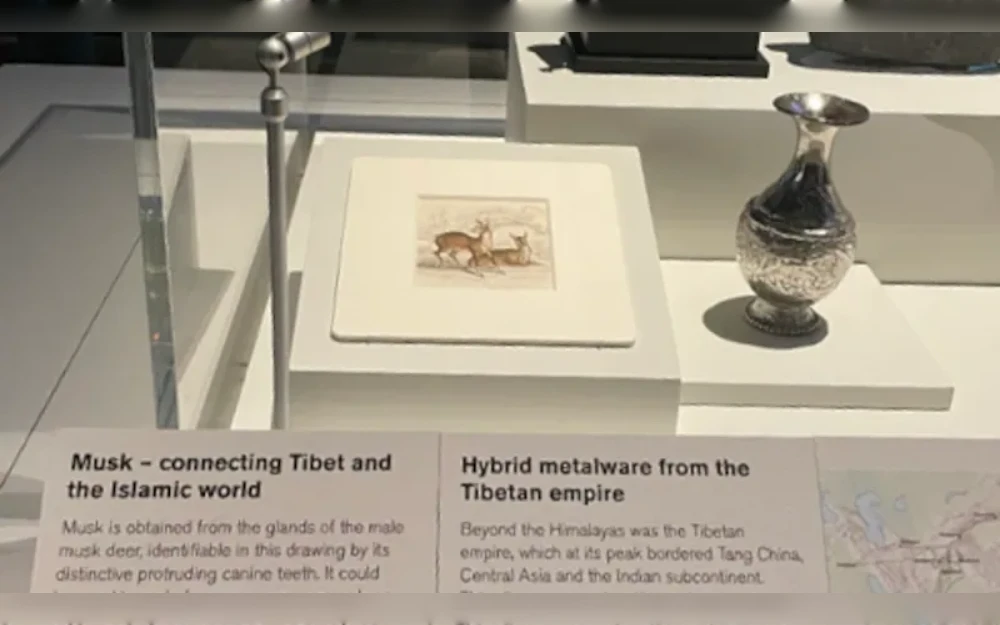
On its labels and in catalogue materials describing Tibetan artifacts, the British Museum has used the phrase “Tibet or Xizang Autonomous Region.”
For example, a silver vase gifted by the 7th-century Tibetan Empire ruled by King Songtsen Gampo to neighboring Tang China was labeled as “Tibet or Xizang Autonomous Region, China.”
Tsering Passang, founder and chairman of the Global Alliance for Tibet and Persecuted Minorities, said use of “Xizang” is “not only inaccurate but deeply offensive to Tibetans.”
“It mirrors the Chinese Communist Party’s efforts to erase Tibet from the global map, rewrite its history, and suppress the Tibetan people’s peaceful culture,” he said.
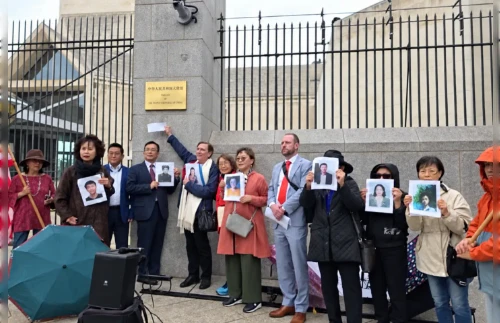
Tibetan groups — led by advocacy group Global Alliance for Tibet and Persecuted Minorities and the Tibetan Community in Britain — wrote to the British Museum, first on Nov. 25 and later on Dec. 18, citing their grave concerns about use of the term.
The British Museum, in its response to initial complaints filed by the Tibetan groups, defended its use of the term Xizang, saying it “reflects the contemporary region,” according to a statement by the Global Alliance for Tibet and Persecuted Minorities.
Tibetan activists, however, have rejected the museum’s explanation, saying it ignores the political implications of promoting terminology perpetuated by the Chinese Communist Party that legitimizes the Chinese state narrative.
The British Museum did not immediately respond to RFA’s request for comment.
In 1965, the Chinese government — which annexed Tibet in 1950 — designated the historic regions of U-Tsang and the western part of Kham as the Tibet Autonomous Region, or TAR.
But later Beijing replaced the use of the term “Tibet” with “Xizang” in all official diplomatic documents, with Chinese official experts saying the name “Tibet” has been geographically misleading to the international community, and rectifying it “will help enhance China’s international voice on Tibet.”
The TAR borders India, Nepal and Bhutan to the south and spans more than 1.2 million square kilometers (460,000 square miles), making it China’s second-largest province-level division after the Xinjiang Uyghur Autonomous Region to the north — which Uyghurs prefer to call “East Turkistan.”
Shaping global understanding
Tibetan activists say the British Museum, which is funded by U.K. Department for Culture, Media and Sport and whose permanent collection of over 8 million items is among the largest in existence — “bears a profound responsibility to present history and heritage with integrity.”
“This is not just about labels; it’s about the museum’s role in shaping global understanding of a culture that is actively being suppressed,” said Phuntsok Norbu, chairman of the Tibetan Community in Britain.
The group has also urged the British Museum to engage in dialogue with Tibetan scholars and community leaders to ensure the accurate representation of Tibetan history and culture in future exhibitions.
Tibetans in France have also been protesting against Paris’ Musée Guimet, which has one of the largest collections of Asian art outside of Asia, saying it had kowtowed to Chinese pressure in referring to its Tibetan section as the “Himalayan World.”
Additional reported by Dickey Kundol. Edited by Tenzin Pema for RFA Tibetan and by Roseanne Gerin and Malcolm Foster.
“Copyright © 1998-2023, RFA.
Used with the permission of Radio Free Asia,
2025 M St. NW, Suite 300, Washington, D.C. 20036.
https://www.rfa.org.”