



But rights groups say they are concerned for his health and safety under continued restrictions.

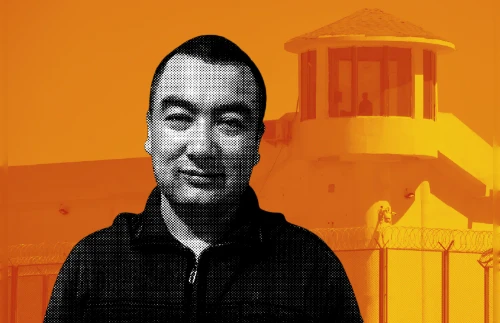
Chinese authorities on Thursday released Tibetan activist Tashi Wangchuk from prison after he completed a five-year term for discussing language restrictions with Western media, but rights groups expressed concerns about his health and safety amid ongoing controls on his freedom.
One of Wangchuk’s lawyers, Liang Xiaojun, announced in a tweet that staffers from the Justice Bureau had taken the activist to his sister’s home in Trindu (in Chinese, Chenduo) county, in Qinghai province’s Yulshul (Yushu) Tibetan Autonomous Prefecture, and that his family members said, “he’s in good health.”
However, Liang noted that he had been unable to meet with Wangchuk or directly contact his family and had not seen a photo of him after his release, and therefore is unsure “whether or not he is fully free.”
With the completion of his jail term, Wangchuk—who is around 35 years old—now begins a five-year deprivation of his rights to free expression, association, assembly, publication, vote, and to stand in elections. Although in practice few of these rights actually exist in Tibet, Wangchuk will be subject to near-constant monitoring by authorities.
A shopkeeper from the Yulshul township of Jyekundo, also called Gyegu, Wangchuk was arrested in January 2016 after giving and interview to The New York Times about his inability to secure the right for children in Tibet to learn the Tibetan language as guaranteed in China’s constitution, despite filing a formal complaint with authorities in Beijing.
He was detained for two years before appearing in court to face charges of “inciting separatism” and in May 2018 was sentenced to five years in Dongchuan Prison, in Qinghai’s provincial capital, Xining.
According to his lawyers, Wangchuk was repeatedly tortured while being interrogated during his early days in detention, endured threats to the safety of his family, and was denied the right to see legal representatives on multiple occasions—both prior to and after his trial.
Multiple human rights groups and Western governments have spoken out against his arrest and imprisonment, as well human rights experts from the United Nations.
While China claims to uphold the rights of all minorities to access a “bilingual education,” Tibetan-language schools have been forced to shut down and kindergarten-aged children regularly only receive instruction in Mandarin Chinese.
Observers say such policies are aimed at eliminating the next generation of Tibetan speakers and part of a broader effort by the government to destroy Tibetans’ cultural identity. Similar policies are deployed against Mongolians in Inner Mongolia and Uyghurs in Xinjiang.
Concerns over health and safety
U.S. lawmakers and The New York Times welcomed Wangchuk’s release on Thursday, but slammed Beijing for arresting him in the first place.
Representative James McGovern and Senator Marco Rubio, co-chairs of the bipartisan and bicameral Congressional-Executive Commission on China (CECC), called Wangchuk’s detention “arbitrary” and said he “should never have spent a single day behind bars.”
“We will be monitoring Tashi Wangchuk’s condition and call on Chinese authorities to ensure that he is fully free from all post-release restrictions” the lawmakers said in a joint statement, that also expressed concern over Beijing’s language policies.
A spokesperson for The New York Times applauded Wangchuk’s release in an emailed statement to RFA’s Tibetan Service, adding that “his imprisonment was an action that appeared intended to silence critics, impede the free flow of information, and ultimately deprive Chinese citizens of information.”
Rights groups questioned whether Wangchuk is truly free, given his ongoing deprivation of rights.
“While we are pleased that Tashi can finally return home to his family after five years, no one should view his release as a victory,” Washington-based International Campaign for Tibet (ICT) said in a statement.
“The Chinese government falsely charged Tashi with breaking the law, held him for years despite an international call for his release, subjected him to a sham prosecution and caused him unimaginable physical and psychological damage, all while refusing to address his legitimate concerns about Tibetans’ language rights.”
ICT also expressed concerns about Wangchuk’s long-term health and safety, noting that some Tibetans have died after their release from prison as a result of the beatings they have received as inmates, while others have been re-arrested.
John Jones, campaign manager for London-based Free Tibet, called it an “outrage” that Wangchuk was ever jailed in the first place.
“It is further galling that he will now have his rights further curtailed and repressed,” Jones said, adding that governments should “take joint action calling on authorities to immediately lift all restrictions on him.”
Tenzin Tselha, campaigns officer for San Francisco-based International Tibet Network, noted that Wangchuk “remains unfree” amid his deprivation of political rights that “will see his every action surveilled.”
“Tashi’s only ‘crime’ was to peacefully call for the right of Tibetans to learn in their own language and governments must take strong, assertive action calling for his human rights to be upheld following his release,” she said.
Sophie Richardson, China Director at New York-based Human Rights Watch, said Wangchuk’s complaint was lodged peacefully and according to both Chinese and international law.
“It is clear that the Chinese government doesn’t want anybody reporting on Tibet, Xinjiang or other human rights violations,” she said.
“The international community must not only focus on defending people like Tashi Wangchuk and the importance of press freedom and freedom of expression, but they should focus on holding Chinese officials accountable who are responsible for these human rights violations.”
‘Non-Release Release’
A day ahead of Wangchuk’s release, rights group Safeguard Defenders issued a report entitled “China’s False Freedom” which details the practice of Non-Release Release (NRR) in which prisoners, once freed from jail or a detention center, are arbitrarily detained by the police at their home, at a hotel or in a secret location for weeks, months or even years.
In a statement accompanying the report, Safeguard Defenders said the study of how China places released prisoners and detainees into an illegal form of house arrest entirely outside of the judicial system “could not be more timely as the world now watches what will happen to Tibetan activist Tashi Wangchuk” upon his release.
“It is widely expected that Tashi will be not be freed,” the statement predicted. “Rather, police will likely spirit him into some form of NRR.”
Peter Dahlin, founder and director of Safeguard Defenders, called NRR “yet another example of systematic illegal behaviour by Chinese police that make a mockery of China’s justice system.”
“It renders serving your sentence or being released on bail meaningless, when being freed simply means being moved into another form of imprisonment.”
Reported by RFA’s Tibetan Service. Translated by Tenzin Dickyi. Written in English by Joshua Lipes.
Copyright © 1998-2020, RFA. Used with the permission of Radio Free Asia, 2025 M St. NW, Suite 300, Washington DC 20036. https://www.rfa.org

Collie Dog Breed

AI Powered Mule Account Detection

China Closes 3 Tibetan Schools in 3 Months; Threatens Language, Cultural Preservation

UN General Assembly Hears Report of International Atomic Energy Agency

A Bizzare Doorbell Video Shows Stranger Eating Banana Through Joe Biden’s Mask

Irish Setters Dog Breed

Real-Time Agentic AI-Driven Fraud Investigation Platforms
Aung San Suu Kyi Phone Call is ‘Political Calculation’ by Military-Backed Government
Subscribe Our You Tube Channel

Fighting Fake News
Fighting Lies