



Shanti Mohila, a group of Rohingya women who bravely fight for justice, should be celebrated this International Women’s Day.
Guest commentary by Ishita Kumar/Cox’s Bazar, Bangladesh
The global celebration of International Women’s Day is a call to action to support and amplify the efforts of the extraordinary girls and women around the world who are tirelessly working within their communities to defend their rights and to empower future generations.
Last month, we saw the Argentinian federal court issue arrest warrants against 25 Myanmar officials, including the seniormost military leaders, for genocide and crimes against humanity committed against the Rohingya community between 2012 and 2018. Our thoughts immediately went to the brave Rohingya women who helped make this significant legal action possible.
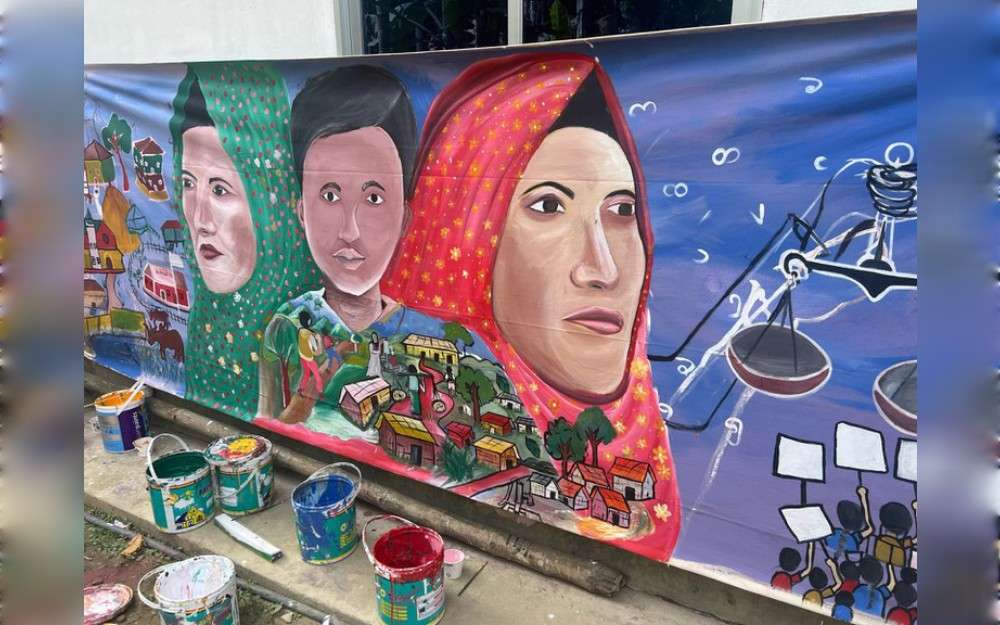
For years, the Shanti Mohila (Peace Women), a group of over 400 Rohingya women living in the refugee camps in southeastern Bangladesh, have defied societal expectations and conservative gender norms.
They are leaders in their community fighting for recognition and justice for the harms endured at the hands of the Myanmar military. They play a vital role as leaders, educators, and advocates for justice.
The 2017 “clearance operations” by the Myanmar military against the historically persecuted Rohingya Muslim minority living in the Rakhine state were a series of widespread and systematic attacks involving mass killings, torture, and destruction of houses that led to the largest forced displacement of the Rohingya community from Myanmar into neighboring Bangladesh.
Sexual violence was a hallmark of these “clearance operations,” with young women and girls disproportionately affected by brutal and inhuman acts of sexual and gender-based violence. Yet, despite efforts to destroy them through long-term serious physical and mental harm, Rohingya women fought back.
Shanti Mohila members have mobilized to raise awareness of the large-scale sexual and gender-based violence endured by Rohingya women between 2016 and 2017. They have spoken about their experiences before international justice proceedings and catalyzed change by breaking down the stigma associated with victimhood and inspiring next generations of Rohingya women through action.
In 2023, their remarkable achievements were recognized as they were honored as Raphael Lemkin Champions of Prevention by the U.N. Office of the Special Adviser on the Prevention of Genocide.
Contributing evidence to justice mechanisms
The testimonies Shanti Mohila members have provided and encouraged other survivors to step forward to provide over the past years have given the opportunity to investigative mechanisms, NGOs, and lawyers to present evidence before all ongoing international justice proceedings.
Specifically, Shanti Mohila members are among the survivors who provided key witness statements in The Gambia v. Myanmar case before the International Court of Justice (ICJ).
In 2019, two representatives were in The Hague as part of The Gambia delegation to observe provisional measures hearings at the ICJ.
In 2023, they were among the group of seven witnesses in Buenos Aires to testify in the investigative hearings under the universal jurisdiction principle before the federal criminal court – leading to the recent court order of the first-ever arrest warrants for crimes of genocide against key state officials and members of the Myanmar military.
“I could not believe I could tell an international court about my sufferings. I could not believe it until I stepped into the courtroom,” said “Salma” (not her real name), a Rohingya female witness who requested anonymity for privacy and safety concerns.
“It was difficult for me to speak about the death of my family and their names, but I did it for justice, for my grandchildren, for a future where we can return home with dignity,” she said. “They [perpetrators] targeted women first to break our community, our morale.”
“Who would have thought that we, the Rohingya women, would one day be taking the Myanmar military to the court?”
It is worth highlighting here why exactly the evidence from survivors of sexual and gender-based violence (SGBV) is so critical to successfully prosecute and hold the Myanmar military accountable, particularly for genocide.
The “intent to destroy a group in whole or in part” is a necessary element to prove the crime of genocide, which can be notoriously difficult to evidence.
In the Rohingya context, the scale and brutality of SGBV during the 2017 “clearance operations” was identified by the U.N. Independent Fact-Finding Mission as one of the key factors that “inferred” the Myanmar military’s genocidal intent to destroy the Rohingya people.
Sexual violence against Rohingya women and young mothers in front of their families, and the accompanying sexual mutilations and forced pregnancies, are some of the most significant reflections of the perpetrators’ desire to inflict severe social and reproductive harm on the community.
The SGBV was not only a part of the campaign of mass killings, torture and destruction of property in 2017 but also committed in the context of decades-long propagated narrative that uncontrolled Rohingya birth rate is a threat to the survival of the nation, and state policies that placed significant legal restraint on Rohingya reproductive rights.
In a 2023 study on long-term impact of sexual and gender-based violence against the Rohingya men, women, and hijra conducted by the Legal Action Worldwide (LAW), clinical analysis by psychologists and medical doctors revealed that the SGBV against Rohingya had resulted in: permanent damage to survivors’ genitalia impacting their ability to procreate; severe psychological injuries that have left them in a state of extreme emotional distress; damaged the survivors’ family relations including with their spouse and children; severe ostracization of the women and children born of rape; and forced reorganization of the Rohingya households.
The evidence of SGBV is critical in that its commission and its enduring and foreseeable impact on survivors clearly shows that the Myanmar military inflicted serious mental and bodily harm and imposed measures intending to prevent births within the community. It also reflects a deliberate incremental step in causing the biological or physical destruction of the group while inflicting acute suffering on its members in the process.
Leaders within the Shanti Mohila network have been instrumental in supporting the conceptualization and implementation of studies such as the 2023 report – making them truly the grassroots advocates for the community.
Towards holistic justice and healing
Alongside these important contributions, the Shanti Mohila members continuously work within the camps in Cox’s Bazar to ensure awareness of the ongoing justice processes and provide peer support to one another and the wider community.
Last year, LAW and Shanti Mohila engaged with Rohingya activists around the globe through LAW’s Rohingya Diaspora Dialogue initiative to foster wider recognition and advocacy for the significant work being done by the Rohingya women in Cox’s Bazar on gender equality and to hold the perpetrators of serious crimes responsible.
These actions embody Shanti Mohila’s commitment and openness to learning.
They are dedicated to remaining bold and effective advocates for their community and being against the illegitimate military regime that continues to commit atrocities against civilians across Myanmar.
The challenges remain plenty since the renewed conflict between Arakan Army and Myanmar military in late 2023 has led to upward of 60,000 Rohingya arriving in Cox’s Bazar in a new wave of forced displacement, joining over 1 million Rohingya refugees already living in the camps.
The evolving conflict dynamics in the Rakhine state and its impact on the Rohingya there add to the tensions in the camps. The risk of another surge in the forced recruitment of the Rohingya in the camps by organized groups pressuring youths to join the civil war in Myanmar persists.
Amid this, the work and growth of Shanti Mohila can prove to be a stabilizing force, beyond their contributions to women empowerment and the justice process. They can provide an avenue to offset the negative impacts of the deteriorating regional security situation through promoting efforts toward reconciliation and encouraging people to keep the rule of law and justice at the center of their struggle.
On this International Women’s Day, we celebrate the groundbreaking work of Shanti Mohila and the power and legacy they are creating for generations of Rohingya women, their community as a whole, and women across fragile and conflict-affected contexts worldwide.
Ishita Kumar, based in Cox’s Bazar, is the legal and program adviser on the Rohingya crisis for Legal Action Worldwide (LAW), an independent, non-profit organization of human rights lawyers and jurists working in fragile and conflict-affected areas. LAW has been supporting Shanti Mohila leaders and representing over 300 Rohingya in the ongoing international justice processes about their treatment in Myanmar, including at the International Court of Justice, International Criminal Court and supporting universal jurisdiction cases in foreign domestic courts such as in Argentina. The views expressed here are hers, not those of BenarNews.
Copyright ©2015-2024, BenarNews. Used with the permission of BenarNews.