



John Bechtel and Ahammad Foyez/Wasginton and Dhaka
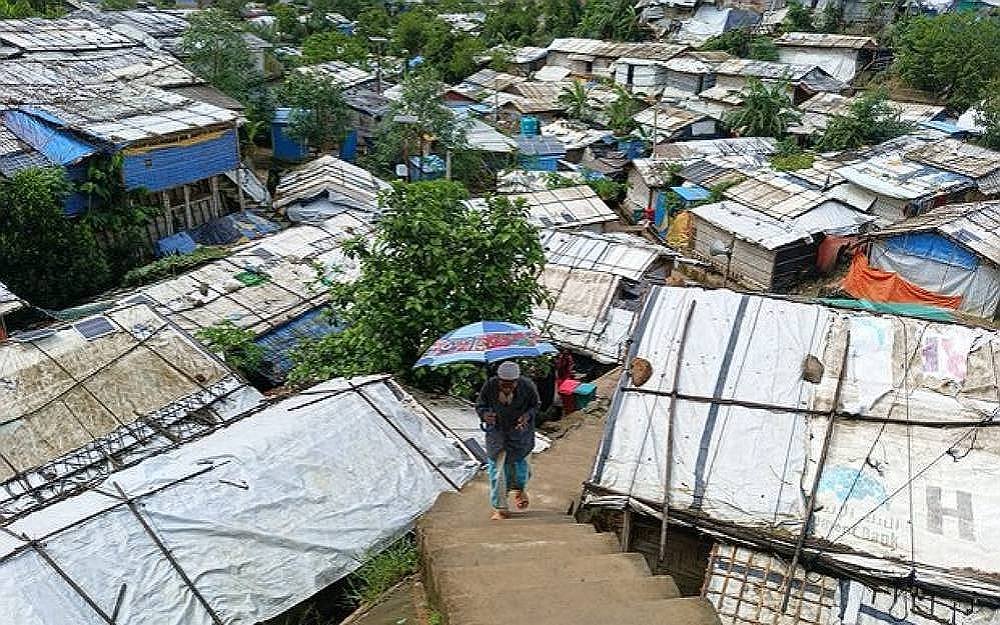
Nearly two-thirds of Rohingya respondents have reported that moving around in Bangladesh refugee camps is more difficult than what they encountered in Myanmar, the country they were forced to flee, a youth advocacy group said in a study released Friday.
The Youth Congress Rohingya (YCR), a refugee-led advocacy organization, placed some of the blame on the Armed Police Battalion, the force primarily responsible for security at the Cox’s Bazar-area camps, for poor conditions faced by about 1 million refugees in the camps.
“The government movement restrictions are violently enforced by both the physical infrastructure put in place by the government authorities and through intimidation and physical and sexual abuse by the APBn,” YCR said using an acronym for the police battalion.
“Fencing constructed around the camps prevents people from moving freely, forcing them to pass through checkpoints where they are at the mercy of the APBn officers who enforce movement restrictions on a seemingly arbitrary basis,” it said in a news release accompanying the study’s report.
FYCR based its 88-page report on 241 surveys and 58 in-depth interviews with Rohingya in 30 of the refugee camps between August 2022 and August 2023. It also interviewed four police officers working in the camps as part of its research, which was supported by the Unitarian Universalist Service Committee and other donors.
Most respondents, 72%, blamed the Bangladesh government for intentionally implementing restrictions to “produce a coercive environment that will force Rohingya to relocate to the undesirable Bhashan Char Island Camp or return to Myanmar.”
Most respondents, 72%, blamed the Bangladesh government for intentionally implementing restrictions to “produce a coercive environment that will force Rohingya to relocate to the undesirable Bhashan Char Island Camp or return to Myanmar.”
Bangladesh’s Home Minister Asaduzzaman Khan defended the actions of security forces and said his government was sincere about ensuring the safety of the Rohingya people.
“The number of Rohingya in Cox’s Bazar is now several times higher than the locals. In this situation, if the Rohingyas are allowed to move freely, it will be difficult for us to handle the situation,” he told BenarNews. “If anyone says they are worse off here than in Myanmar, it would be totally wrong.”
About 740,000 of the Rohingya began arriving in Bangladesh beginning in August 2017 after the Myanmar government launched a bloody crackdown on minority-Muslims in the Rakhine State.
The crackdown was in response to attacks against Myanmar police and army posts by Arakan Rohingya Salvation Army (ARSA) insurgents in the state. The new arrivals pushed the number of refugees in the camps to 1 million.
A camp dweller said life was better in Bangladesh at the beginning.
“There was freedom for us when we first arrived here,” said a 43-year-old woman identified as Samira. YCR changed the names of those quoted in the report over safety concerns.
“Then the army was replaced with the police, the fences were set up around the camp and the markets within the camp were all demolished, which started causing so many problems for us.”
‘Bribes and extortion’
Rohingya are prohibited from leaving camps, face a 6 p.m. to 6 a.m. curfew, and are prohibited from assembling in groups or owning or using smartphones or laptops.
The report noted that respondents said people caught violating curfews could face severe repercussions from police “including beatings, fines, detention and confiscation of their goods or personal items.”
It said extortion and other forms of corruption are commonplace in the camps, adding police will often fabricate evidence.
“Bribes must also be paid to accomplish many aspects of basic functioning in the camps, including crossing checkpoints, working, transporting necessities, seeking health care, carrying a mobile phone, holding weddings or funerals and participating in religious life,” YCR said.
One of the police officers interviewed for the study said he had not taken money from Rohingya, but he knows others who did.
“Sometimes my colleagues take money from them, and they give me some of it, or we spend that money on snacks and coffee costs,” said the officer who was given a pseudonym.
YCR said the Bangladesh government claimed it has instituted a series of measures to protect Rohingya to crack down on crime, reduce radicalization and violence.
“However, they have had the opposite effect. The camps are becoming increasingly unsafe due to violence by both armed groups and the APBn,” it said in its news release.
Khan said security forces faced a difficult task dealing with armed criminal groups inside the camps. But he added authorities would investigate and take appropriate action on specific complaints against personnel.
The report concludes with 39 recommendations for the Bangladesh government, the international community and humanitarian organizations.
Among the recommendations for the government are: eliminate restrictions on freedom of movement; remove curfews; halt the strategy to coerce Rohingya to relocate to Bhashan Char or Myanmar; consider replacing police with the military to provide security; adopt a zero-tolerance policy toward corruption; and investigate and prosecute police abuses against Rohingya.
The international community should prioritize the rights of Rohingya and hold Bangladesh government officials accountable for abuses and provide financial support to civil society organizations, YCR said.
Humanitarian organizations including UNHCR should also collaborate with the government to implement training programs for the camps, including ways to empower Rohingya youths, as well as strengthen food security and improve living conditions and health care facilities.
Copyright ©2015-2022, BenarNews. Used with the permission of BenarNews.