




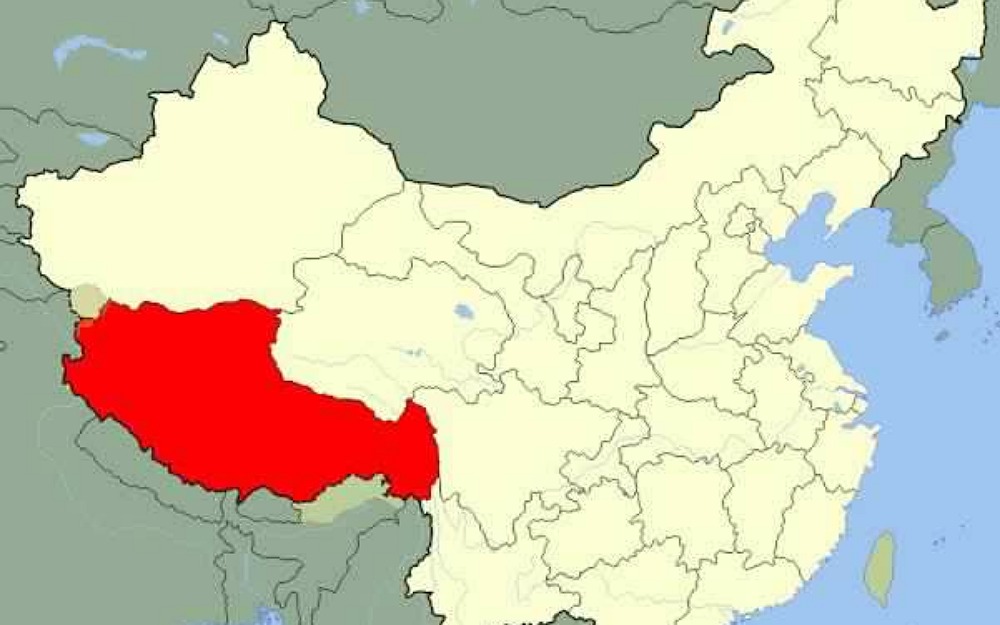
Tibetan nomads in China’s western Sichuan province have appealed to the Chinese government to drop a plan that would make Mandarin Chinese the official language of instruction in Tibetan schools in the Ngaba (in Chinese Ābà) Tibetan Autonomous Prefecture.
A delegation of nomads said in a letter Monday to authorities that moving from Tibetan to Chinese as the main medium of instruction would have an “adverse impact on relationships between parents and their children and goes against regional ethnic laws.”
The nomads, herders who raise livestock and move their animals as seasons change, said the consequences of the switch would be “far-reaching on future generations of Tibetan students with nomadic backgrounds.”
“Their welfare and happiness depends on a sound Tibetan education through their mother tongue,” it said.
“We therefore appeal that the medium of instruction of all subjects remain in the Tibetan language,” the letter said. It was submitted to the Standing Committee of the National People’s Congress. Instruction in Mandarin has been in effect in most middle and high schools in Tibet since the 1960s, but in the 2010s, many elementary schools and even kindergartens are now also teaching in Mandarin due to the educational policies of the regional government, a recent Human Rights Watch (HRW) analysis showed.
RFA reported last week that Chinese was being promoted heavily in rural areas of the Tibetan Autonomous Region (TAR) and other Tibetan areas, raising concerns among parents that Tibetan children becoming more proficient in Chinese than their native language native.
The HRW analysis, publish last month, focused mainly on the TAR, but the New York-based rights watchdog noted the policies were also being promoted in Tibetan areas outside that region’s boundaries.
“China’s policies for Tibetan children in the TAR … show decreasing respect for their right to use their mother-tongue or learn about and freely express Tibetan cultural identity and values in schools,” it said.
“Rather, they embody an approach to schools and schoolchildren that appears to be eroding the Tibetan language skills of children and forcing them to consume political ideology and ideas contrary to those of their parents and community,” it said.
Several ethnic Tibetan scholars and activists said that the move to Chinese amounted to an erasure of the Tibetan language, and by extension its unique cultural identity.
“The nomads are most concerned that if such a change goes into effect, it will have an impact on their learning outcomes,” a source in the region who requested anonymity for legal reasons told RFA’s Tibetan Service.
“Education is key in building relationships, and the type of education students receive shapes their character, so this is a really big deal for many reasons,” the source said.
The nomads argue that if the Chinese government insists on changing the medium of instruction to Chinese, students who are currently being schooled in Tibetan would be at a disadvantage when taking national college-entrance exams.
“Without a good test score, they will not get into a good university. Without a college education, it will be difficult to get a decent job,” said the source.
“The rights of children to an appropriate education is directly tied to career ambitions, so parents are genuinely concerned about the proposed changes,” the source added.
Shelge, a Tibetan former political prisoner living in Australia, told RFA that the delegates were representing Amoi, Meywa, and Serde villages in Ngaba.
“They have complained that the proposed change to the medium of instruction goes against Chinese law in general, and particularly the Regional Ethnic Autonomy Law,” Shelge said.
Article 36 of China’s Regional Ethnic Autonomy Law says agencies in ethnic autonomous areas have the right to make decisions about education, including “the language used in instruction,” but only “in accordance with state guidelines on education and in accordance with the law.”
“When news of the proposed change emerged, many of the teachers in Ngaba, Zogue and Chungchu county spoke out openly against the proposal by writing dissenting views in article form and publishing them [on social media],” Shelge said.
“Even though the Chinese government attempted to eliminate the views through [censorship] of social media, Tibetans from all over continue to express their dissatisfaction by writing about it in both Tibetan and Chinese,” the former political prisoner added.
Several of the nomadic delegates who signed the letter had published their opinions publicly in the preceding weeks.
“If the proposed switch to Chinese as the medium of instruction is true, then we, the people’s delegation have the responsibility to bring it up with our higher authorities to ensure the promotion and advancement of minority education remains in line with the Regional Ethnic Autonomy Law,” wrote Nya Melong, a delegate from Meywa Dhona village, on April 13.
“If we fail to address this issue, then we will have failed in our responsibilities as the people’s delegation,” he added.
Another delegate, Juchoe Pal from Mewa Gongthang village, said that “if such proposed changes becomes reality, this is willingly suppressing and trampling upon the culture and civilization of an entire race with nothing other than a show of contempt.”
“Such a proposed change is against national law and will sow the seeds of disharmony among the ethnicity,” he said, saying the scheme reflects “shortsightedness of a few poorly educated authorities who disregard the laws of the land.”
HRW said the language policies are “the result of increasing moves by the ruling Chinese Communist Party since 2014 to shift away from encouragement of cultural diversity, which had been the official policy towards minorities since the early 1980s.”
A recent poll on the proposed change in Ngaba, which was shared on the WeChat social media platform, shows the Chinese government’s attempt to limit the scope of the Tibetan language goes “against the wishes of the Tibetan people,” Tibetan legal expert Dolma Kyab said.
“As of April 20, 27,270 people, which accounts for 97 percent of participants, said they were in support of keeping Tibetan as the medium of instruction,” he said.
“Only 319 people, about 1 percent, voted against Tibetan as the instructional medium,” the U.S.-based writer said.
“During a meeting of school administrators, the Ngaba government announced that it was the Tibetan people’s aspiration and wish to [be educated in Chinese], which is a blatant lie,” added Dolma Kyab.
Reported by Lobe, Takha Gyal and Sonam Lhamo for RFA’s Tibetan Service. Translated by Dorjee Damdul. Written in English by Eugene Whong.
Copyright © 1998-2016, RFA. Used with the permission of Radio Free Asia, 2025 M St. NW, Suite 300, Washington DC 20036. https://www.rfa.org

Trapped moose in Idaho Rescued from Roll of Wire Fencing

Quiz:Origins of Dog Cat Breeds
Algorithmic Trading Fraud
China-Laos Air Base Could be Another Southeast Asian Forward Outpost for Beijing

UN Security Council Discusses Developments in Kosovo

Quebec Animal Rescue Rescued Three dogs That Were Stuck on Cliff for Five Days

Pyrenean Mastiff Dog Breed

Autonomous AI Agents
Subscribe Our You Tube Channel

Fighting Fake News
Fighting Lies