



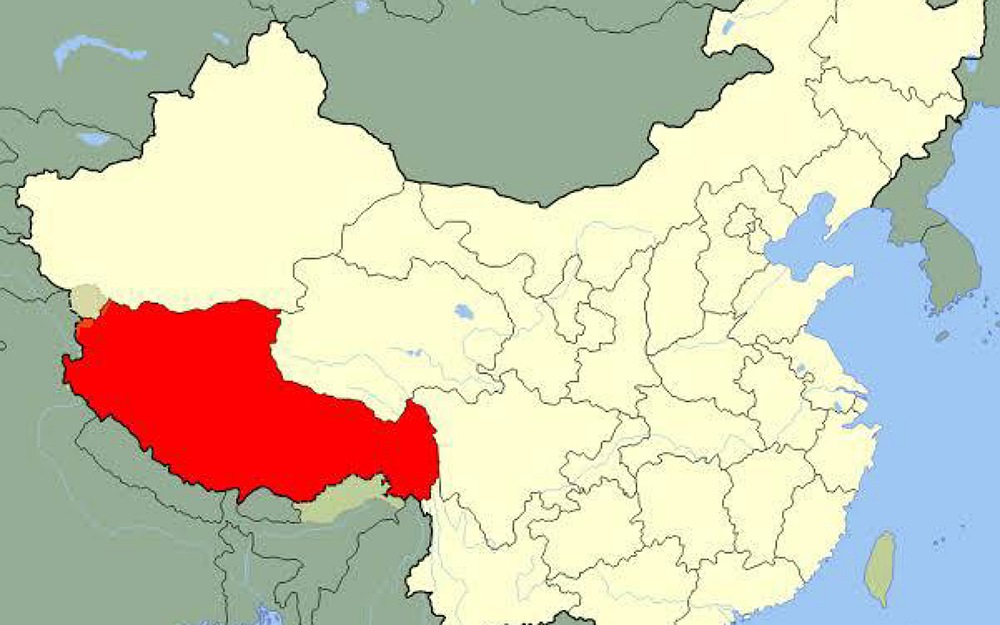
Recent deadly clashes between Indian and Chinese forces along the unmarked border between the two countries are prompting calls for India to rethink its policy toward Tibet, which before its conquest by China had historically served as a buffer between the two larger powers.
India must now “be bolder” in considering its policy regarding questions on Tibet, deputy speaker of Tibet’s India-based exile parliament Yeshi Phuntsok told RFA’s Tibetan Service in an interview last week.
“Until the Tibet issue is resolved, the present simmering Himalayan border conflict between the Chinese and Indian troops will remain. Therefore, finding a peaceful solution to the problem of Tibet is key to India’s security,” Phuntsok said.
“We are asking the Indian government to help resolve these issues by supporting resumed dialogue between the Dalai Lama’s representatives and the Chinese leadership on the basis of the Middle Way Approach,” Phuntsok said.
The Middle Way refers to the proposal of the Dalai Lama, who fled to India after an abortive Tibetan uprising against Chinese control in 1959, to recognize Beijing’s rule over Tibet in exchange for a greater autonomy in Tibetan areas.
Five Tibetan NGOs including the Tibetan Youth Congress (TYC) and Students for a Free Tibet, however, met in India on June 18 to condemn what they called China’s aggression on the border and to call instead for Indian support for Tibet’s return to its former independence.
“It is high time for India to recognize Tibet as an independent country and an occupied nation,” TYC president Gonpo Dhundup said, according to a June 18 report in the Hindustan Times.
“An independent Tibet is the only solution to the Indo-China conflict,” added the national director for Students for a Free Tibet, quoted in the Times.
A clash between Indian and Chinese security forces in the Galwan Valley in northwestern India’s mountainous region of Ladakh in June left dozens of soldiers dead on both sides, many of them beaten to death with clubs, marking the first fatalities in a confrontation between the two militaries in more than four decades.
Each side blamed the other for the clash, with both India and China saying that troops from the other side had crossed into their territory. Corps-level talks continued on Monday, The Times of India reported.
Indian views of China harden
In India, views toward China have hardened, with growing grassroots calls for a boycott of goods from the country’s second largest trade partner.
The Indian government has banned 59 apps developed by Chinese firms – including, Tik Tok, WeChat and Weibo – citing concerns that they were engaging in activities that are “prejudicial to sovereignty and integrity of India, defence of India, and security of state and public order,” the Press Information Bureau said Monday.
The current face-off in Ladakh is only the latest in a series of flare-ups along China’s and India’s 2,200-mile-long undemarcated border, or Line of Actual Control, with Indian soldiers on May 9 using their fists to block an attempt by Chinese troops to cross into Indian territory at the Nakula pass in northern Sikkim.
In June 2017, India sent hundreds of troops into Bhutan to defend its ally against efforts by China to build a road southward into Doklam, an area claimed by both China and Bhutan. The stand-off continued for over two months and ended when both sides withdrew.
China and India, now both nuclear-armed powers, fought a border war in 1962 that left hundreds killed or wounded on both sides.
After gaining independence from Britain in 1947, India had never bothered to consolidate its northern border, because Tibet was “a friendly, peaceful, and culturally linked country,” Indian defense analyst and retired general PG Kamath told RFA’s Tibetan Service.
This was shown to have been a strategic mistake after China invaded and occupied Tibet in 1950, bringing Chinese troops up to the still undemarcated border with India, he said.
India then helped China by recognizing its occupation of Tibet as legitimate, said retired general and former director of Indian military training Vinod Saighal.
“If India had not recognized China’s occupation of Tibet, no one else in the world would have done so,” Saighal said, adding that India may soon “change course” in its view of China’s presence in Tibet.
“China has overplayed its cards this time,” he said.
Can policy change?
China is an expansionist power, “which is obviously not to the liking of the government of India and the people of India,” added retired general and former director of India’s Center for Land Warfare Studies Dhruv C. Katoch.
“But I don’t think that any [Indian] political party will change the status quo on Tibet. I think what’s important nowadays is that there is support for the Tibetan people, and their cause is increasing among the Indian public,” he said.
Indian government policy toward Tibet may be difficult to change, agreed Tenzin Lekshay, deputy director of the Dharamsala, India-based Tibet Policy Institute.
“But Tibetans should take the opportunity to make the Indian public more aware of the situation in Tibet. I think that creating awareness of the Tibetan issue will also help us in our cause,” Lekshay told RFA.
India, home to 85,000 refugees from Tibet, has given mixed signals to Tibetans over the years as it courts China as an economic partner.
In 2018, on the eve of a meeting between Indian Prime Minister Narendra Modi and Chinese President Xi Jinping, the Indian government issued a directive prohibiting bureaucrats and leaders from attending events organized by the Central Tibetan Authority (CTA) marking 60 years in India in 2019.
Lobsang Sangay—president of the CTA, the India-based Tibetan exile government—called on China this month to withdraw its forces from Tibet and allow the formerly independent Himalayan country to resume its historic role as a buffer state.
“When Tibet was independent, the Indian army did not require a defense budget of 60 billion dollars. It was not necessary at all,” Sangay said in an interview with India Today.
“So, once Tibet is demilitarized and declared a zone of peace, the two largest populated countries in the world, India and China, will have permanent peace.”
China, which has occupied Tibet for over 70 years, is unlikely now to pull its forces back from the border with its rival India, though, many believe.
Only a restoration of Tibet’s independence will fully address the question of Tibet’s status and help promote peace along the border, Tibetan activist Tenzin Tsundue said to RFA in a recent interview.
The Tibetan people’s demand for independence is not just because we don’t trust [Chinese president] Xi Jinping and his machinery of control,” Tsundue said, “but because we believe only the restoration of Tibet’s independence can truly guarantee the survival of Tibet’s religion, culture, land, and people.”
“We can respect China only as our neighbor, not as our boss,” Tsundue said.
Reported by RFA’s Tibetan Service. Translated by Dorjee Damdul. Written in English by Richard Finney.
Copyright © 1998-2020, RFA. Used with the permission of Radio Free Asia, 2025 M St. NW, Suite 300, Washington DC 20036. https://www.rfa.org
Pyrenean Mastiff Dog Breed

Autonomous AI Agents
Rare Photos of Aung San Suu Kyi Spark Renewed Calls for Her Release

Cuba Libre: The Oppression Havana Hides

Red Bull Skateboarder Breaks Record for Fastest Downhill Skateboard Speed Ever
Akbash Dog Breed

Multi-Layered Verification Strategy
Tibetan Rights Group: South Africa Arson Attack is Transnational Repression by CCP
Subscribe Our You Tube Channel

Fighting Fake News
Fighting Lies