



Journalists say they are limited by fear of prosecution, amid warnings that the ‘China factor’ is a global threat.
By Chen Zifei for RFA Mandarin
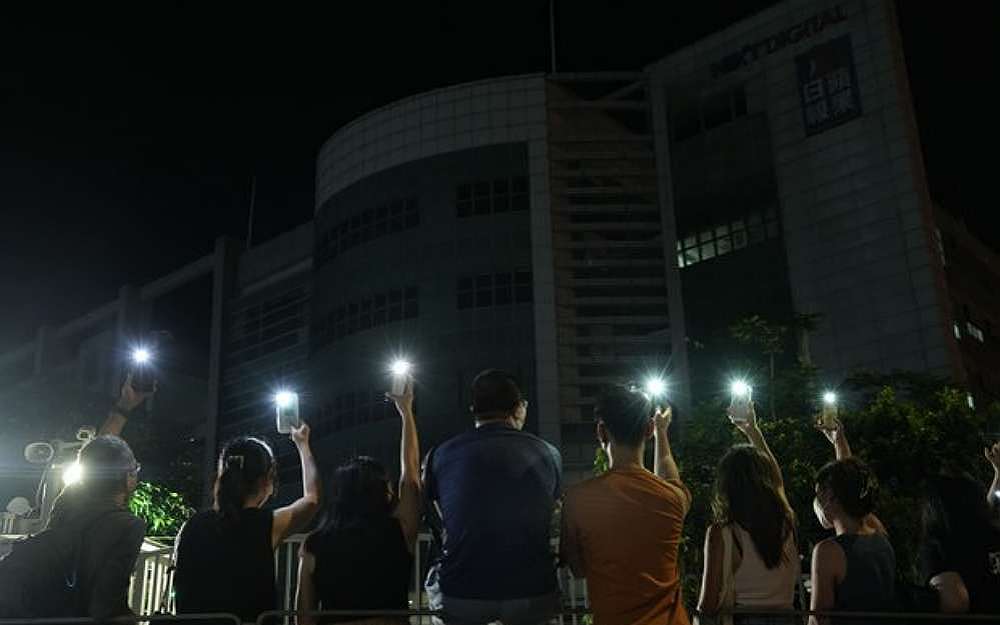
Press freedom in Hong Kong has declined for yet another year, with most local outlets now hesitant to criticize the Chinese government, according to a recent survey by the city’s journalists.
HK’s press freedom has declined for yet another year, according to HKJA’s latest Press Freedom Index,” the Hong Kong Journalists’ Association (HKJA) said in a news release posted to its Twitter account.
“Ratings by journalists dropped almost six points, showing that the city’s press freedom hit a new low in 2021,” it said.
In a recent poll carried out for the HKJA by the Hong Kong Public Opinion Research Institute (HKPORI), 97 percent of journalists who responded said press freedom is in decline, while more than half of public respondents agreed with this view.
“Some journalists … did not participate in the survey for fear of reprisals,” the HKPORI said in a press release.
“Some Hong Kong journalists bluntly said that they were worried about their own safety and did not dare to report on topics that might violate the National Security Law,” it said, in a reference to a draconian security law banning public criticism of the government that has been used to jail most of the city’s pro-democracy activists and former members of the political opposition.
“Some media management said that the government and media executives had put pressure on them to make Hong Kong journalists self-censor and be forced to become official mouthpieces,” it said.
“Commentators pointed out that the China effect has deteriorated the Hong Kong media.”
One country, two systems
The ruling Chinese Communist Party (CCP) under Deng Xiaoping had promised Hong Kong could run its own affairs under a “one country, two systems” arrangement, with the city’s freedoms preserved for at least 50 years, and with progress promised towards fully democratic elections.
The reality has been very different. Just 25 years after the handover, Hong Kong is no longer the world’s freest economy and has plummeted in global press freedom rankings following a citywide crackdown on dissent under the national security law.
Hong Kong journalist Cheung San said the June 2021 raids on the now-shuttered Apple Daily newspaper and the jailing of several top editors and founder Jimmy Lai, as well as subsequent targeting of Stand News in December 2021, had changed the environment for working journalists in the city.
“There are some stories I will filter of my own accord, as I may be suspected of violating the national security law,” Cheung told RFA. “I am afraid that it may already be dangerous to touch on certain issues.”
“In the past, when I ran into a story that I wanted to report … I would definitely try to get my superiors [to agree to it],” he said. “Now I don’t do that any more, because I know that everyone is worried, and I can’t ask others to risk their lives so I can write the stories I want to write.”
An editorial manager who gave only the surname Yim said media bosses often use the threat of the national security law to suppress media reporting that the Hong Kong government doesn’t want to see.
“The media fear the red lines of the national security law more than anything now,” Yim said. “Media bosses use [it] as a way to put pressure on editors and reporters.”
Exiles off limits
Yim said one topic that quickly became off-limits in Hong Kong was the doings of exiled pro-democracy politicians in other countries.
“We can’t write about emigres overseas,” he said. “On COVID-19 policy, there are some experts who don’t agree with the government’s zero-COVID policy, but they’re not allowed to speak. But if the government criticizes them, then we can report that.”
“Some of our audience are telling us that a lot of media in Hong Kong have turned into government media,” Yim said.
“Yim believes that sometimes the political pressure on the media comes all the way from Beijing.
“If the pressure is coming from higher up, then it could have come all the way from Beijing,” he said. “You will find that most of Hong Kong’s media are dealing with this … they are suppressed regardless of who they are, and you can tell that there is someone higher up handing down instructions from behind the scenes.”
Huang Chao-nien, an assistant professor at the National Development Institute of Taiwan’s National Chengchi University, said the rapid disappearance of press freedom in Hong Kong also shows the power of CCP influence far beyond the borders of mainland China.
“Hong Kong is a very prominent example, because it had a very high degree of press freedom before, and it has declined in just a few short years,” Huang told RFA. “The fundamental factor at play here is China; it’s the spillover effect of Chinese authoritarianism.”
“Hong Kong is just the first stop, when it comes to the damage done by the China factor,” he said, calling on the rest of the world to take warning from events in Hong Kong. “[The CCP] is [also] trying to influence and manipulate foreign media through various channels.”
Translated and edited by Luisetta Mudie.
Copyright © 1998-2020, RFA. Used with the permission of Radio Free Asia, 2025 M St. NW, Suite 300, Washington DC 20036. https://www.rfa.org.