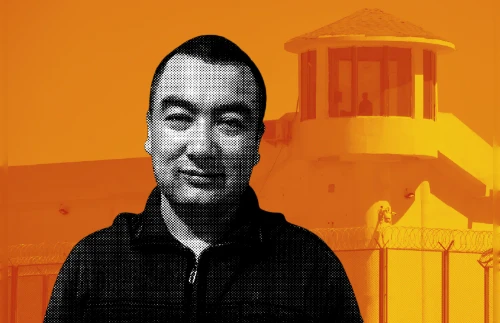




Rizwangul NurMuhammad was heckled for mentioning her imprisoned brother in Xinjiang.
By Alim Seytoff
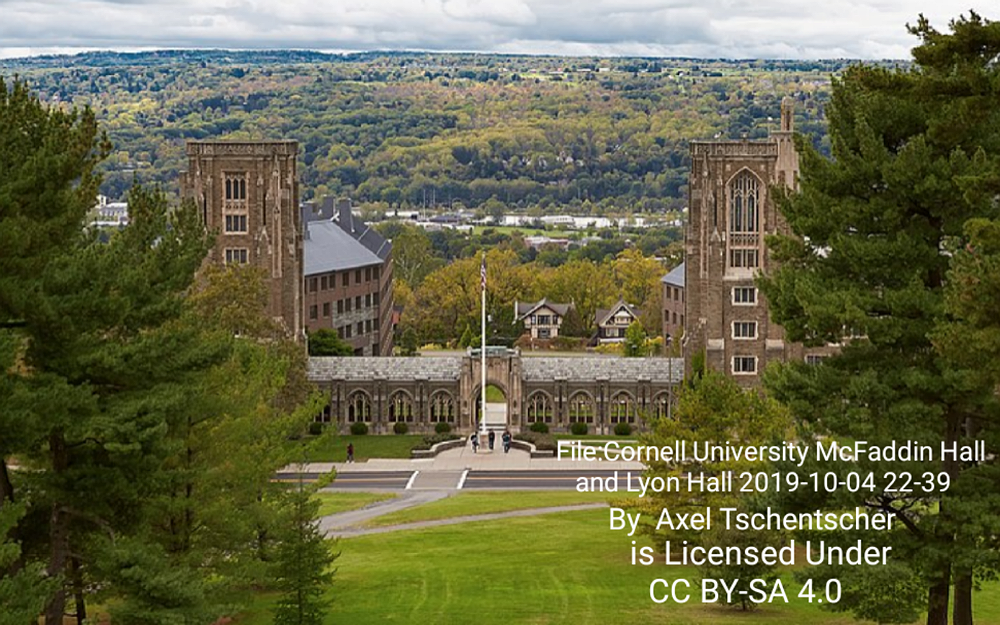
The harassment by Chinese students of a New Zealand Uyghur Fulbright scholar who spoke about her brother’s detention in China during an event at Cornell University is the latest in a series of alleged incidents involving efforts to intimidate critics of Chinese policies on American campuses.
On March 10, U.S. Rep. Elissa Slotkin, a Michigan Democrat and Cornell alumna, gave a virtual address to graduate public administration students about her career in public service. During the talk, Rizwangul NurMuhammad asked the congresswoman why the U.S. and other countries have sought to punish Russia for invading Ukraine but had not imposed similar sanctions on China for its genocide of the predominantly Muslim Uyghurs in Xinjiang.
NurMuhammad told the Slotkin that her brother Mewlan had been arbitrarily arrested in 2017 amid mass detentions of Uyghurs and that she had since lost contact with him, according to a report published by Axios.
While she was speaking, Chinese students heckled her, and then about 40 of them walked out of the lecture hall in protest, the report said.
RFA could not reach NurMuhammad for further comment on the incident. But a series of tweets after the incident indicated that the harassment had continued after Slotkin’s talk.
“What I am experiencing at @CornellBPP since last Thursday only gives me more courage to speak up. I feel unjust, and unsupported for the truth that I am standing for, for my brother and for Uyghurs at large,” she tweeted.
“What happened at @Cornell is only the tip of a massive iceberg. Universities and beyond must have policies and measures in place to deal with such incidents — the Chinese censorship, the chronic but lethal threat to democracy — all over the world,” she added.
Slotkin posted a tweet thread of her own on Tuesday about the incident, saying that the Chinese students left in an apparent coordinated protest in response to the criticism of their government.
The congresswoman said she took no issue with the Chinese people or students in the class, but that she would not “dance around the human rights abuses of the Chinese Communist Party.”
In the final tweet, Slotkin said: “Since then, the young woman who asked me the question has become the victim of bullying & intimidation by some fellow students. There’s no excuse for that behavior, and I expect Cornell to ensure that all students can express themselves free of intimidation or threats.”
A day after the incident, graduate student William Wang, who is president of the Cornell Public Affairs Society, sent a letter signed by more than 80 Chinese students to public policy Professor Matthew Hall that said the Chinese students walked out of the event because they felt the atmosphere was hostile toward them, The Cornell Daily Sun reported.
On Sunday, Hall, who is director of the Cornell Institute for Public Affairs, and Colleen Barry, the dean of public policy school, issued a letter to students, the report said.
“These events have spurred divisive discourse and engaged us in serious conversation related to how best to speak up in the face of genocide and human rights atrocities against the Uyghur people,” they wrote. “At the same time, they remind us how harmful it is when conversation devolves into derogatory anti-Asian expression.”
The statement also said that the school had “reached out to the students directly involved to offer assistance.”
Rights lawyer harassed
In another recent incident, Chinese students allegedly harassed Uyghur human rights lawyer Rayhan Asat, who was invited to speak at Boston College Law School.
Asat has campaigned for the release of her brother Ekpar Asat who has been held in an internment camp in Xinjiang since 2016, and on behalf of other Uyghurs and ethnic minorities in China.
Asat went through with the visit even though Chinese students asked the university not to host the event.
On March 15, Asat tweeted about the experience, saying: “I wanted our attention on Ukraine, so I kept this for weeks. My message to the Chinese gov, I would appreciate it if it does not support Chinese students to threaten my safety or security. Their behavior only provoked justice-oriented law students to show up!”
Asat also wrote that she demanded the Chinese government free innocent people held in imprisonment camps.
Last year, Purdue University President Mitch Daniels wrote a letter to students warning disciplinary actions against anyone who was found to have harassed a Chinese student who praised protestors at Tiananmen Square during the 1989 massacre. The letter was in response to a ProPublica article that included allegations that the student received harsh pushback from other Chinese students on campus.
Uyghurs who live in exile in Europe also have reported being harassed by Chinese authorities back home, cajoling and threatening them not to engage in activist activities or to return home.
Just after the latest incidents emerged, the U.S. Justice Department on Wednesday indicted five people for attempting to suppress criticism of the Chinese government on American soil, including by trying to thwart the election campaign of a candidate for Congress who is a former Chinese dissident.
U.S. government prosecutors allege several plots to undercut criticism of China in three separate cases, including physically assaulting a congressional candidate, attempting to bribe U.S. tax officials in exchange for information about an advocate for democratic reform in China, and spying on members of the U.S.-based Chinese dissident community.
“Transnational repression schemes pose an increasing threat against U.S. residents who choose to speak out against the People’s Republic of China and other regimes,” said assistant director-in-charge Michael J. Driscoll of the FBI’s New York Field Office in a Justice Department news release.
“The FBI is committed to protecting the free speech of all U.S. residents, and we simply will not tolerate the attempts of foreign governments to violate our laws and restrict our freedom,” he said.
Nury Turkel, vice chair of the U.S. Commission on International Religious Freedom and a senior fellow at the Hudson Institute in Washington, said it is encouraging to see U.S. law enforcement going after individuals and entities engaging in transnational repression, particularly the Chinese Communist Party (CCP).
“The CCP’s ongoing threats against American citizens, and Uyghurs in particular, must be investigated and stopped as mandated under the Uyghur Human Rights Policy Act enacted in June 2020,” he said, referring to a federal law requiring various U.S. government bodies to report on human rights abuses by the CCP and the Chinese government against Uyghurs in Xinjiang.
“Foreign governments and their agents engaging in these types of brazen and illegal acts should compel U.S. law enforcement to specifically focus on those threatening Uyghur-Americans,” Turkel told RFA.
“By holding those individuals who inflict harm in this manner to account, the United States will also send a powerful message to China that the United States won’t tolerate transnational repression on American soil,” he said.
Written in English by Roseanne Gerin.
Copyright © 1998-2020, RFA. Used with the permission of Radio Free Asia, 2025 M St. NW, Suite 300, Washington DC 20036. https://www.rfa.org