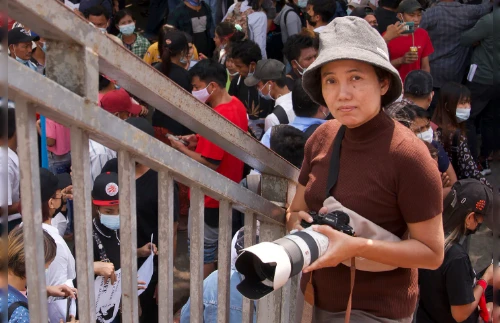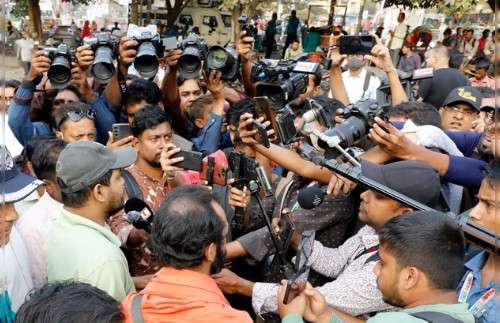





is licensed under CC0 Public Domain use only
for representational purposes
Journalists in Gambia have launched a self-regulatory body they hope will offer legitimacy, and far more freedom, to media emerging from a dictatorship that ruled the tiny West African nation for more than two decades.
During the 22 years of former President Yahya Jammeh’s rule, journalists were regularly abducted, tortured and killed. The new government has vowed new freedoms after he fled into exile in early 2017 following a surprise election defeat.
Outdated sedition laws are still on the books, however, and the public is urged to bring any complaints about journalists to the new Media Council of The Gambia instead of to the courts.
There is a need to promote higher professional standards, said Saikou Jammeh, the secretary-general of the Gambia Press Union, which oversees the new body. He is not related to the former president. “We also set it up to keep the government far away from any attempts to regulate the media,” he said. “It’s not their business and it shouldn’t be their business.”
The new media council represents a significant step for press freedom, he said.
Under the former regime, many journalists “had to switch on survival mode and they would not publish anything that would get them in trouble,” Jammeh said. “The relationship of the media and the public was characterized by paranoia and mistrust.”
He said a free press has blossomed since the election win of President Adama Barrow in December 2016, with new television stations opening and online newspapers returning from exile to fearlessly publish investigations and criticism of alleged government mismanagement.
The Gambia Press Union’s president, Sheriff Bojang Jr., spoke of headlines that he said would have been “suicidal during (Yahya) Jammeh’s time,” but said the greatest change could be heard on radio talk shows, “where on a daily basis people are blasting the (current) regime.”
The new government has promised support.
“We will work with you in this difficult journey,” Gambia’s information minister, Ebrima Sillah, recently told journalists, vowing the government would do what it takes for media to “continue to operate without restrictions.”
At least 30 journalists have returned to the country after more than 100 fled the previous regime, according to Reporters Without Borders, although it said a couple have faced violence upon their return from supporters of the previous government.
“We are in a truly new era for the press in the Gambia,” Arnaud Froger, head of the group’s Africa desk, told The Associated Press. “Things have moved very quickly since the new administration took power.”
As of 2018, Gambia ranks 122 on the group’s annual World Press Index of media freedom violations in 180 countries. In 2017, it ranked 143rd and in 2016, when Jammeh was in power, it was 145th.
“Gambia is the country that has shown the largest progression” this year, Froger said.
Despite the optimism and expectations of wider freedoms, a legal battle continues over old media laws that human rights defenders call “draconian.” The Supreme Court in May called old laws against criminal defamation and libel unconstitutional, but parts of the criminal code on sedition remain.
A sedition law that protects the president from media criticism but permits criticism of the government is “a paradox in a democracy,” Saikou Jammeh with the press union said.
Other experts said the government, which has pledged to work with journalists, still needs to do more.
“It’s also about the courts being able to enforce that media law and it’s also about getting to educate the people in the country to understand the role the media plays in the democracy,” said John Mukum Mbaku, a researcher at the Brookings Institution’s Africa Growth Initiative.
As Gambian journalists assembled for the launch of their new council, memories of past violence hung in the air. The council launched amid events marking the anniversary of the 2004 killing of Deyda Hydara, a veteran newspaper editor who was gunned down by what the Yahya Jammeh regime called “unknown assailants.”
Days before his death, Hydara pledged to take legal action to stop attempts to regulate the media through a government-established media council, which could have imprisoned journalists for nearly two decades or levied heavy fines.
“This council is a continuation of his legacy,” Saikou Jammeh said.
He said he hoped to re-establish trust with a skeptical public unaccustomed to accurate reporting.
“You cannot claim to be a legitimate representative of the public if they do not trust you,” he said. “That relationship is now being built, and the public is getting more and more involved with the press. That’s the biggest qualitative difference between then and now. It is really quite amazing.” ~VOA