



Chinese authorities may “imminently” execute the jailed former head of Xinjiang University Tashpolat Teyip, according to London-based rights group Amnesty International, which called on President Xi Jinping to intervene in his case and release him unconditionally.
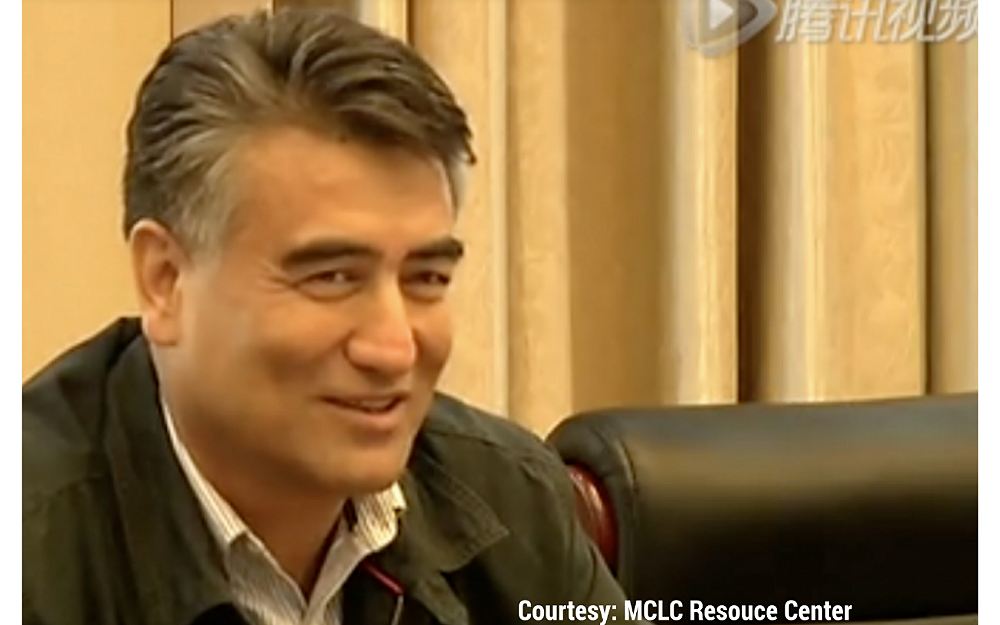
Teyip vanished in 2017 amid rumors he had run afoul of China’s increasingly hardline policies in the Xinjiang Uyghur Autonomous Region (XUAR). Later reports said he had been detained while traveling to Germany with a group of students for a conference.
Last year, sources told RFA’s Uyghur Service that students and teachers had been shown a police documentary film which said Teyip had been sentenced to a suspended death sentence, along with five other members of the Xinjiang Education Supervision Bureau, for attempting to split the country.
On Monday, Amnesty International published an “urgent action” appeal to the international community to call for Xi Jinping’s “urgent intervention to halt the execution of Tashpolat [Teyip],” which it said “could be carried out as soon as September.”
The group urged other organizations and concerned individuals to appeal to Xi in a letter asking that he “immediately halt plans to carry out the execution” and “release Tashpolat [Teyip] unconditionally, unless there is sufficient credible and admissible evidence that he committed an internationally recognized offence and is granted a fair trial in line with international standards.”
Amnesty said that Teyip had been convicted “in secret and grossly unfair proceedings” and noted that he had been granted the possibility of commutation of his suspended death sentence after two years’ imprisonment when no other crimes are committed.
The group also noted that no information has been made available about charges and proceedings against his and his current whereabouts remain unknown.
When asked how Amnesty International had learned of the imminent execution, Francisco Bencosme, Amnesty’s U.S.-based Asia Pacific advocacy manager, suggested that Teyip’s family had notified the group, but said relatives had “not provided to us any additional information as to why now.”
“We have a high vetting process that usually involves consent from the family and multiple different sources,” Bencosme told RFA on Tuesday, adding that Amnesty “only issue[s] urgent actions when it’s extremely a timely case for this to be raised.”
He acknowledged that Amnesty does not “have an exact timeline” and that the group had received no confirmation of plans to execute Teyip from Chinese government officials.
Bencosme noted that Amnesty had previously reported on the lack of transparency in China’s criminal justice system, but questioned why Beijing would pursue the execution of “somebody that is so well-respected … given all of the heightened sensitivity right now about what’s going on with Uyghurs and Xinjiang.”
Raising Teyip’s case
Authorities are believed to have held more than 1.5 million Uyghurs and other Muslim minorities accused of harboring “strong religious views” and “politically incorrect” in a vast network of internment camps in the XUAR since April 2017.
While Beijing initially denied the existence of the camps, China this year changed tack and began describing the facilities as “boarding schools” that provide vocational training for Uyghurs, discourage radicalization, and help protect the country from terrorism.
But reporting by RFA’s Uyghur Service and other media outlets suggest that those in the camps are detained against their will and subjected to political indoctrination, routinely face rough treatment at the hands of their overseers, and endure poor diets and unhygienic conditions in the often overcrowded facilities.
Bencosme said that Amnesty wants the international community, and particularly the U.S., to raise Teyip’s case “at the highest levels,” including at the Sept. 17-30 session of the United Nations General Assembly in New York.
Tashpolat Teyip’s brother, Nuri Teypi, told RFA on Tuesday that he hadn’t heard anything about the former university president’s welfare, or that of his other family members in the XUAR, because he had been unable to communicate with them from the U.S., where he currently lives in exile.
But he suggested that China is “taking swift action to exterminate scholars in the interest of rewriting history” in the XUAR, amid reports that authorities have jailed or detained hundreds of Uyghur academics in recent years.
“Some people would say a cultural genocide is taking place in Uyghur region, but I argue that what is happening is an ethnic genocide,” he said.
“All of the intellectuals and outstanding scholars are being charged with groundless crimes, and just one of them is my brother. I call on the international community to act and save not only my brother, but my people as a whole.”
Mass incarcerations
Mass incarcerations in the XUAR, as well as other policies seen to violate the rights of Uyghurs and other Muslims, have led to increasing calls by the international community to hold Beijing accountable for its actions in the region.
At the Ministerial to Advance Religious Freedom in Washington in July, U.S. Secretary of State Mike Pompeo called the internment camps in the XUAR “one of the worst human rights crises of our time” and “truly the stain of the century.”
U.S. Vice President Mike Pence also slammed the camps “where [Uyghurs] endure around-the-clock brainwashing” and survivors have described their experience as “a deliberate attempt by Beijing to strangle Uyghur culture and stamp out the Muslim faith.”
U.S. Ambassador-at-Large for International Religious Freedom Sam Brownback recently told RFA in an interview that countries around the world must speak out on the Uyghur camps, or risk emboldening China and other authoritarian regimes.
The U.S. Congress has also joined in efforts to halt the incarcerations, debating legislation that seeks accountability for China’s harsh crackdown on the Uyghurs. The Uyghur Human Rights Policy Act would appoint a special State Department coordinator on Xinjiang and require regular reports on the camps, the surveillance network, and the security threats posed by the crackdown.
Reported by Gulchehra Hoja for RFA’s Uyghur Service. Translated by Mamatjan Juma. Written in English by Joshua Lipes.
Copyright © 1998-2016, RFA. Used with the permission of Radio Free Asia, 2025 M St. NW, Suite 300, Washington DC 20036. https://www.rfa.org